|
|
|
Structure
Interesting Questions, Facts and Information
- There are a total of 110 general entries. We are selecting 30 for display.
Special Topics
|
Interesting Questions, Facts, and Information
Australian History
John Hunter. He was Governor between 1795 and 1799. There was a period of military rule under Grose and Paterson after Captain Arthur Phillip left, and before Hunter's arrival.
What explorer went missing in the mid 1800's, whilst attempting to cross Australia from East to West? | Australian History
|
Ludwig Leichhardt . It is still uncertain what happened to him and his party.
One Australian Prime Minister served a term lasting only 8 days - who was it? | Australian History
|
Francis Forde. He served from 6-13 July, 1945, as caretaker PM after the death of John Curtin. Ben Chifley then took over.
The first Australian cricket team to tour England was made up of Aboriginal players. Besides being given Anglicised names for the tour, how else were they identified on the field? | Australian History
|
Coloured sashes. During the 1868 tour, several became ill and had to return home, and one player also died.
The goldmining area known as Lambing Flat was near what current day southern NSW town? | Australian History
|
Young. Lambing Flat was the scene of many riots and attacks on Chinese goldminers.
South Sydney. When the competition was reduced to 12 teams in 2000, the Rabbitohs were one of the teams eliminated. However after several court cases they were back in 2002.
What was the name of the man who purchased land from the local Aborigines, upon which Melbourne is situated today? | Australian History
|
John Batman. No Robin. :-)
Immigrants. She was especially concerned with helping young single immigrant women in Sydney.
Paddy Hannan. He discovered it in 1893. Edward Hargraves discovered it in Bathurst, Peter Lalor was the leader of the Eureka stockade rebellion and Henry Williams is a made up name.
Alfred Deakin. Alfred Deakin served 3 terms as PM - 1903-4, 1905-8 and 1909-10.
1990s. In 1999, a referendum was held in Australia. What was the issue that was voted on, and rejected? | Australian History
|
That Australia should become a republic. For a referendum to become law, a majority of voters in a majority of states is required. This did not happen, with only the Australian Capital Territory voting 'Yes'. While many Australians see the links to Britain as an anachronism, the question was phrased in such a way that the position of 'President of Australia' would have merely been a figurehead of the government of the day. The electorate decided to retain the status quo.
1980s. In 1983, Australia finally claimed a trophy that had been in American hands for over 130 years. What yacht defeated Dennis Connor and his yacht 'Liberty'? | Australian History
|
Australia II. Originally called the Hundred Guineas Cup, the Americas Cup was held by the Americans from 1851 until the Alan Bond-sponsored Australia II won it for the Royal Perth Yacht Club, Western Australia. We did not hold the glory for long, however, with Connor winning it back in 1987, aboard 'Stars and Stripes'.
Tracy. The hit song about the tragedy, 'Santa Never Made it into Darwin' was released by Bill and Boyd early in 1975. Over 50 lives were lost when Tracy demolished the city at dawn on Christmas Day and more than three quarters of the population of the city was evacuated to southern cities. Did you know that more bombs were dropped on Darwin in WW2, than on the whole of American territory?
1950s. In 1953, Mervyn Victor Richardson invented which Australian icon in his backyard shed? | Australian History
|
Victa lawnmower. All of these were invented by Australians, but Richardson's lawnmower was the only one that made its appearance in 1953. Powered by a small Villiers motor, it sold 350 units in its first year and 5000 in the second. Seven years later, 140,000 noisy mowers were spoiling weekends for householders (and their neighbours) everywhere. The Victa brand launched another world first in the 1970's when they developed the rear grass-catcher.
1940s. In 1948, Prime Minister Ben Chifley launched Australia's first locally mass-produced car, the Holden. What was the 'official' model designation for the car more commonly known as the 'FX'? | Australian History
|
48-215. Canbra (the phonetic spelling of the national capital) and Emu were just two of several suggestions that were rejected. During the production stage, the vehicle was simply known as the '320'. The first car, an ivory-coloured sedan, rolled off the line in November of 1948, and Australians were soon clamouring to buy one. The company changed its name from 'General Motors-Holden Automotive' to 'Holden Ltd' in the 1990's, completing the circle back to 'J.A. Holden and Co.', the name of the Adelaide saddlery business that started in 1856.
The '3801' is a famous steam train that used to operate around Sydney.
1930s. In 1931, a paramilitary group called the 'New Guard' was established to protect the country from "communists, anarchists and other wreckers". When the Sydney Harbour Bridge was being opened in 1932 New Guard member Captain de Groot charged out of the crowd on his horse and slashed the ribbon with a sword. Which dignitary had the honour of cutting the hastily-mended ribbon? | Australian History
|
Jack Lang, New South Wales Premier. de Groot thought that such an important event should be carried out by royalty, not a 'lowly' Premier. He was arrested and taken to an insane asylum, where he was found to be sane. He was charged with offensive behaviour, and fined 5 pounds.
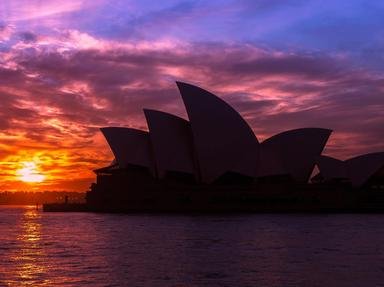
The 'Coathanger', as the bridge is affectionately known, is one of the largest arch bridges in the world, and contains six million hand-made rivets. Together with the nearby Sydney Opera House, it has become the focal point of Sydney.
Did you know that Paul Hogan (Crocodile Dundee) was a rigger on the bridge before he made his acting debut?
1920s. When Charles Kingsford-Smith and Charles Ulm made the first trans-Pacific flight in 1928, what astronomical name did they give to their aeroplane? | Australian History
|
Southern Cross. The best known Southern Hemisphere constellation, it features on the flags of Australia, New Zealand, Papua New Guinea, Brazil and Samoa. It is known to astronomers as 'Crux Australis'.
'Smithy' was a legend in the early days of flight, establishing many firsts in long-distance flying, but did you know that he could down a beer while standing on his head?
He disappeared near Burma in 1935 while trying to break his own record for the England-Australia run.
1910s. At the disastrous WW1 campaign in Gallipoli, Turkey, a British soldier named John Simpson Kirkpatrick went down in Australasian history for his rescuing of wounded troops under fire. Who was his companion? | Australian History
|
A donkey named Duffy. Simpson and his donkey rescued many wounded, until he was killed 22 days after landing. He was technically AWL after four days, because his C.O. had not seen him, but after he learned what Simpson was doing, he turned a blind eye. An ongoing campaign to have Private Simpson posthumously awarded the Victoria Cross has been stalled by British Army officialdom ever since, but hopefully it will happen one day. A true hero in every sense of the word!
1900s. Which author published her first novel, "My Brilliant Career", in 1901? | Australian History
|
Miles Franklin. She was born in New South Wales in 1879, and "Career" was released 22 years later. It is a semi-autobiographical book, telling of a young woman growing up in the country plains of the Australian outback. On her death in 1954, she bequeathed her estate to the annual award that bears her name- the Miles Franklin Award- awarded to the best book depicting Australian life.
Judy Davis starred with Sam Neill in the film version, released in 1979.
1890s. 1894 was a very turbulent year in Australian history. A strike by a group of workers brought violence, death, arson and even piracy! What type of workers went on strike? | Australian History
|
Shearers. A strike in 1891 was partially resolved, but the shearers were not happy. The catalyst was the attempt by the Pastoralist Association to reduce wages, and to have the control of the shearing crews given to the station owner. Contract labour (scabs) were brought into play, and were being shipped to the sheds on the steamer 'Rodney'. Unionists stormed the boat on the Darling River, the scabs lost the ensuing brawl, and the ship was put to the torch. The situation was exacerbated by the shooting death of a young shearer, Billy McLean, and emergency legislation had to be introduced by Parliament. This was the start of unionism in Australia, and also inspired A.B. 'Banjo' Paterson to write the famous 'Waltzing Matilda'.
1880s. Ned Kelly was hanged on November 11, 1880 in Melbourne for murder and bushranging, but where did his famous last stand against the law occur? | Australian History
|
Glenrowan, Victoria. Hero or villain? Australia's answer to Robin Hood or Jesse James still polarises opinion today. He was sentenced to die for the murder of a policeman, but he had been pursued and harassed mercilessly by the law for most of his short life. He was only 26 when he was executed at Old Melbourne Gaol with his famous last words allegedly being "Such is life". His life and death have been the subject of many movies, books and even postage stamps, with many featuring his distinctive coat of armour.
1870s. Australia's Aboriginal population has been treated very poorly since the arrival of Europeans, with many being shot or enslaved. In 1876, the last full-blooded Tasmanian Aboriginal died. What was her name? | Australian History
|
Truganini. Over 4,000 Aborigines were 'eradicated' in the forty years after Tasmania (then Van Diemen's Land) was settled by the white man. Wooraddy was her husband, who pre-deceased her, and Wybelanna was the name of the settlement that her people were forcibly moved to.
1860s. Which variety of apple was developed in Australia in 1868 from Tasmanian crab apples? | Australian History
|
Granny Smith. Maria Smith developed this yummy treat in Tasmania, and later in Eastwood (a Sydney suburb). A lovely shade of green, they are crunchy, long-lasting and delicious in apple pies.
1850s. What precious commodity was discovered at Bathurst in February 1851 and at Ballarat in June of the same year? | Australian History
|
Gold. Gold had previously been discovered as early as 1823 but news of this discovery was suppressed for fear of a convict uprising. These strikes had a remarkable effect on the population of Victoria in particular, with the colony expanding fourfold in a very short time. The Eureka Stockade rebellion of 1853- a short but bloody battle between miners led by Peter Lalor and police- was one of the first steps towards gaining rights for the 'common man'.
1840s. Which wife of a British Naval officer was the first woman (besides royalty) to be depicted on an Australian decimal bank note? | Australian History
|
Caroline Chisholm. She pressured Governor Gipps to provide her with accommodation and assistance for newly arriving young women, establishing the 'Female Immigrant's Home' in 1841. Her face graced the first five dollar note, issued in 1967.
1830s. Which island, situated about 700 kilometres north-east of Sydney, was first settled in 1834? | Australian History
|
Lord Howe Island. The island, which is part of New South Wales, was discovered in 1788, but was only used as a provisioning base until several Europeans and Maoris set up home there. Just south of the island is Ball's Pyramid, the tallest single rock in the world. In 1982, the entire island was listed as a World Heritage site, because of its unique flora and fauna.
1810s. In 1813 the previously impassable barrier to the west of Sydney was crossed for the first time. What name is given to these mountains, part of the Great Dividing Range? | Australian History
|
Blue Mountains. Escaping convicts were convinced that if they crossed the mountains they could arrive in China. Instead Blaxland, Wentworth and Lawson discovered the very fertile lands of the Australian interior. Their successful crossing opened the way for many further explorations.
1800-1809. Sydney was established first, but what is the second oldest capital city in Australia? | Australian History
|
Hobart, Tasmania. Hobart was founded in 1804 by Lieutenant-Governor David Collins, who led a group of settlers and convicts. It was named after Lord Hobart, British Secretary of State for the Colonies. Hobart Town was used as a base for seal hunters and whalers.
Melbourne was founded in 1835, Perth in 1829 and Adelaide in 1838. Sydney was the landing site of the First Fleet, in 1788.
1790s. Which officer of the NSW Corps is credited with creating the wool industry in Australia? | Australian History
|
John Macarthur. He arrived in Sydney in 1790 and was granted land in what is now Parramatta. Because part of his Corps duties was the allocation of convicts to landholders, he gained considerable influence in the colony. Macarthur imported Merino sheep from Spain, and bred them into some of the finest wool producers in the world.
1780s. The First Fleet arrived in Sydney in January 1788, but which French explorer was only a few days behind them? | Australian History
|
Jean-Francois de La Perouse. La Perouse was another explorer who did much in the Pacific area, travelling the American west coast as far as Alaska, visiting Japan and Samoa before arriving in Botany Bay, Australia. He left a few weeks later, never to be heard of again, although it is believed that his ship was wrecked on the Solomon Islands. A suburb of Sydney still bears his name.
1770s. In 1770 Captain James Cook claimed the land known as Terra Australis for the British Crown, but what was his main reason for sailing to the South Pacific? | Australian History
|
To observe the transit of Venus from Tahiti. Cook was a prolific explorer. In 1757, he charted the St Lawrence River in Canada and the following year he was given command of the HMS Endeavour. His 'secret' agenda was to ascertain the existence of the 'Great Southern Land'. He left Tahiti in 1769 and discovered New Zealand, claiming it for England. Heading west, he sighted Terra Australis (Australia) on April 19, 1770 and claimed the entire country when he landed on Possession Island (in Queensland) on August 22 the same year. On subsequent voyages he became the first person to see Antarctica, and he did extensive charting of the west coast of what is now Canada and USA. He was killed by natives on the Sandwich Islands (now Hawaii) in 1779.
|