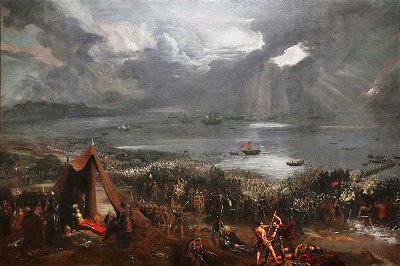
1. One of the best-known battles in Ireland took place in 1690 and was to shape the destiny of several European nations. On which river did it take place?
From Quiz Battlefield Ireland
Answer:
Boyne
The Battle of the Boyne was fought on July 1st, 1690, but due to the later adoption of the Gregorian calendar in place of the Julian calendar, it is now marked on July 12th.
The fighting was between the armies of King William III (aka William Prince of Orange) and King James II.
James had been king of Britain and Ireland. However, he was a convert to Catholicism in the predominantly Protestant Great Britain.
William was the Protestant head of the Dutch royal house of Orange, and was married to James's daughter, Mary.
In 1688, Parliament invited William and Mary to take the throne and they landed with an army in Devon. James fled to France.
This is the point where pan-European politics came into play.
King Louis XIV of France was at the time determined to make himself overlord of Europe
A 'Grand Alliance' of other powers opposed this, and William of Orange was among them. Pope Alexander VIII supported the alliance.
Supported by the French king, James II landed in Ireland with an army, intent on winning back his throne and promoting the Catholic faith.
In this campaign, there were a number of battles throughout Ireland, but the most significant was on the banks of the Boyne.
The kings led their armies. William had 36,000 men, comprising English, Scottish, Dutch, Danes and Huguenots (French Protestants). James had 25,000, made up of Irish Catholics, reinforced by 6,500 French troops.
About 1,500 men died during the battle.
William was victorious. After a portion of James's army was drawn off in a movement toward the town of Drogheda, the remaining 6,000 Jacobite troops were unable to withstand the onslaught of 26,000 led by William as they crossed the Boyne.
William's victory made him leader of the Grand Alliance and in 1697 Louis XIV relinquished much of the territory he had won by conquest.
(Apologies for the length of the II, but the Battle of the Boyne is often simplistically portrayed - especially in Ireland - when it was part of a more complicated political stratagem.)

 This adopted quiz takes a look at one thousand years of Irish history (1000 AD - 2000 AD). Please click on maps and images for a closer look!
  Quick Question
 = Top 5% Rated Quiz,
 Top 10% Rated Quiz,
 Top 20% Rated Quiz,
 A Well Rated Quiz
 =
added recently,
=
added recently,  = Editor's Pick
 = FunTrivia Editor
  = Gold Member
