
Fun Trivia | Quizzes | Games | People | Services | Help | Me
Register - Log In
Index : M : Medieval History Encyclopedia FunTrivia

Structure

Interesting Questions, Facts and Information

  • There are a total of 55 general entries. We are selecting 30 for display.

Frequently Asked Questions & Answers

  • There are 30 user-asked question matches ( goto )

Special Topics


Interesting Questions, Facts, and Information

    Medieval History

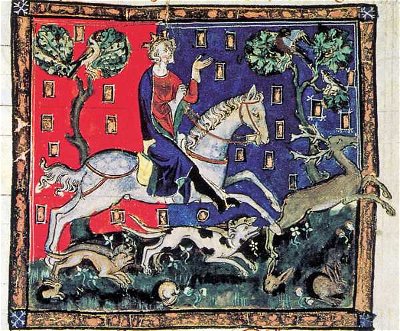
    William I of England's successor came to a infamous end: shot through the heart whilst hunting alone with a favourite. Foul play? Court intrigue? Regardless: he is known to history by his nickname: ___________ .Historical Miscellany (brutus_cassius)

      William Rufus . A "new" theory (see Hugh Ross Williamson's "Historical Enigmas", reprinted by Penguin in 2000 as "Who was the Man in the Iron Mask and other Historical Mysteries") suggests that Rufus, a patron of Cathar troubadours from the south of France, could have "given" himself in a ritualistic self-sacrifice linked to the Cathar and Druidic belief that in times of crisis the king must give his blood for his land. Years of poor harvests and a general feeling of unease were recorded by period chroniclers. It is further interesting to note that William Rufus' nephew died in a similar manner the preceeding year: did he die trying to save his sovereign from having to participate in the ritual?

    Who was killed at Holyrood on March 9th, 1566?Historical Miscellany (brutus_cassius)

      David Riccio. Apparently, Darnley (Mary's husband) was worried about losing the throne to Mary's unborn child, so he orchestrated the brutal murder of her Italian secretary, Riccio, hoping the horror of it would cause her to lose her child. Riccio was stabbed some 57 times. Anyone who has ever been to Holyrood and seen the room where it happened will tell you that it sends a shiver down your spine.

    Who invented the system of solfeggio?General European Medieval History (enchkevi)

      Guido d'Arezzo. Solfeggio is the system of assigning a sung syllable to an actual pitch. Originally the system was based on the Guidoian hand, where every syllable related to a different finger.

    Which two kings did the sisters of King Henry the VIII of England marry?General European Medieval History (enchkevi)

      Louis XII and James IV. Henry's younger sister married Louis XII of France who died less than a year after they were married. He was 72 and she was 14. Henry's older sister Margaret married James IV of Scotland. Their grand-daughter was Mary, Queen of Scots. (Her parents were James V of Sctland and Mary of Guise).

    Which famous Frenchman tried to shoot himself to cheat the guillotine and failed?Historical Miscellany (brutus_cassius)

      Robespierre. Robespierre's foes bandaged his chattered jaw together, convicted him in a kangaroo court and executed him. Saint Just fell with him. Both were responsible for the executions of Danton and his friend Camille.

    Which Arab philosopher did St. Thomas Aquinas credit as the greatest influence on his 'Summa Theologica'?General European Medieval History (enchkevi)

      Averroes. Averroes formulated most of the ideas and the essential method of debate now known as Scholasticism.

    Where did the future Duke of Wellington first prove his military competency?Historical Miscellany (brutus_cassius)

      India. The Duke's brother was a British East India Company executive who landed him the job of fighting the various aggressive indigenous princes and their French advisors.

    What was the name of the monk who helped Ferdinand and Isabella begin the Spanish Inquisition?General European Medieval History (enchkevi)

      Torquemada. Torquemada was Isabella's personal confessor, and it was he who counseled the greatest of Spanish monarchs not only to bring the Inquisition to Spain, but to expel the Jews and the remaining Muslims. He was the archetypal fanatic.

    What was the name of King Henry II's wife?General European Medieval History (enchkevi)

      Eleanor of Aquitaine. Eleanor of Aquitaine was queen of England and Burgundy, and also was the mother of two of England's kings: Richard I Lionheart and King John.

    What was the capital of the Muslim empire in Spain?General European Medieval History (enchkevi)

      Cordova. Under Muslim rule Cordova was the greatest seat of learning in Europe from the 8th to 12th century, and was one of few cities in Europe where Jews, Christians and Muslims lived together in tolerance.

    What was the 'French Disease'?General European Medieval History (enchkevi)

      Syphillis. It got its nickname in the Middle Ages from the belief that the French were particularly promiscuous.

    What form of Medieval music involves singing in parallel fifths and fourths?General European Medieval History (enchkevi)

      Organum. Organum is the earliest kind of polyphonic singing, and was brought to its most elaborate form at Notre Dame, Paris.

    What famous castle did the ruling family of Austria take their name from?General European Medieval History (enchkevi)

      Habsburg Castle. The word "Habsburg" means 'Hawk's Fortress'.

    What country were the Tudors of England originally from?General European Medieval History (enchkevi)

      Wales. When Henry VII killed Richard III on Bosworth Field, he killed the last of the 'purely' Anglo-French kings.

    The year 1958 saw the first night of Pizzetti’s opera “Assassinio nella Cattedrale” (“Murder in the Cathedral”). Who was killed in 1170 at the Canterbury Cathedral?Operatic Medieval History: I (JanIQ)

      Thomas Becket. Ildebrando Pizzetti (1880-1968) was an Italian composer. Www.operone.de lists sixteen compositions of his for theater music. You would by now have guessed the victim of the murder was a certain Thomas. But which one of those four was it? Thomas a Kempis (1379-1471) was a mystic author, who would have written the “Imitation of Christ”. Thomas was fascinated by the mystery of Redemption and by Jesus’ love for mankind even during the Passion. Thomas of Celano (1200-1255) is probably the most obscure of this quartet. He was an Italian Friar Minor and a close friend of Saint Francis of Assisi. Thomas of Celano wrote some books on Saint Francis’ life. Saint Thomas Aquinas (1224-1274) was an Italian Dominican. His masterpiece is the “Summa Theologiae” (This masterpiece has no English title. I would translate it as “Summary of Theology”). He is the patron saint of Catholic education. His feast is celebrated on January 28th. Saint Thomas Becket was born in 1118. He was appointed Archbishop of Canterbury in 1162 at the instigation of King Henry II of England. As Henry tried to meddle with ecclesiastical affairs, the friendship between Thomas and Henry cooled off, up till the point where Thomas had to flee to France. After a few years, they were reconciled – or so it appeared. In 1170, Henry II exclaimed something like “Will no one rid me of this meddlesome priest”. Soon after, four knights went to Canterbury and killed Thomas in the Cathedral. He is the patron saint of secular clergy and is celebrated on December 29th, the date of his death.

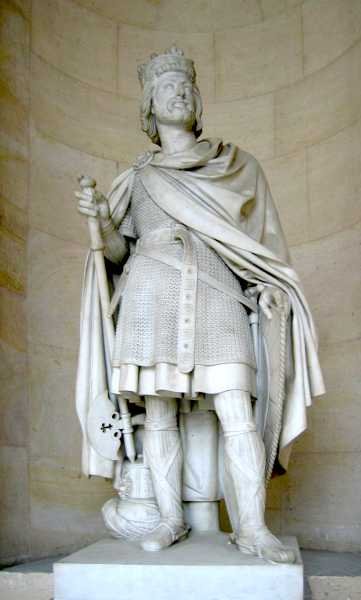
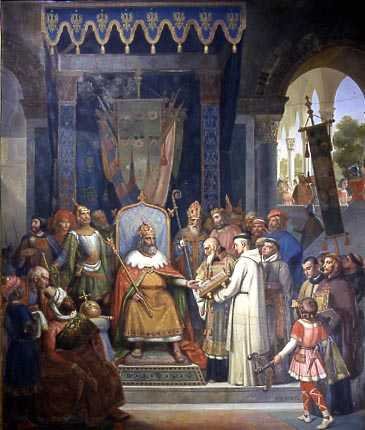
    The Italian composer Vincenzo Manfredini created in 1763 an opera named after one of the most powerful monarchs of the 8th century. This Frankish sovereign was crowned Emperor in Rome on Christmas Day, 800. Who was this emperor, who died in 814?Operatic Medieval History: I (JanIQ)

      Charlemagne. Manfredini (1737-1799) was an Italian composer. He left us seven operas, two intermezzi, three cantatas and two masses. Haroen al-Rasjid (766-809) was an Abbasidian caliph. His nickname “al-Rasjid” means “the righteous”. Egbert (died 839) was king of Wessex. In 802, Northumbria and Mercia recognised him as "King of All England" (at least nominally). Eric the Red was a Viking adventurer, who discovered Vinland (Canada) in 1002. Charlemagne (768-814) was a Frankish king. Pope Leo III has crowned him Emperor. Later generations have misinterpreted this title and gave Charlemagne the title of “Holy Roman Holy Empire” – but this Empire only evolved long after Charlemagne’s death.

    Teodulo Mabellini relates in his 1844 opera a dramatic episode during the Fourth Crusade. Because of what we would now call "a trade dispute", the Crusaders didn't march against the Moslems but against their fellow Christians at Constantinople. Which people were behind this diversion of the Fourth Crusade?Operatic Medieval History: II (JanIQ)

      Venetians. Mabellini (1817-1897) was an Italian composer who left us nine works for stage music. In this question, I refer to his opera "I Veneziani a Constantinopoli" ("The Venetians in Constantinople"). The Irish were notable missionaries from the fifth till eighth centuries. After Saint Patrick (390-461) christened Ireland, many Irish people parted to rechristen Europe. The French had largely contributed to the First, Second and Third Crusades, and dominated the Seventh and Eighth Crusades. However, they played no significant role in the Fourth Crusade. The Lithuanians were not active Crusaders. On the contrary, the German nobility started a "war on paganism" in Lithuania. The Venetians tried to monopolise trade routes with the Middle East. This had to lead to conflict with Constantinople. The Venetians, who “sponsored” heavily the Fourth Crusade, misused their influence to besiege Constantinople. Baldwin IX of Flanders (1171-1205) was crowned by the Crusaders as “the Latin Emperor of Byzantium” after its fall.

    Sergei Rachmaninoff completed in 1906 an opera named after the wife of Giovanni Malatesta. As Giovanni was lame and deformed, his wife committed adultery with his brother Paolo. When Giovanni caught them "in flagrante delicto", he killed them both. Who was this woman born an Italian noble?Operatic Medieval History: II (JanIQ)

      Francesca da Rimini. Rachmaninoff (1873-1943) was a Russian composer and pianist. He composed four operas. All the people I've mentioned as options were recited in Dante’s "Divina Commedia". Apart from Francesca, these are all male persons, so they could not be (legally at that time) someone's wife. Farinata degli Uberti died in 1264. This Italian aristocrat and military leader from Florence was convicted of heresy in 1283. So he was exhumed and his body was burnt. Dante mentions him in the Sixth Circle of the Inferno, the one with the burning tombs. Brunetto Latini (1220-1294) was a Florentine philosopher and a friend of Dante's. He appears in the Seventh Circle of Hell, that of the violent people. Most interpretations lead to the conclusion that Latini was notorious for his sodomy, although Dante is the only one who hinted at this. Others tend to interpret Latini's place in Hell as Dante's conviction of Latini for writing in French rather than in Italian. Guido da Montefeltro (1220-1300) is perhaps the best known of these three men. He started his career as a military strategist, at first in Florentine service, later working for Pisa. In 1296, Guido laid down his arms and became a Friar Minor. He gave Pope Boniface VIII (1235-1303) treacherous advice in a judicial case. This is the reason why Dante placed him in the Eighth Circle of Hell: the one of the frauds. Guido is trapped in individual flames. Francesca da Rimini (1255-1285) is placed by Dante in the Second Circle: the one belonging to the adulterers, punished by cold storms.

    Pavlos Carrer completed in 1852 an opera entitled "Dante e Beatrice" – about the famous poet and his beloved. Did Dante and Beatrice ever marry each other?Operatic Medieval History: II (JanIQ)

      No. Pavlos Carrer (1829-1896) was a Greek composer who composed eight operas. Dante d'Alighieri (1265-1321) is probably the best known Italian poet. He married Gemma Donati, but was in fact in love with Beatrice Portinari (1266-1290). She married Simone de Bardi in 1287 and died in 1290. Dante’s "magnum opus" was the "Commedia", which was later known as "Divina Commedia" ("The Divine Comedy"). In this epic poem, Dante visits Hell, Purgatory and Heaven. His guide through Hell and the first stages of the Purgatory is Virgil (70BC -19BC). In latter stages of the Purgatory and in Heaven he is guided by his eternal beloved, Beatrice.

    One of Giuseppe Verdi’s early operas has the First Crusade as its historical setting. Which tribe did Verdi name his 1843 opera after?Operatic Medieval History: I (JanIQ)

      Lombards. Giuseppe Verdi (1813-1901) is the most influential Italian opera composer of the 19th Century, and perhaps of all centuries. He is particularly well known for his choral arias. He left us twenty-six operas (not counting any revised versions). Verdi’s opera “I Lombardi alla Prima Crociata” (“The Lombards at the First Crusade”) was an instant success. The chorale “Gerusalemme” will certainly sound familiar. The First Crusade (1096-1099) was the only one to achieve its goal of liberating Jerusalem from the Muslims. During this Crusade, many people did send some Crusaders. The most important sovereigns of Western Europe however (Philip I of France, William II of England and Henry IV of the Holy Roman Empire) did not contribute.

    One of Giuseppe Verdi's more obscure operas had its first night in 1857. This opera entitled "Simone Boccanegra" was named after the first Duke of an Italian city, who took command in 1339. This city was the birthplace of Christopher Columbus in 1451. Which Italian city was commanded by Duke Simone Boccanegra from 1339 on? You may answer in the English or Italian orthography.Operatic Medieval History: II (JanIQ)

      Genoa . As I’ve stated before, Verdi (1813-1901) was an Italian opera composer famous for his operas "Nabucco" (1842), "Rigoletto" (1851), "La Traviata" (1853), "Il Trovatore" (1853) and "Aida" (1871). The Genoese created the function of Duke in 1339 to end the quarrels between the two officials who had reigned Genoa up till then: the "podesta" (mayor) on the one hand and the "capitano del popolo" ("people’s capitan") on the other hand. After Boccanegra, the most prominent dukes belonged to the family Doria. Andrea Doria, the best known of these Dukes, reigned from 1528 till 1560. Christopher Columbus (1451-1506) is of course the explorer who tried to find a westward trade route to India and landed in America. His account of the natural riches over there inspired the Spanish and Portuguese to colonize these new regions. Many historians have attributed the discovery of the Americas to Columbus, although he was not the first European over there: Leif Ericsson visited Canada around the year 1000, but there was no follow-up to his discovery.

    Nicholas Bochsa composed in 1814 an opera about a certain Alfonso I. He ruled one of the Spanish kingdoms around 1100. Which kingdom was it?Operatic Medieval History: I (JanIQ)

      Aragon. Bochsa (1786 -1856) was a French harpist and composer. He left us over 150 compositions, one of which is the work I’ve hinted at: “Alphonse de Aragon” (“Alfonso of Aragon”). The first king of Navarre recorded in history was Sancho I, who ascended the throne in 905. He was one of the fervent champions of Christianity against the Moors. It was united with Aragon between 1076 and 1134. Castile emerged during the 9th Century. Together with Leon, it would grow into one of the leading monarchies in Spain. Around 1100, it was ruled by King Alfonso VI. Andalusia derives its name from the tribe of the Vandals, who settled there in the 5th century. In 711 the Moors defeated the local resistance. They turned Andalusia into the Caliphate of Cordoba in 756. Around 1100, Andalusia was divided in three separate Moorish monarchies. Alfonso I of Aragon came to power in 1104. During his thirty-year reign, he conquered some neighbouring territories from the Moors.

    Louis Niedermeyer named an opera he composed in 1846 after Robert, the Scottish King from 1306 till 1329. The surname of this Robert may hint at the city where his ancestors lived. Which city would have given a surname to Robert?Operatic Medieval History: II (JanIQ)

      Bruges. Niedermeyer (1802-1861) was a French composer who completed six operas. Robert the Bruce (1274-1329) struggled for Scottish independence. He defeated the English near Bannockburn in 1314. There are some theories that his surname "Bruce" was derived from "Bruges", the city where his ancestors lived. However, there is no written evidence dating from that time which can corroborate or refute such theory. On the contrary, his father was a Scot of Norman descent and his mother was a Gaelic-Irish noblewoman.

    Jean-Claude Gillier composed in 1731 an opera about the first king of Sicily. In 1130, Roger II united the island of Sicily with the Duchy of Apulia and the region of Campania. To which people did Roger’s ancestors belong?Operatic Medieval History: I (JanIQ)

      Vikings. Jean-Claude Gillier (1667-1737) composed over 100 operas. However, almost all are very rarely performed these days. The opera I refer to is “Roger de Sicile”. Roger II of Sicily was born in 1095 and died in 1154. His ancestors belonged to the Norman branch of the Vikings. The French did control Sicily only for a while. Charles of Anjou became king of Naples and Sicily in 1266 and was expelled in 1282. Spanish rule of Sicily and Campania lasted a very long time. Peter III of Aragon became King of Sicily in 1282, while the continental territories (Campania and Apulia) remained French. The Spanish stayed in Sicily until the start of the Italian reunification in 1860.

    In what country was Richard Coeur de Lion imprisoned on his return from the Crusades?General European Medieval History (enchkevi)

      Austria. Richard I Lionheart was held captive by the Hapsburg Duke of Austria for a period of years to extract ransom from his brother, Prince John. Contrary to popular legend, Robin Hood did not raise the money to bring Richard back to England.

    In 1983, Olivier Messiaen composed an opera about a very important Saint. This Saint lived in Italy from 1181 till 1226. He founded the Order of the Friars Minor and is best known as Patron Saint of animals. His feast is celebrated on October 4th. Who is this Saint? Please use the ENGLISH orthography.Operatic Medieval History: II (JanIQ)

      Francis . Messiaen (1908-1992) was a French composer, who specialised in orchestral works. He studied many bird songs and would incorporate these in his music. In this way, it is quite becoming that his only opera ("Saint-François d'Assise") is dedicated to Saint Francis. One of the best known legends about Saint Francis is that during his hermitage, the birds would come and listen to his sermon. This legend is also the final scene in the second act of the opera "Saint-François d'Assise".

    In 1886, Henry Litolff composed an opera about a notorious monastic order that came into conflict with the French King Philip IV the Fair. Philip had the Grandmaster of this monastic order executed in 1314. What was the name of this monastic order?Operatic Medieval History: II (JanIQ)

      Knights Templar. The Knights Templar were both a monastic order and an order of chivalry. Henry Litolff (1818-1891) was a French composer and pianist. He left us thirteen operas, of which only ten were executed entirely on stage. His opera "Salvator Rosa" was only partially performed, and the operas "Rodrique de Tolède" ("Rodrigo of Toledo") and "Le Roi Lear" ("King Lear") never made it on to the stage. Philip IV the Fair (1268-1314) was crowned in 1285. He sought finances for his skirmish with England over the region of Guyenne (South-West France). When he tried to make the clergy pay for his quarrel with the English, Pope Boniface VIII (1230-1303) and his successor Benedict XI (1240-1304) had fierce critics. Upon the death of Pope Benedict XI, Philip schemed to have Bertrand de Got, bishop of Bordeaux, elected as Pope. Bertrand de Got took as papal name Clemens V, moved to Avignon and further supported the French monarchy. Meddling with the papal election didn’t profit to Philip financially, so he still had to find some funds. This was probably one of the main reasons for trying the Knights Templar, an opulent monastic order with a dubious reputation. The Knights Templar are best known for their capacity of drinking large amounts of alcoholic beverages – in Dutch, this led to the proverb “drinken als een tempelier” – “to drink as a Knight Templar”. The process against the Knights Templar ended in the suppression of the monastic order (ratified by Pope Clemens V), the confiscation of their possessions and the execution of Grandmaster Jacques de Molay (1243-1314). The Jesuit Order (Societas Jesu) didn’t exist yet in 1314. It was founded in 1534 by Saint Ignace of Loyola (1491-1556). Jesuits are well known for their missionary activities and the founding of several schools. The Dominican Order (Ordo Fratrum Praedicatorum, “Order of the Preachers”) was founded in 1215. Many Dominicans became involved in the Inquisition, as “guard dogs” of the true belief. Hence the nickname for this order: “Domini Canes” (“The Dogs of the Lord”). The Cistercians were named after their first convent at the French city Cîteaux. This order was founded by Robert de Molesme in 1098 and became world famous when Saint Bernard of Clairvaux (1090-1153) joined the order in 1112. The Order of the Cistercians was divided in two different orders in 1892: the “usual” Cistercians and the Cistercians of Strict Observance, the latter also known as “Trappists”.

    In 1885, Jules Massenet completed an opera named after Rodrigo Diaz de Vivar. This Spanish nobleman is better known by the nickname the Moors gave to him. What is this nickname, which is also the title of Massenet’s opera? You may answer in French or in Spanish (the orthography differs only very slightly).Operatic Medieval History: I (JanIQ)

      El Cid . Jules Massenet (1842-1912) was a French composer. Www.operone.de lists 41 operas of his. Classical music amateurs will certainly recognise “Manon” (1884), “Werther” (1891) and “Thais” (1898). By the way, Massenet wasn’t the only one to name an opera after El Cid. Other operas bearing the same title (in different languages) were composed by Peter Cornelius (1824-1874), Leonardo Leo (1694-1744), Giovanni Pacini (1796-1867) and Giuseppe Farinelli (1769-1836). El Cid is the Moorish-Spanish equivalent of “Lord”. It was at that time complemented by the word “Campeador” (“champion”, with the connotation of having won duels against select adversaries). Rodrigo Diaz de Vivar, better known as El Cid, was born around 1040 and died in 1099. He became world famous for his battles against the Moors. Even during his lifetime, chroniclers wrote poems about him that later formed the basis of his legendary status.

    In 1878, Jules Deswert completed an opera about a group of people living near a city in Southern France. Pope Innocent III (1160-1219) summoned in 1209 a Crusade against these people. Who were these people, who called themselves "Catharists" ("The Pure")?Operatic Medieval History: II (JanIQ)

      Albigensians. Jules Deswert (1843-1891) was a Belgian composer. His only opera (according to www.operone.de) was entitled "Die Albigenser". The Catholic Encyclopaedia (www.newadvent.org/cathen) explains that the Albigensians supposed God was responsible for the spiritual world (and everything that turns out for the better), whereas Satan created the material world and every evil. This led to astonishing conclusions: Albigensians would have preferred living together without being married (as marriage had to last forever), they would approve suicide and would have been in favour of the extinction of the human race… No wonder Innocent III disagreed with them. As was usual in that time, the Pope excommunicated all those whose opinions differed from his. The other options I gave are also condemned by the Roman-Catholic Church as heretics. The Gnostics were people who believed the soul would benefit from some kind of hidden knowledge. Gnostics thought that only a small minority could acquire this (secret) knowledge and liberate their souls; the rest had to suffer eternally. The Roman-Catholic Church teaches that every one can earn his place in heaven by living virtuously. (Of course, we see every day that the majority of people don’t meet the standards of virtue set out by the Roman Catholic Church – but that is a different story). Gnosticism was quite important during the first and second centuries. Arians found the doctrine of the Holy Trinity too complicated. The Roman Catholic Church teaches us that there is only one God, but that He is present in three Divine persons: the Father, the Son and the Holy Spirit. Arians believed that only God the Father was really God, while His Son was a mere human. This heresy was prevalent during the fifth and sixth centuries. Hussites are the disciples of Jan Hus (1369-1415). This Czech philosopher tried to convince Pope Alexander V (1340-1410) to revoke his sanctions against John Wycliffe (1320-1384). Both Wycliffe and Hus publicly condemned misconduct by the high clergy (including the Pope), and were in this regard some predecessors of Luther, Calvin and other Protestants.

    In 1864 Auguste Mermet completed an opera about one of Charlemagne’s bravest vassals. While the main army retreated, this vassal guarded a mountain pass near the Spanish city Roncevalles. When the Muslim army attacked, he only blew his horn to call for help as soon as he was seriously wounded. Charlemagne returned to chase away the Muslim army, but his brave vassal succumbed before Charlemagne’s arrival. Who was this much commemorated vassal? Operatic Medieval History: I (JanIQ)

      Roland. Auguste Mermet (1810-1889) was a French composer, of whom only 2 operas are registered at www.operone.de. The opera composed by Mermet in 1864 is entitled “Roland à Roncevaux” (“Roland at Roncevalles”). Roland’s song was quite popular during the Dark Ages. The first version was probably written down about 1150. Its story emphasises on the bravery of the Christian soldiers against the Muslim army. As it was written during the "Reconquista" period, when the Iberian peninsula was reconquered, there was no praise for the Muslim soldiers.

    In 1829, Gioacchino Rossini completed his opera "Guillaume Tell". This national hero of Switzerland was be a historical character according to some sources, but a fictional character according to other sources. However, fact is that Switzerland emerged as an independent country after the oath taken by three present-day cantons. Two of the three cantons who first claimed independence from the Habsburg Empire were Uri and Unterwalden. Which was the third?Operatic Medieval History: II (JanIQ)

      Schwyz. Rossini (1792-1868) was a prolific opera composer during his youth. His masterpiece "Il Barbiere di Siviglia" ("The Barber of Sevilla") was completed in only thirteen days. "Guillaume Tell" was the last of his 33 operas. At the end of 1829, he "retired" from composing operas. Later on, he specialized in ecclesiastical music. The "Confederatio Helvetica" ("Swiss Confederation") started with the "Eidgenossenschaft" (confederation) of Uri, Schwyz and Unterwalden. The canton of Schwyz was probably the most important of these three and hence gave its name to the entire country ("Schweiz" in German, "Suisse" in French). Unterwalden is nowadays divided into two cantons: Obwalden and Nidwalden. The first confederates were regions in which German was the main language. Fribourg (with a large population that speaks French) joined in 1481, Ticino (mainly Italian-speaking) was acquired in 1516. The canton of Graubünden, one of the few regions in which Rhaeto-Romanic is a major language, joined in 1567. From that date on, the Swiss confederation has to cope with four different languages. All these languages are official languages since 1938, so all legislative documents have to be published in German, French, Italian and Rhaeto-Romanic. Everyone will probably know the story of William Tell, who led the insurrection against the Habsburg governor Gessler. The most dramatic moment in this popular legend is when Gessler forces William to shoot an arrow at an apple placed on his son’s head. William prepares two arrows and declares afterwards: "If I should have missed the first arrow, the second would not miss your head".

Frequently Asked Questions about Medieval History

    • What is the oldest medieval cathedral still standing? ( goto )


    • 'The Council of Ten' ruled which medieval European empire? ( goto )


    • Which English county has the most medieval churches? ( goto )


    • In the UK, where would you find the street that is wholly medieval? ( goto )


    • What was the unkind nickname of medieval theologian St. Thomas Aquinas? ( goto )


    • What did the medieval and "ancien régime" office of "Constable of France" entail? ( goto )


    • What were the first three subjects taught at medieval university collectively known as? ( goto )


    • What part of Paris’ Left Bank was named for the language spoken by its medieval scholars? ( goto )


    • Which early medieval goat farm has now become a modern British airport? ( goto )


    • What medieval English instrument is the ancestor to the modern trombone? It can often be heard in recordings of Renaissance music. ( goto )


    • Is it true that when gentlemen in medieval Japan wished to seal an agreement, they urinated together, crisscrossing their streams of urine? ( goto )


    • In medieval France, streets would echo to the sound of "have your hanaps mended with gold or silver wire." What was a hanap? ( goto )


    • In "Tea with Mussolini," what is the name of the Italian city where the ladies visited? The little city had medieval towers, tall and thin. ( goto )


    • What is the history of Rice Krispies? ( goto )


    • What is the history of the bubblegum machine? ( goto )


    • What's the worst fire in history? ( goto )


    • What was the shortest correspondence in history? ( goto )


    • What is the history of tea in England? ( goto )


    • Which war was the shortest in history? ( goto )


    • What is the connection between a medieval torture implement and a word used to describe a female body form who would bear no resemblence to (cough) Ms. Anderson? ( goto )


    • What medieval philosopher is described by a Latin inscription on his tomb as brought forth by Scotland, taken up by England, taught by France, but "held" and buried in the German town of Cologne? ( goto )


    • In Carribean history who was Queen Nanny? ( goto )


    • What is the history of M&M's candy? ( goto )


    • What is the significance of 24th December in the history? ( goto )


    • The luge made history in the 1980's by becoming what? ( goto )


    • What happened in American history in January of 1778? ( goto )


    • What was the longest war in US history? ( goto )


    • Who is the first robot in cinematic history? ( goto )


    • Of the nine muses, which is the muse of history? ( goto )


    • Where was the first tunnel in recorded history? ( goto )


  • All content is (C)opyright 1995-2006 FunTrivia.com. Content may NOT be copied, reprinted, or distributed without our written consent. Feel free to link to any page you wish.

  • While we try to keep trivia as accurate as possible through a regular volunteer editing process, FunTrivia cannot guarantee the validity of the information found here. FunTrivia offers no professional advice, and you take all responsibility for your use of anything contained herein.
  • Feel free to send a note to a particular item's author for further details or source information; most of our authors love to hear feedback about their work.
  • See our conditions of use for details.