
Register New Player - Log In
Welcome to our world of fun trivia quizzes and quiz games:     New Player quiz register Play Now! trivia game
Fun Trivia : Roman Myth Encyclopedia FunTrivia

Structure

fun facts,factoids,info

Interesting Questions, Facts and Information

  • There are a total of 40 general entries. We are selecting 30 for display.

Special Topics

Interesting Questions, Facts, and Information

    Roman Myth

    Africus, Aquilo, Auster, Corus, and Favonius are the Roman gods of?Uncommon Roman Mythology

      the winds. Not content with 4 winds, the Romans had to have 5: Africus is the southwestern wind, Aquilo the North wind, Auster the south wind (which brought fogs and rain or sultry heat), Corus the north-northwest wind, and Favonius the western wind (the herald of spring).

    The Larvae are...?Uncommon Roman Mythology

      spirits of deceased family members.. These malignant spirits dwell throughout the house and frighten the inhabitants. People tried to reconcile or avert the Larvae with strange ceremonies which took place on May 9, 11, and 13, called the 'Feast of the Lemures'. The master of the house usually performed these ceremonies either by offering black beans to the spirits or chasing them away by making a lot of noise. Their counterparts are the Lares, friendly and beneficent house spirits.

    Mens is the goddess of?Uncommon Roman Mythology

      the mind. Goddess of mind and consciousness, her festival was observed on May 8. Her name gives title to the group Mensa, for people with extremely high IQ's.

    The name Alipes is used in reference to which major god?Uncommon Roman Mythology

      Mercury. Alipes ('with the winged feet') refers to the shoes worn by the messenger of the gods, the Talaria (winged sandals).

    Sentia is the goddess of what?Uncommon Roman Mythology

      awareness. Specifically, she is the Roman goddess who brings about a young child's first awareness. We derive the word 'sentient' from her name, often used to describe animals or creatures who have awareness of themselves (sentient beings).

    The Romans were nothing if not very specific about their deities. Who ruled over door-handles?Uncommon Roman Mythology

      Carna. A nymph who lived at the site where in later times the city of Rome would be built. The god Janus fell in love with her and gave her power over door-handles.

    Her brother is the sun, and her sister the moon. Four of her sons are the four winds). According to one myth, her tears cause the dew as she flies across the sky weeping for one of her sons who was killed. She is also certainly not the most brilliant goddess as she asked Jupiter to grant one of her husbands immortality, but forgot to ask for everlasting youth (as a result, her husband soon became aged). Who is she?Uncommon Roman Mythology

      Aurora. Aurora is the personification of the dawn, the Roman equivalent of the Greek goddess Eos. She is seen as a lovely woman who flies across the sky announcing the arrival of the sun. Aurora is not one of the better-known {goddesses;} however, Shakespeare refers to her in Romeo and Juliet.

    Who is the Roman goddess of truth?Uncommon Roman Mythology

      Veritas. She is a daughter of Saturn. Her name is used in one of the most famous Latin quotations: 'In vino veritas' ('The truth is in wine'), therefore a drunk person tells the truth.

    The Romans equate Diana with the Greek Artemis, and her brother Apollo with the Greek Apollo. What is the Roman name for the Greek Titan Leto, who is mother to Artemis and Apollo?Uncommon Roman Mythology

      Latona. Luna is the personified goddess of the {moon;} Letum is a monster in the underworld (his name means {'death');} and Laverna is the goddess of unlawfully obtained profits - therefore a goddess of thieves, imposters and frauds.

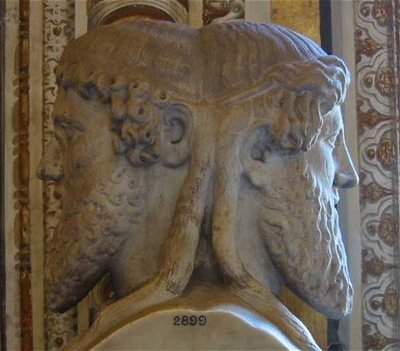
    Geminus is an epithet for whom?Uncommon Roman Mythology

      Janus. It means 'Double', referring to his two faces. Janus is the god of gates and doors, beginnings and endings - hence represented with a double-faced head, each looking in opposite directions.

    Sors is the Roman god of...?Uncommon Roman Mythology

      luck. Very little is know of him, as the goddess Fortuna (good fortune) is the more popular diety in this area.

    Cura is the goddess attributed with what?Uncommon Roman Mythology

      the creation of man. Cura is a goddess who first fashioned humans from clay.

    How many members of the Consentes Dii are there?Uncommon Roman Mythology

      12. The twelve major gods of the Roman pantheon, identified with the Greek Olympians. Six gods, six goddesses, they are: Jupiter and Juno, Neptune and Minerva, Apollo and Diana, Mars and Venus, Vulcan and Vesta, and Mercury and Ceres. Their statues could be found in the hall of the Consentes Dii at the Forum Romanum.

    Magna Mater is equated with which Greek character?Uncommon Roman Mythology

      Rhea. The Roman name for the Phrygian goddess Cybele, and also an appellation of Rhea. The full name is Magna Mater Deorum Idaea (Great Mother of the Gods), who was worshipped on Mount Ida. The cult spread through Greece from the 6th to 4th century, and was introduced in Rome in 205 BC.

    What was the name of the goddess of shepherds and their flocks?Early Roman Myth

      Pales. Not all early Roman gods' names are obvious. 'Marino' is a breed of sheep whose wool, particularly that of the ram, is highly prized. Sheep belong to the 'ovine' family, which word is Latinate in origin. Pasturus, of course, I made up from 'pasture'. Pales' festival falls on April 21.

    What name was given collectively to the minor gods of the store cupboard?Early Roman Myth

      Penates . The Penates were rather like house elves.

    What was/were the dominion(s) of Robigus?Early Roman Myth

      Blight and mildew. Robigus was also sometimes known as Robigo.

    Nuo and Numina were two of the most important deities. Both of their names derive from Latin words or phrases - 'Numina' means 'divine power'; what does 'Nuo' mean, literally?Early Roman Myth

      I nod. The god Nuo existed to grant assent or dissent to human actions.

    What area was Convector's primary responsibility?Early Roman Myth

      Binding sheaves. Binding sheaves means to make bundles of grain stalks following the harvest.

    Which goddess dealt with flowers?Early Roman Myth

      Flora. Indeed she did, hence fauna and...

    Janus, the god of Beginnings, had what distinguishing physical characteristic?Early Roman Myth

      He had two faces. Vulcan, god of blacksmiths (Hephaestus in Greek myth) was lame. A little-known branch of English known as 'Janus words' deals with the very few individual words in the language which can mean opposite things, such as 'sanction' ('restrict' and 'permit') and 'cleave' ('adhere' and 'separate').

    Contrary to what one may think (given the sound of the name), Puta was not the deity of prostitutes. Over what did Puta have dominion?Early Roman Myth

      Pruning. Obarator oversaw ploughing, while the busy Sarritor was patron of both hoeing and weeding.

    Not every mythological woman was human. One particular mythological "lady" was Medusa, best known for her snaky hair and stony glare. What creature was Medusa?The Leading Ladies of Roman Mythology

      Gorgon. Medusa had two Gorgon sisters, Stheno and Euryale, with whom she lived until she was eventually beheaded by the hero Perseus.

    Niobe was a particularly fertile mythological woman who made the mistake of mocking the mother of Apollo and Diana for having only two children. Who was this vengeful mother who changed Niobe into a weeping stone?The Leading Ladies of Roman Mythology

      Leto. Leto was the mother of Apollo and Diana by Jupiter, who seduced her in the form of a swan.

    A quiz on mythological women cannot be complete without mention of the Amazons. These fearless warrior women are mentioned in several myths, including the story of Hercules. What is the name of the queen of the Amazons whose girdle Hercules was charged with procuring?The Leading Ladies of Roman Mythology

      Hippolyte. While the three wrong answers were all warrior women, Hippolyte is the particular Amazon mentioned in the myth of Hercules. Camilla, queen of the Volscians, appeared in the 'Aeneid'. Tomyris, queen of the Massagetae, was described by Herodotus in 'The Histories'. Boudicca, queen of the Iceni, was described by Tacitus in the 'Annals' and 'Agricola'.

    This Roman goddess is credited with the creation of the seasons. Her daughter, Proserpina, was kidnapped by Hades and forced to stay in the Underworld for half of every year because of her unfortunate decision to eat pomegranate seeds. Who is this mother whose yearly grief causes the harsh winter season?The Leading Ladies of Roman Mythology

      Ceres. Ceres is the goddess of agriculture and the harvest. Thus, for the six months that her daughter spends in the Underworld with Hades, Ceres's sorrow hinders the production of crops.

  • All content is (C)opyright 1995-2006 FunTrivia.com. Content may NOT be copied, reprinted, or distributed without our written consent. Feel free to link to any page you wish.

  • While we try to keep trivia as accurate as possible through a regular volunteer editing process, FunTrivia cannot guarantee the validity of the information found here. FunTrivia offers no professional advice, and you take all responsibility for your use of anything contained herein.
  • Feel free to send a note to a particular item's author for further details or source information; most of our authors love to hear feedback about their work.
  • See our conditions of use for details.