
Quizzes at Fun Trivia Fun Trivia | quizzes Quizzes | games Games | community People | services Services | help Help | me Me
New Player - Log In
Currently 4115 players online.   Trivia games, quizzes, and contests - FREE !     Get Started! quiz register
Fun Trivia : Ancient Greek Drama Encyclopedia FunTrivia

Structure

fun facts,factoids,info

Interesting Questions, Facts and Information

  • There are a total of 35 general entries. We are selecting 30 for display.

Special Topics


Interesting Questions, Facts, and Information

    Ancient Greek Drama

    What does the word 'hipokrites' mean in Greek drama?Ancient Greek Comedy

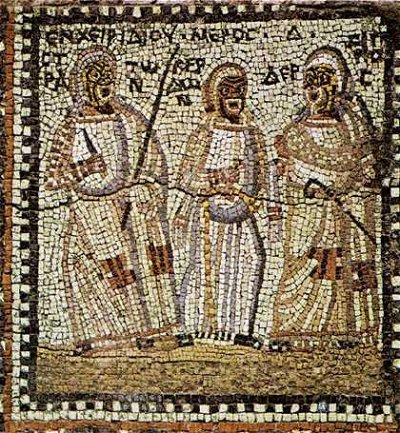
      Actors. Derives by the greek verb 'ypokrinomai' that means to pretend.

    What were the shoes with elevated soles that were worn by the actors of the comedy called?Ancient Greek Comedy

      Cotharnus. They were used to make the actors look taller and more impressive and they were made the same for both legs (no left or right shoe).

    In order to create a female appearance, the actors wore paddings. What was the one over the chest called?Ancient Greek Comedy

      Prosternida. Progastrida was the one over the belly.

    The Greek Comedy had three stages: Old, Middle and New Comedy. Who represents the New Comedy?Ancient Greek Comedy

      Menander. Aristophanes, Cratinus and Eupolis represent the Old Comedy. We have no comedies survived from the two lasts, but 11 of approximately 40 comedies of Aristophanes are extant.

    During which period was the Old Comedy performed?Ancient Greek Comedy

      450-380 B.C..

    The word comedy derives from the Greek 'komodia'. What does this Greek word mean?Ancient Greek Comedy

      The song of the komos. A 'komos' is a communal ritual carouse, part of the festival of Dionysus, it recalls modern carnivals such as that of Mardi Gras.

    The imitation penis that was often worn in comedies was called what?Ancient Greek Comedy

      Phallos . It was often too large for one pesron to lift with ease that it was carried on a pole or cart.

    How many members did the chorus have in a comedy play?Ancient Greek Comedy

      24. The chorus frequently breaks into two opposed camps, one of which supports the hero while the other opposes him.

    In which comedy does the hero become a bird and later founds a city in the sky, the 'Cloudcuckooland'?Ancient Greek Comedy

      Ornithes. 'Ornithes' is the greek word for birds.

    The long choral passage both recited and sung, that was a direct address to the audience was called what?Ancient Greek Comedy

      Parabasis. It was representing the views of the poet during which the action of the play is suspended.

    What was the festival at which the comic playwrights produced their works in January called?Ancient Greek Comedy

      Lenaea. During the City Dionysia, in March, there were both tragedies and comedies performed. In the Lenea, there were only comedies.

    Women were not allowed to watch a comedy. True or False?Ancient Greek Comedy

      False .

    What was the front seating privilege called?Ancient Greek Comedy

      Prohedria. The term is referred as both the privilege and the location of the seat. This seating was reserved for state officials, public benefactors or foreign dignitaries.

    What is the name of Oedipus' wife in "Oedipus Rex"?Various Greek Drama

      Jocasta. Jocasta is not only Oedipus' wife, she is also his mother. He was, of course, doomed to sleep with her.

    Who kills Agamemnon at the end of Aeschylus' play "Agamemnon"?Various Greek Drama

      Clytemnestra. Clytemnestra is Agamemnon's wife. She kills him because he has been away for ten years, has killed their daughter, and brings back a slave concubine in the celebratory parade.

    How does Medea kill Jason's bride-to-be in Euripides' "Medea"?Various Greek Drama

      Medea gives her poison garments. Medea is a very very very scary lady. She utilizes the power of Greek fire in the garments to kill Jason's fiancee. The ensuing fire also kills Jason's father-in-law to be.

    In Homer's "Iliad", which hero inherits Achilles' armor?Various Greek Drama

      Odysseus. Odysseus is of course the main character of "The Odyssey". He inherits the armor in a case of brains versus brawn against Aegis. In a rare scenario, brains win.

    What is the color of Dionysus' toga in Aristophanes' "The Frogs"?Various Greek Drama

      Yellow. Aristophanes, a satirist, was ridiculing contemporary Greek drama. Dionysus, who is the god of drama, was wearing yellow to imply that he was a homosexual and a fool. Aristophanes was mocking the lack of respect for the gods and the terrible and inferior drama that was being presented to the Greek public.

    Which god is determined to punish Odysseus in Homer's "Odyssey"?Various Greek Drama

      Poseidon. After Odysseus had blinded Poseidon's son, he shouted out his name (the son's) and the Cyclops called upon his father to punish Odysseus, which Poseidon did for ten years.

    Who wrote the "Greek Way" (not technically ancient Greek literature)?Various Greek Drama

      Edith Hamilton . Hamilton is one of the definitive sources on the ancient world. She also wrote "The Roman Way" and "Mythology".

    Where was the first of the classical great tragic dramatists born?Ancient Greek Tragedians

      Eleusis. Aeschylus, the first of classical Athens' tragic dramatists was born at Eleusis, close to Athens, while Sophocles was born at Colonus, near Athens as well. Euripides was born at Athens or maybe in the Island of Salamis.

    Was Aeschylus' influence on the development of tragedy fundamental?Ancient Greek Tragedians

      Yes. Previous to him, Greek drama was limited to one actor and a chorus engaged in a largely static recitation. By adding a second actor with whom the first could converse, Aeschylus vastly increased the drama's possibilities for dialogue and dramatic tension.

    Is Sophocles credited with several dramatic innovations?Ancient Greek Tragedians

      Yes. He increased the number of members in the chorus and added a third actor. The chorus was a group of actors who responded to and commented on the main action of a play with song, dance, and recitation. The actor could assume different roles by changing masks and costumes, but in the beginning he was limited to engaging in dialogue only with the chorus.

    Who was known as the "Father of Tragedy"?Ancient Greek Tragedians

      Aeschylus. Aeschylus'plays are of lasting literary value in their lyrical language, in the intricate architecture of their plots, and in the universal themes which they explore so honestly. Aeschylus' language in both dialogue and choral lyric is marked by force, majesty, and emotional intensity.

    Who wrote “The Persians”?Ancient Greek Tragedians

      Aeschylus. "The Persians" is unique among surviving tragedies in that it dramatizes recent history rather than events from the distant age of mythical heroes. The play treats the decisive repulse of the Persians from Greece in 480, in particular their defeat at the Battle of Salamis.

    Who is the precursor of the modern psychological drama?Ancient Greek Tragedians

      Euripides. Euripides is regarded as the forerunner of the modern psychological drama. In "Hippolytus", in fact, and in "The Bacchae", for example, he explores the psyche of men attempting to deny a natural life-force such as sexuality or emotional release. In another timeless classic, "Medea", he takes a penetrating look at the frenzied jealousy of a woman.

    How many plays by Aeschylus have survived, according to the traditional attribution?Ancient Greek Tragedians

      seven. Aeschylus wrote approximately 90 plays, including satyr plays as well as tragedies; of these, about 80 titles are known. Only seven tragedies have survived entire: "The Suppliants", "The Persians", "Seven against Thebes", "Prometheus Bound", "Agamemnon", "The Libation Bearers", "The Eumenides". Please note that I do not agree with modern theory that attributes "Prometheus Bound"("Prometheus desmotes", in Greek) to another tragedian, maybe Euphorion, one of Aeschylus' sons. In fact such a theory is not proved right now. On the contrary I agree with classical scholars Albin Lesky (A History of Greek Literature) and Gilbert Murray (Aeschyli Septem quae supersunt tragoediae, Oxford University Press) who attribute “Prometheus Bound” to Aeschylus, though it's difficult to date this play.

    Is there a story about Aeschylus’death as well as about Euripides’death?Ancient Greek Tragedians

      Yes. After producing his masterpiece, the "Oresteia" trilogy,i.e. "Agamemnon", "The Libation Bearers","The Eumenides", in 458 Aeschylus went to Sicily again. The chronographers recorded Aeschylus' death at Gela (on Sicily's south coast) in 456/455, aged 69. A ludicrous story that he was killed when an eagle dropped a tortoise on his bald pate was presumably fabricated by a later comic writer. As for Euripides,his death, which took place in 406, at the court of Archelaus, king of Macedonia, who was a noted patron of the arts, was, like that of Aeschylus, in its nature extraordinary. Either from chance or malice, the aged dramatist was exposed to the attack of ferocious hounds, and by them so dreadfully mangled as to expire soon afterward, in his seventy-fifth year.

  • All content is (C)opyright 1995-2006 FunTrivia.com. Content may NOT be copied, reprinted, or distributed without our written consent. Feel free to link to any page you wish.

  • While we try to keep trivia as accurate as possible through a regular volunteer editing process, FunTrivia cannot guarantee the validity of the information found here. FunTrivia offers no professional advice, and you take all responsibility for your use of anything contained herein.
  • Feel free to send a note to a particular item's author for further details or source information; most of our authors love to hear feedback about their work.
  • See our conditions of use for details.