|
|
|
Structure
Interesting Questions, Facts and Information
- There are a total of 175 general entries. We are selecting 30 for display.
Special Topics
|
Interesting Questions, Facts, and Information
Music Theory
Two oboes playing in unison. Also, how do you tune those two oboes? ....Shoot one! Ha! Thanks for taking my Quiz!
Soprano. Nothing to explain. It's just one of those things Bach did that sounds good.
Altered. Not much to explain. The two are synonymous.
melodic. The difference between the three minor scales lies in which notes are lowered. A natural minor scale lowers the third, sixth and seventh notes both when the scale is played ascending and descending. Harmonic minor scales lower the third and sixth notes when the scale is played, both ascending and descending. The melodic minor lowers only the third when played ascending, and lowers the seventh, sixth and third when played descending.
If you are in the key of Ab Major and out of nowhere, a C major chord comes along and go right back into Ab, what kind of chord is that C major chord? | Music Theory for Theory Buffs
|
Chromatic Mediant. Had the C major been followed by an f minor chord (for example) it would have functioned as a secondary dominant. But because it didn't and it was a 'mediant' chord, it is a Chromatic Mediant.
In a Singing Style. Easy for anyone in a choir!
Play with the hair of the bow. This was found by a friend in a Grade Four Theory Book; if you know it, you're doing well!
With Fire . Another Italian word, almost all words in music are from Italian.
GBD. Subdominant is merely the technical term for a 4th.
Soprano Alto Tenor Bass . This can be written in either open or short score.
B Flat. Transposing a minor third is purely going up 3 semi-tones.
D# Minor. F Sharp major and G Flat Majors are actually enharmonic equivalents, and a lot of people get that confused.
buffa. Seria is the term used for serious opera, and buffa, which means "funny" in Italian, is used to describe comedic opera.
bagatelle. This form of piano composition was used greatly by Beethoven. "Fur Elise" is one.
thematic recollection and transformation. Leitmotif is the basis for thematic recollection and transformation, which refer to the way a composer establishes, changes and develops certain melodic themes that have an idea associated with them. Thematic recollection and transformation is the only answer choice that refers to leitmotif at all.
membranophone. The term "idiophone" refers to all percussive instruments that are membraneless. Unlike most percussive instruments, the timpani is not an idiophone.
chromaticism. Chromaticism was often added to Romantic works to add a mysterious, darker aspect to the piece.
The twelve-tone or chromatic scale contains all the tones we hear in western music, and can be understood as inflections of what? | Music Terminology and Theory
|
diatonic scale. When the music changes from one key to another, we call it modulation. The mode, like a scale, works to create a basis for a song, but unlike a scale, may also incorporate a much more complex emotion or idea. The diatonic scale consists of seven notes and is either major or minor. The pentatonic (5-note) scale can also be described as major or minor.
70- 100 M.M.. According to the United States Academic Decathlon, a larghetto tempo falls between 70- 100 metronome markings. 100- 128 M.M. is adagio, 184- 208 M.M. is presto, and 156- 184 M.M. is allegro.
Octatonic. The Octatonic scale is made of alternating whole and half steps. The name is derived from octa-eight and tonic-tone.
The 3rd and the 5th. Because they clash considerably with the 11th and 13th, the 3rd and 5th of the chord are usually left out.
E. The first five notes in the C harmonic series are as follows: C-C-G-C-E.
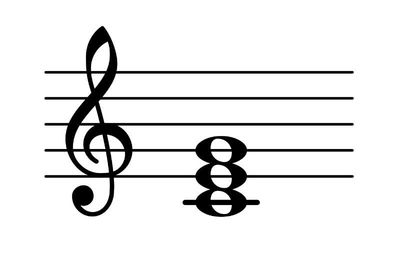
A, C, E, G. All Cows Eat Grass. A, C, E, G.
G, B, D, F, A. Great Big Dogs Fight Animals. G, B, D, F, A.
F, A, C, E. It spells Face, so there is no need for a saying to remember that one.
E, G, B, D, F. There are little sayings to remember the notes to each clef and I'll give them to you one at a time. This one is one of two. Either, "Every Good Boy Does Fine" or "Elvis's Guitar Broke Down Friday" Either way it's E, G, B, D, F. Take the first letter of each word and that's the note. Remember, always go from bottom ro top when reading notes on a staff.
Legato. A slur groups notes into a musical phrase. A dot over or under a note means to play Staccato. Accents tell you to play notes louder or softer. Slurs, especially long ones, have the best affect when you use the damper peddle. It holds the tone longer and you're better able to play the notes connected.
very loud. Fortissimo, very loud, is marked by ff. The same thing with p, piano, which means soft and pp, pianissimo, very soft. I ask my Primer students that after learning forte and piano and every one of them get it. I hope you got it too. Oh, and, never bang on the piano, this is not good for the instrument. There is a difference between playing 'fff', very very loud and banging on it. Please be careful!
Yes. All rests equal the notes. For example, a quarter note gets one beat, so the quarter rest gets one beat. A half note gets two beats, so a half rest gets two beats.
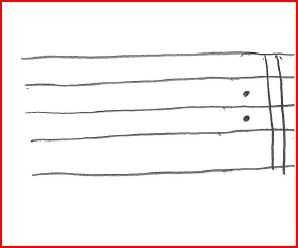
bass clef. The Bass Clef is sometimes called the F clef because the two dots of the clef sign straddle the F line.
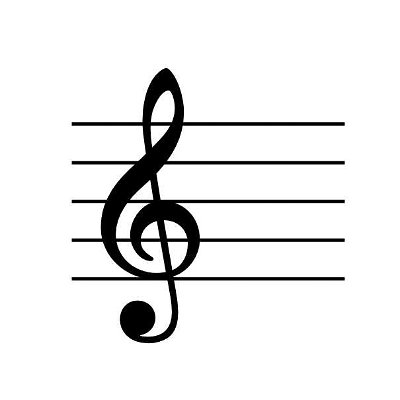
treble clef. The Treble Clef is called the G clef because the circle part of the Treble clef circles around the G line. The brace holds the treble and bass clefs together to make the Grand Staff.
|