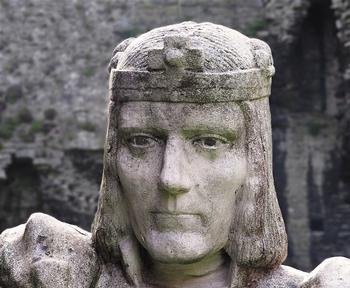

|
Structure
Interesting Questions, Facts and Information
- There are a total of 45 general entries. We are selecting 30 for display.
|
Interesting Questions, Facts, and Information
Richard I
Henry. Richard's mother, Eleanor of Aquitaine, in her second marriage, had given two heirs to the throne of England, with Henry (the Young), Richard's elder brother, and Richard himself. She would have two others sons, Geoffrey, and the last, John, born in 1167.
What event happened on December 29th 1170, which caused huge problems for the Royal Family? | Richard Coeur de Lion
|
Thomas Beckett was murdered. Thomas Beckett, Archbishop of Canterbury, was killed, by order of Henry II, King of England, in his Cathedral.
Aquitaine. Richard refused, he had spent the formative years of his life in Aquitaine, bending the recalcitrant province to his will, and was not going to give it up. Richard kept his Duchy. John remained 'John Lackland'.
In 1190, Richard I, set of for the Crusades with King Philip, but bad weather caused the two Kings to winter on which Island? | Richard Coeur de Lion
|
Sicily. The two Kings decided to winter in Sicily. The time passed quietly and pleasantly enough. But on February 2, 1191, the two Kings had a violent quarrel.
Whilst on the Island, in question 6, Richard met his future wife, they were married on Limassoll in May 1191, who was she? | Richard Coeur de Lion
|
Berengeria of Navarre. In April, Richard sailed, with Berengeria, for Cyprus. On May 12th, three days after they arrived, Richard and Berengeria were married in the Chapel of St Georges at Limassol.
In September 1191 Richard won a victory in Palestine. What was the name of the Battle? | Richard Coeur de Lion
|
Returning from the Holy Lands, with a three year truce, Richard fell into the hands of whom? | Richard Coeur de Lion
|
Leopold, Duke of Austria. After a difficult voyage brought him back from Marseille to Corfu, and then to Ragusa, he landed with just a handful of fellows in arms. Alas, he was in the estates of his mortal enemy : Leopold, Duke of Austria. Shortly before Christmas 1192, Richard fell into the hands of Leopold who had been warned that the English King was back. Richard was thrown in a dungeon. A few months after, Leopold sent Richard to a strong castle built high on a mountain-slope overlooking the Danube. This was the castle of Durnstein, at Trifels, in the estates of the Emperor Henry VI. The whole of Europe knew about it the capture. But nothing helped and the European sovereigns as a whole made no secret of their contentment, Richard was neutralized at last. Alone, Eleanor negotiated her son's ransom and brought it to the Emperor in Cologne. On February 2, 1194, Richard was free.
Gangrene. Richard was attacking the fortress at Chalus. A guard saws a little horsemen squadron below the castle, he fired, his crossbow bolt struck one of the horsemen in the left shoulder. The wounded knight stood up on his stirrups and congratulated the soldier on his dexterity. Richard was the wounded knight. He dismounted, sat on a rock, to have himself examinated by the doctor. Richard rode back to his quarters, making light of his wound. But it proved difficult to remove the iron arrow-head. Gangrene set in after a few days and Richard knew that he was dying. He forgave the defenders and Pierre Basile in particular, who had shot him. Thus, the Coeur de Lion died.
In Oxford in England. Richard was born the 8th September, 1157 at Beaumont Palace in Oxford. Thus, in spite of not speaking a word of English, Richard was at least born in the country.
Seven - four brothers and three sisters.. The eight children of Henry II and Eleanor of Aquitaine were William (who died young), Henry, Matilda, Geoffrey, Eleanor, Joan, John and, of course, Richard himself. The legends tend to focus on Richard and John, though Geoffrey's son, Arthur, is often included when King John becomes king.
Poitiers. Though Richard's reputation is largely based on his exploits during war-time, he actually preferred the company of his sophisticated and well-educated mother in Aquitaine to that of his belligerent father who was always on the move. This didn't stop Richard from becoming the sort of man who seemed to look anywhere for an opportunity to fight.
His father - Henry II. The campaign was in fact a revolt by the brothers against the will of their father and the way he insisted they should run their parts of his larger kingdom. It seems odd that Richard's reputation should remain so high after betraying the trust of the one who gave him life and who was his king. He was more than once a traitor.
Henry's nose suddenly began to bleed.. Howden and Giraldus both report this incident. To them contemporary people would have assumed that this indicated that Richard was guilty of killing his father. That Richard may have contributed to his father's death is certainly probable for he had combined with the France king in a final rebellion. On the other hand John, Henry II's favourite son, probably caused his father more grief when he too was found to be numbered amongst the rebels.
31. Richard was born on the 8th September, 1157 and was crowned on the 2nd September, 1189. Thus he was 31 years of age and only just short of being 32. Two older brothers had died before he, the third son, came to the throne. His brother Henry had actually been crowned as King of England but this was done by the Archbishop of York rather than that of Canterbury and Henry II had tried to give this son this minor kingdom whilst he considered himself the King of several kingdoms. The "young king" was not recognised by the Pope nor any of the important European monarchs. Thus when young Henry died Henry II was forced to recognise Richard, whom he did not like or trust, as his heir.
The slaughter of a large number of Jews.. Richard was probably partly responsible for the massacre that took place. It is reported that in the strongest terms he encouraged his subjects to turn away the unbelievers from the ceremony. This was interpreted as a license for attacking the Jews and their property in London.
Less than 1 year. Some sources say that he spent no more than 6 months in England. Others report that is was 10 months. All agree that it was certainly less than a year. The truth is that he had no love for England and a great deal of love for those areas of France which he considered his home.
London. The only thing that appealed to Richard about England was the money that he could raise by taxing his people or by selling his estates. There is no evidence whatsoever of concern for any of his subjects.
The Third Crusade. Some historians report that Richard I went on the Third Crusade as a result of a promise that he made to his dying father. He won several victories but never did capture Jerusalem. His reputation as a fierce fighter was certainly enhanced at this time.
His mother's - Eleanor of Aquitaine. The marriage took place on the 12th May at Limassol in Cyprus. The lands of Navarre were adjacent to those of Aquitaine, the part of Richard's own lands that he most loved. In spite of this marriage Richard and Berengaria had no children and Richard only lived openly with his wife when a charge of sodomy was brought against him.
He ordered them to be massacred.. The numbers given for this act of slaughter were 2,700. The fact that the victims had surrendered rather than been taken prisoner during the battle made this crime seem even worse. It is suggested that Richard I lost his patience over the negotiations and ordered the men, women and children to be butchered in full sight of the opposing army of Saladin. In contrast Saladin enjoyed a reputation for treating his prisoners well.
His nephew Arthur. In spite of this nomination Richard actually left England to be run by William Longchamp, Bishop of Ely. He was another Frenchman much hated by most of the people of England. Longchamp operated under the supervision of Richard's mother, Eleanor of Aquitaine. Before he died Richard nominated John as his heir in spite of Arthur's better claim through an elder brother. Thus he caused the succession to be disputed once again.
He wanted to claim some gold that a peasant had dug up.. Richard's motivation on this occasion seems to have been greed. The peasant had passed the gold to his immediate overlord and Richard had demanded that it be passed on to him. It was a trivial way for a king to die. Typically Richard carried it off in great style by pardoning the man who had fired the fatal crossbow bolt.
At Fontrevault near his father.. His body was buried at Fontrevault but his heart was removed from his corpse and buried in Rouen. The building of Chateau Gaillard was just one of the ways he had found of costing his country a fortune. His captivity in Austria meant that a ransom equivalent to £12 million in modern money had to be screwed out of the people of England for a man who showed no affection at all for the country.
Richard was the son of Henry II and Eleanor of Aquitaine. Which child of this royal pair was he? | Richard I
|
the fourth child. Richard was the fourth child of Henry and Eleanor and the sixth child of Eleanor who had had two daughters by her first husband, Louis VII of France. His older siblings were William who died in infancy, Henry (the young king) who died at age 28 and Matilda who married Henry 'the Lion', Duke of Saxony.
Richard was known by the cognomen "the Lionheart". He also had another cognomen, also based upon a characteristic. What was it? | Richard I
|
Richard Yea and Nay. Richard got the nickname "Yea and Nay" due to the rapidity with which he made decisions - especially in preparation for the crusade. He also deserved the other names, although they were not applied. He was responsible for the ordering of the massacre of captured prisoners, died while attempting to lay claim to a disputed treasure trove and was born in Oxford.
Richard was a leader in which of the crusades? | Richard I
|
the third . The crusades were first proposed by Pope Urban II at the Council of Clermont in 1095. The First Crusade took place in 1096-99. Originally the crusades were to free the Holy Land from the Muslims but as time wore on the objectives changed. The Eighth Crusade (1270) was the last major Christian attempt to free the Holy Land but it attacked the Arabs in Tunis. Although there were other 'crusades' ie the Albigensian Crusade (1200s), the Crusades of the Teutonic Knights (1229-1525) and the crusades in Spain (711-1492), crusades as commonly understood ended in 1291 with the fall of Acre to the Muslims.
When Richard went on crusade, whom did he nominate as his heir in case something happened to him while away? | Richard I
|
Arthur of Brittany. Arthur of Brittany, although a child, was the posthumous son of his next oldest brother, Geoffrey of Brittany and so was the natural successor. John, Count of Mortain was his youngest brother. Although he was the only surviving son of Eleanor and Henry II, according to the strict line of succession, the son of Geoffrey took precedence. Geoffrey of York was an illegitimate son of Henry II and had been created Archbishop of York.
In order to raise money for his crusade, what action(s) did Richard take? | Richard I
|
All of these (He sold crown lands., He awarded court verdicts on the basis of bribes., He sold charters to towns allowing them freedom from feudal obligations.). During the money raising period, England was really just a major auction house with everything going to the highest bidder. Richard was quoted as saying that he would sell London itself if he could find a bidder. Upon his return from the crusades, he cancelled all the sales, saying that the buyers had, in effect, only been paying rent for the estates while he was away.
Richard had for twenty years been betrothed to Philip's half sister. As a result of the betrothal, she had been raised at the court of Henry II. Who was that lady? | Richard I
|
Alais (aka Alice and Alys). Alais, according to gossip, while at the court of Henry II had become the mistress of Henry II and, according to some, had borne him children. Richard had no intention of marrying his father's leman. Philip reluctantly released Richard from his obligation while travelling to the Holy Land, thus allowing Richard to marry Berengaria. When Philip left the Holy Land ahead of Richard, plots began to arise, one of which included the marriage of Alais to John. That plan also came to naught and the unfortunate Alais was then married to William of Ponthieu. Margaret was the wife of Richard's deceased elder brother Henry, and Matilda and Joan were Richard's sisters.
What was the most significant difference between the third crusade and the first and second crusades? | Richard I
|
The crusaders undertook to travel by sea.. Unlike the first and second crusades that travelled basically overland, the third crusade relied upon sea transport to get them to the holy land. Although there were fewer women in the entourage, they were there. Berengaria, Richard's wife was in the entourage as was his sister Joan. The fourth crusade attacked Constantinople.
|