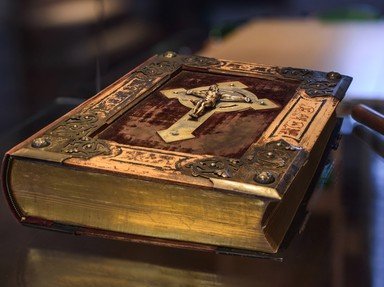
Answer: A love song
The Song Of Solomon is a love song. Solomon was considered Israel's greatest and wisest king. Taken at face value it is the story of Solomon's love for a lovely country girl who would become his bride but many Biblical scholars consider it an allegory describing God's love for the people of Israel or Christ's love for His bride the Church.
From Quiz: BBB Bible Series: Song of Solomon
Answer: love song
Solomon's name means peace. He had great wisdom, wealth and power. He is the eleventh son of King David, and his mother was Bathsheba.
From Quiz: Song of Solomon
Answer: mare
"I liken you, my darling, to a mare among Pharaoh's chariot horses." (Song of Solomon 1:9 NIV)
Horses and chariots were the ultimate mode of transportation in Solomon's time.
"Solomon accumulated chariots and horses; he had fourteen hundred chariots and twelve thousand horses, which he kept in the chariot cities and also with him in Jerusalem." (1 Kings 10:26 NIV)
Even in Solomon's time it seems a girl had to measure up to her man's "ride".
From Quiz: BBB Bible Series: Song of Solomon
Answer: grapes
Song of Solomon 2:15 "Take us the foxes, the little foxes, that spoil the vines: for our vines have tender grapes."
Grapes must have been an important fruit in Biblical times. In the Last Supper they drank unfermented wine, which would have been made of grapes.
From Quiz: Song of Solomon
Answer: She isn't named
Beloved, fairest of women, my dove are a few of the many endearing terms with which Solomon refers to the girl he loves but she is never specifically named. In several places in the song she is described as the Shulammite which could mean she came from a town called Shulam.
From Quiz: BBB Bible Series: Song of Solomon
Answer: wood of Lebanon
Song of Solomon 3:9 "King Solomon made himself a chariot of the wood of Lebanon."
It is believed that the wood of Lebanon was cedar wood.
From Quiz: Song of Solomon
Answer: daughters of Jerusalem
"Dark am I, yet lovely, daughters of Jerusalem, dark like the tents of Kedar,
like the tent curtains of Solomon." (Song of Solomon 1:5 NIV)
The daughters of Jerusalem probably refer to the women who were assigned to attend and prepare the Shulammite girl for her wedding day.
From Quiz: BBB Bible Series: Song of Solomon
Answer: tower of David
Solomon 4:4 "Thy neck is like the tower of David builded for an armoury, whereon there hang a thousand bucklers, all shields of mighty men."
The Tower of David was a fortress built to protect Jerusalem.
From Quiz: Song of Solomon
Answer: I found him not
The Shulammite woman had a terrible dream that she went looking for Solomon, but could not find him anywhere. Eventually she finds her love, and brings him to the most secure place she can think of - her mother's bedroom. It is evident that she truly loves Solomon as she repeatedly states throughout Solomon 3, "Saw ye him whom my soul loveth?" I believe this dream suggests a deep fear of the actual consummation of marriage and whether it will continue to be a loving and prosperous one over the course of time.
From Quiz: Song of Solomon
Answer: foxes
"Catch for us the foxes, the little foxes that ruin the vineyards, our vineyards that are in bloom." (Song of Solomon 2:15 NIV)
Meeting your lover's family, planning a wedding can put a strain on the best of relationships. The wise couple will keep this in mind and stay focused on what is really important to them, their love and their future together.
From Quiz: BBB Bible Series: Song of Solomon
Answer: honey and milk
Song of Solomon 4:11 "Thy lips, O my spouse, drop as the honeycomb: honey and milk are under thy tongue; and the smell of thy garments is like the smell of Lebanon."
This implies she must have been kind in words as honey is very sweet, and milk which coats can be very soothing.
From Quiz: Song of Solomon
Answer: lilies
Song of Solomon 5:13 "His cheeks are as a bed of spices, as sweet flowers: his lips like lilies, dropping sweet smelling myrrh."
There are over 100 species in the lily family which is known as Liliaceae. The most commonly recognized lily is the Easter lily.
From Quiz: Song of Solomon
Answer: fountain sealed
Solomon used these words in praise for his bride's commitment to him in being a pure woman. Solomon is pleased in knowing that the woman he will marry has been true to him and has maintained her virginity for this wedding day.
"A garden inclosed is my sister, my spouse; a spring shut up, a fountain sealed." (Song 4:12)
From Quiz: Song of Solomon
Answer: A crown
"...Look on King Solomon wearing a crown, the crown with which his mother crowned him on the day of his wedding, the day his heart rejoiced." (Song of Solomon 3:11b New International Version)
Solomon was the second son born to King David and his wife Bathsheba. Their first son, conceived in an adulterous affair, died shortly after his birth. David had many sons by other wives but he had promised Bathsheba Solomon would be his successor to the throne. Solomon's love and respect for his mother is demonstrated in the following verse.
"When Bathsheba went to King Solomon to speak to him for Adonijah, the king stood up to meet her, bowed down to her and sat down on his throne. He had a throne brought for the king's mother, and she sat down at his right hand.
(1 Kings 2:19 NIV)
From Quiz: BBB Bible Series: Song of Solomon
Answer: Tirzah
Song of Solomon 6:4 "Thou art beautiful, O my love, as Tirzah, comely as Jerusalem, terrible as an army with banners."
Tizah was a town in what was the Samaritan high lands. The name means "she is friendly".
From Quiz: Song of Solomon
Answer: Twice
The first reference is after the beloved describes her lover's many charms she then says, "Daughters of Jerusalem, I charge you by the gazelles and by the does of the field: Do not arouse or awaken love until it so desires." (Song of Solomon 2:7 NIV)
It is found a second time is chapter 3:5 after what seems to be a dream in which she thinks her lover has left her. Many believe this is admonition against entering into a sexual relationship outside the covenant of marriage.
In the final chapter, supposedly after their marriage, you will find a similar verse.
"Daughters of Jerusalem, I charge you: Do not arouse or awaken love
until it so desires." (Song of Solomon 8:4 NIV)
In this verse "by the gazelles and the does of the field have been omitted. Rather than an admonition against sexual relations outside of marriage it may have been an affirmation that it was worth the wait.
From Quiz: BBB Bible Series: Song of Solomon
Answer: the roof of his mouth
Song of Solomon 7:9 "And the roof of thy mouth like the best wine for my beloved, that goeth down sweetly, causing the lips of those that are asleep to speak."
From Quiz: Song of Solomon
Answer: bride
"Come with me from Lebanon, my bride, come with me from Lebanon." (Song of Solomon 4:8a NIV)
After a long discourse on all the ways her beauty delights him he call his bride to come with him. The traditional wedding ceremony of Solomon's time was for the groom to prepare a special room, usually in his father's house, for his bride. He would then go for her in the night as if to kidnap her from her family's home and carry her back to the place he had prepared. The wedding celebration lasted seven days after which the couple would emerge from the room signifying the marriage had been consummated.
From Quiz: BBB Bible Series: Song of Solomon
Answer: death
This is shown throughout the Bible. In fact in many cases love proves stronger than death. For example, in the New Testament, when Jesus gives His life for our sins. Our bodies die, but his love for us overcomes death so we die in this life, but will be alive again in a new life if we accept his love and what he did for us as a result of that love.
From Quiz: Song of Solomon
Answer: spices
Song of Solomon 8:14 "Make haste, my beloved, and be thou like to a roe or to a young hart upon the mountains of spices."
I hope you enjoyed this quiz. The next Bible quiz in my Biblical series will be on the book of Isaiah.
From Quiz: Song of Solomon