|
Structure
Interesting Questions, Facts and Information
- There are a total of 75 general entries. We are selecting 30 for display.
Frequently Asked Questions & Answers
- There are 30 user-asked question matches ( goto )
Special Topics
|
Interesting Questions, Facts, and Information
Earth Science
When we think of the consequences of volcanic eruptions, we tend to think of whole swatches of land burned beyond recognition, people injured or left homeless, and if we're creative we think of things like climate change and so on. But here is far stranger tale.
The 1815 eruption of Tambora in Indonesia was the largest in recorded history. The following year, 1816, was called "the year without summer." A group of friends went on vacation in Switzerland that summer, but it was so cold and nasty that they spent almost their entire holiday indoors. They decided to pass the time with a scary-story writing contest. The contest was won by Mary Shelley, who decided to call her creation... I seem to have forgotten. What was it? | Strange Facts about Volcanoes (pu2-ke-qi-ri) |
Frankenstein. I'll bet you didn't know that Frankenstein wouldn't have been written if it wasn't for a major volcanic eruption! I hope this quiz has given you an appreciation for the finer points of volcanoes-- let's just hope there's no major volcanic eruption any time soon!
What was the mineral smithsonite named after? | Interesting Mineral Facts (ig_petrologist) |
founder of the Smithsonian Institution. Smithsonite was named after John Smithson, an Englishman who donated funding for the establishment of the Smithsonian Institution.
What temperature can the center of Earth's core reach up to? | Challenging Earth Trivia (Natsirt) |
7500 K. To put this in perspective again the surface of the Sun only reaches temperatures of about 5800 K.
What percentage of the Earth's surface is covered in water? | Challenging Earth Trivia (Natsirt) |
71. Be thankful you can have a glass of water since Earth is the only planet where water can exist in liquid form on the surface. Although there may be liquid ethane or methane on Titan's surface and liquid water beneath the surface of Europa, but then again don't get your hopes up.
What mineral paved the way for the invention of fiber optics? | Interesting Mineral Facts (ig_petrologist) |
ulexite. Each fiber of ulexite transmits light and images, thus it paved the way for the invention of fiber optics by transmitting images along a bundle of threadlike crystals.
What mineral is derived from an ancient name for brass? | Interesting Mineral Facts (ig_petrologist) |
aurichalcite. Aurichalcite is derived from an ancient word meaning brass. It actually is so close to brass alloy, that it could be considered as a natural brass ore. It is a very rare mineral so it probably will never serve this purpose.
What mineral has an index of refraction so close to water that when placed in water it becomes invisible? | Interesting Mineral Facts (ig_petrologist) |
cryolite. Cryolite has a low ability to bend light, being close to water in that aspect. When placed in water it appears invisible; however it will eventually dissolve since cryolite is soluble in water.
What mineral are bones and teeth composed of? | Interesting Mineral Facts (ig_petrologist) |
apatite. Bone and teeth have essentially an apatite structure and composition. Apatite has a hardness of 5, compared to a diamond which has a hardness of 10.
What is the name of the station which experienced the lowest temperature ever recorded? | Challenging Earth Trivia (Natsirt) |
Vostok Station. And boy was it ever cold! At -89.6 degrees celsius (-128.6 degrees fahrenheit) it was definitely hot cocoa weather. In complete contrast the highest recorded temperature ever recorded was 58 degrees celsius (136 degrees farenheit) at Al Aziziyah, Libya.
What is the name of the phenomenon, which may be caused by earth tremors that are to weak to be felt, but sounds like a distant cannon especially on or near the water? | Challenging Earth Trivia (Natsirt) |
Barisal Guns. They are named Barisal Guns because they are often heard near the city of Barisal, in Bangladesh (there's a line over the a). If you've ever heard one be sure to send me a comment, I'm curious to hear your experience.
What is the equatorial circumference of Earth? | Challenging Earth Trivia (Natsirt) |
40, 070 km (24, 903 m). And to prevent someone from lodging a correction the actual number is 40,065.5 km.
What is the distance to the center of the earth? | Facts About Earth (GeniusBoy) |
What is the average distance of the Earth from the sun? | Facts About Earth (GeniusBoy) |
What is the average distance of the Earth from the Moon? | Facts About Earth (GeniusBoy) |
What causes the red color in the mineral corundum? | Interesting Mineral Facts (ig_petrologist) |
metal oxides. Pure corundum is clear in color. The gem colors of corundum are a result of minor metal oxide impurities; ruby is colored by chromium oxide.
Troposphere: What percent of the atmospheric mass is concentrated in this region? | Earth's Spheres: Random Facts (Mr5) |
90%. Most of the atmosphere mass is concentrated in the close vicinity of the Earth's surface. It was measured that the atmosphere's total mass (half of it located just in the 5 km above sea level) is just a million part of the Earth's mass.
Due to earth's centrifugal force, the troposphere takes the planet's shape, becoming bulged at the Equator (reaching heights of 16-18 km) and slightly flattened at the poles (reaching a height of 6 km). The troposphere is delimited from the stratosphere by the tropopause, situated at an average of 12 km above sea level.
The troposphere is the region where most weather phenomena occur. The troposphere is divided into six zonal flow regions, which are responsible for atmospheric circulation. In the troposphere, the temperature drops with height, with an average value of 6.4 degrees Celsius for each km; thus, the temperature recorded at the tropopause level is about -60 degrees Celsius.
The word troposphere comes from the Greek "tropos" meaning turning or mixing.
Triassic (250-210 million years ago): What was the name of the supercontinent that tied all the land together? | Earth's Ages - Random Facts (Mr5) |
Pangaea. Pangaea was formed in the Permian as the merger of all the EarthÂ’s lands masses. This supercontinent endured through the Triassic and it eventually began to break up at the end of this period into a northern continent - Laurasia and a southern continent - Gondwana, separated by the Tethys Sea. This theory, proposed by German geologist Alfred Wegener (he also coined the name Pangaea - "All-Earth"), is supported by fossil evidence: some species remains were found in all the continents.
Thermosphere: What is this layer also known as? | Earth's Spheres: Random Facts (Mr5) |
Ionosphere. Also known as the ionosphere because of the ionized particles that prevail here, the thermosphere is situated between 80 and 500-1000 km. The temperature rises again from the inferior part (-83 degrees) toward the superior part, reaching up to 1100-1600 degrees. The thermosphere includes several layers (D, E, F, G) which play an important role in absorbing solar radiation and reflecting the radio waves emitted from Earth. Another phenomenon which occurs within this region are the auroras, which are caused by the interaction of high energy particles, carried by solar winds, with the neutral atoms from the thermosphere.
The surface area of the earth is around how many square miles? | Facts About Earth (GeniusBoy) |
The mineral phenakite is named after a Greek word that translates to what phrase in English? | Interesting Mineral Facts (ig_petrologist) |
to deceive. Phenakite is named from a Greek word for "to deceive" because it was long confused with quartz and other minerals that appear similar. A British specimen, pictured in an 1811 work, was described as white tourmaline for twenty years before it was recognized as a new mineral.
The metal cobalt is named from the German word "Kobalt" or "Kobold" meaning what in English? | Interesting Mineral Facts (ig_petrologist) |
imps or gremlins. Kobalt or kobold is named from a myth that imps or gremlins lived underground and teased the miners.
The Laki eruption produced climate change in places as far away as the fledgling United States of America. Which American founding father was the first person to make the connection between volcanism and climate change? | Strange Facts about Volcanoes (pu2-ke-qi-ri) |
Benjamin Franklin. Franklin's scientific prowess extended beyond the lightning-and-kite experiment that everyone hears about. Franklin thought "smoke might be spread by various winds, over the northern part of the world," causing the massive crop failure in the US of A. Right on. To elaborate further, volcanos spew stuff above the troposphere, where weather occurs, and into the stratosphere. While the stuff in the troposphere is washed out by rain relatively quickly, the stuff that reaches the stratosphere can persist for years and years.
The interaction between the the Earth and the Moon slows the Earth's rotation by how many milliseconds per century? | Challenging Earth Trivia (Natsirt) |
2. Current research shows that about 900 million years ago there were 481 18-hour days in a year.
The Earth's atmosphere is primarily made up of what gas? | Challenging Earth Trivia (Natsirt) |
Nitrogen. Nitrogen makes up approximately 77 percent of the atmosphere with Oxygen in second with 21 percent.
The Earth is headed towards what constellation? | Challenging Earth Trivia (Natsirt) |
Hercules. While we're on a one way trip to Hercules with the rest of the solar system at rate of approximately 20.1 km per second or 72,360 km per hour (approximately 12.5 miles per second or 45,000 mph) the Milky Way Galaxy as a whole is headed toward constellation Leo at about 600 km per second (about 375 miles per second). Is it a coincidence that Earth is headed towards the same guy who tricked Atlas into carrying the Earth on his shoulders? I'll leave you to decide.
The Crust: What discontinuity delimits it from the mantle? | Earth's Spheres: Random Facts (Mr5) |
Mohorovicic. The crust is the "shell" of the planet. The border with the mantle is marked by the Mohorovicic (Moho) discontinuity. The crust is about 20-80 km thick in continental regions while only 5-10 km in oceanic regions. Its density is about 3 g/cubic cm. Depending on the predominant rocks, the structure of the crust is characterized by three different layers: basaltic (oceanic), granite(continental) and sedimentary. The basaltic layer is found both under the continents and in the ocean floor. The granite layer is mostly found in the continents and generally not the ocean floor. The sedimentary cover (strati-sphere) is made up of the materials proceeding from the erosion of preexisting rocks by the external agents (water, wind etc); it is 0-km thick. The sedimentary rocks make up only 5% of the crust's total volume, but they cover 75% of the earth's surface.
The Core: What is it made up of? | Earth's Spheres: Random Facts (Mr5) |
nickel and iron. Earth's radius measured at the equator is 6378 km, while at the poles it's 6356 km. The internal structure of our planet was discovered by analyzing the compression (P) and shear (S) waves that pass through the Earth after earthquakes. The core is the part of the planet which starts at 2900 km and runs all the way down to the center. The core includes the outer core (2900-5000 km), a liquid molten core of nickel and iron, a transition zone (5000-5200 km) and the inner core (5200-km), a solid core made up of the same two metals. The three parts of the core are delimited by two discontinuities, Lehmann (5000 km) and Oldham-Gutenberg (5200 km). The core's density is 8-12 g/cubic cm.
The core of the Earth is mostly composed of what element? | Challenging Earth Trivia (Natsirt) |
Iron. Iron equates to to 34.6 percent of the the core, while Oxygen is 29.5 percent, Silicon is 15.2 percent, and Magnesium is 12.7 percent to round out the top four.
The 1783 eruption of Laki on Iceland was a huge catastrophe. 22 separate volcanos erupted on a crack 15 miles long, piled up lava 60 feet high in places, and poured an enormous amount of toxic gasses into the atmosphere. Over 9,000 people died on Iceland alone. What was the single largest cause of death? | Strange Facts about Volcanoes (pu2-ke-qi-ri) |
Starvation. While the toxic gasses did not kill off the people, they did kill off the livestock that the people in Iceland relied upon for food. So, a huge percentage of the population starved to death. In other regions, like the US, where most of the population lived off of subsistence agriculture, large numbers of people starved to death as well.
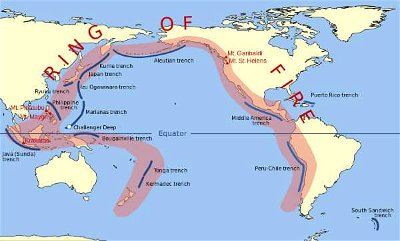
The "Ring of Fire" is a region of extensive volcanic activity along the edges of the Pacific Ocean. It contains the largest number of active volcanos in the world. What other geologic event is creating this massive amount of volcanism? | Strange Facts about Volcanoes (pu2-ke-qi-ri) |
The Pacific Plate subducting. As the Pacific plate subducts under the neighboring plates consisting of continental crust, the continental crust heats up and eventually melts. The magma eventually shows up at the crust as volcanos. Interestingly enough, the subducting oceanic crust does not heat up significantly, because the continental crust acts as a heat sink. This results in a rare high-pressure, low-temperature metamorphism that can form a rock called "blueschist."
Stratosphere: Which type of radiation can get through the ozone layer situated within this atmospheric region? | Earth's Spheres: Random Facts (Mr5) |
infrared radiations. The stratosphere is situated above the troposphere and extends up to 50 km - marked by the stratopause. The temperature rises from -60 to -4 degrees Celsius because of the ozone layer (between 20-40 km) which absorbs the solar ultraviolet radiation and reflects the cosmic radiation.
Frequently Asked Questions about Earth Science
- What creation connects a Japanese heartbeat to a company called Earth in Kirkcaldy, Scotland and the science of facial attractiveness and gender recognition? ( goto )
- The ground crews of the American space program have over the decades made countless advances in science in attempts to get people up into space and back down to Earth safely. Have flight directors and crew directors won any Nobel Prizes or other such awards for their advances? ( goto )
- What is known as the 'Gay Science'? ( goto )
- What is the science of measuring time? ( goto )
- Who is the father of computer science? ( goto )
- Who founded the journal "Science" in 1883? ( goto )
- Who said "Science is mankind's brother"? ( goto )
- What is the difference between science and pseudoscience? ( goto )
- Is the Earth expanding? ( goto )
- What word describes the science of fruit growing? ( goto )
- What is the name for the science and history of manned flight?
( goto )
- Why is the science fiction award called a 'Hugo'? ( goto )
- With which branch of science do you associate Copernicus? ( goto )
- What university hosts the "Australasian Schools Science Competition"? ( goto )
- What is the longest-running science fiction series in TV history? ( goto )
- In science, do neutrons have a negative charge or no charge at all?
( goto )
- Outside science fiction, who in the 19th century were Uranians? ( goto )
- More correctly, who attended More Science High School? ( goto )
- The earth is in what galaxy? ( goto )
- How old is the Earth? ( goto )
- What on Earth is trigonometry? ( goto )
- What shape is the Earth? ( goto )
- How was the earth created? ( goto )
- 32.71% of people on Earth are what? ( goto )
- Which is the only play by William Shakespeare to be made into a science fiction movie? ( goto )
- What is the branch of science which deals with the study of roots and seeds called? ( goto )
- The name of what science is derived from the Greek word 'tribein' meaning 'to rub?' ( goto )
- What has Stephen Hawking ACTUALLY contributed to Cosmology and modern science in general ? ( goto )
- I was told this was a trivia question. What is the no-man's land between science and theology? ( goto )
- Who was the "Man with the Golden Nose" and how did his works contribute to science? ( goto )
|