|
|
|
Structure
Interesting Questions, Facts and Information
- There are a total of 175 general entries. We are selecting 30 for display.
Special Topics
|
Interesting Questions, Facts, and Information
Stars
Centaurus. Although it is the dimmest of the three-star system, Alpha Centauri C is often called Proxima Centauri because, at 4.3 lightyears, it is the closest star to the Solar System.
Cepheus. Cetus is the Whale, and Bootes is the Herdsman. And Elvis is dead! :o)
Vega. Vega's apparent magnitude is .03 and Deneb's is 1.25. (But in absolute magnitude, Deneb is much brighter.)
Canis Minor. Procyon has an apparent magnitude of .38 and an absolute magnitude of 2.6.
Leo. Regulus is Leo the Lion's foot. It has an absolute magnitude of -0.3 and an apparent magnitude of 1.35.
-27. The apparent magnitude is how bright the star seems to us. The lower the number, the brighter it is. (Note: a star with an apparent magnitude of 437 is waaaaaaaaaay too dim to be seen.)
Lyra. Vega is in Lyra, the Lyre (a sort of harp). If the earth lasts as long as 10,000 years, the star Vega will then become the new North Star!
The Whale. Cetus is the sea {monster;} or whale.
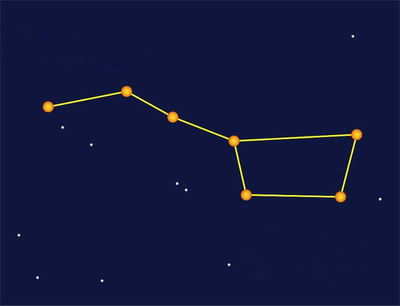
If you follow the 'pointers' of the Big Dipper upward, you find Polaris (the North Star). What constellation do you see if you follow the pointers the other way? | Stars And Constellations III
|
What astronomer coined the phrase 'binary star'? | Binary Stars
|
Sir William Herschel. Herschel, discoverer of the planet Uranus and first to posit our galaxy's spiral shape, used the term in an 1802 paper, 'On the Construction of the Universe.' Here's hoping this quiz has helped you construct YOUR vision of the universe.
Observations of a visual double must record two characteristics: the angle orientation of the secondary with respect to the primary, and ... what? | Binary Stars
|
angular separation between the two stars. We observe stars from one point in the galaxy - Earth. (Interstellar distances are so vast that our planet can be treated as a single point.) Thus, we aren't in a position to measure linear distances - but we CAN measure the apparent separation in the arc of the sky. This is called angular measure and the basic unit is the degree, although the separations are so small that we mostly use arcminutes (a sixtieth of a degree) and arcseconds (a sixtieth of an arcminute).
In ancient times, the Persian and Roman armies tested their soldiers' eyesight by seeing whether they could distinguish the two stars in what well-known 'pair', now understood to be gravitationally unrelated? | Binary Stars
|
Alcor and Mizar. Although Alcor and Mizar are not a binary pair, each of those 'stars' is actually a binary star system in itself.
Of the four main types of binary stars, which can be 'resolved' into its separate components through a telescope? | Binary Stars
|
visual. Through a telescope of sufficient magnification, visual binaries appear as multiple points of light - they are 'resolved' into the correct image. Eclipsing binaries are oriented such that, from our perspective, one star passes in front of the other during the course of its orbit. These are detected by changes in brightness. Spectroscopic binaries are too close to be resolved by a telescope, and are detected by changes in their spectra - analyses of their light output.
Of the four main types of binary stars, which is detected by 'wobbles' in a point of light's motion across the sky? | Binary Stars
|
astrometric. A star's apparent motion across the sky is called its 'proper motion,' and is determined by its distance from Earth, among other things. Single stars seem to travel in a straight line, but the orbital motion of binary stars causes them to 'wobble' in their motion.
Taurus. Aldebaran is another red giant star about 68 light years distant.
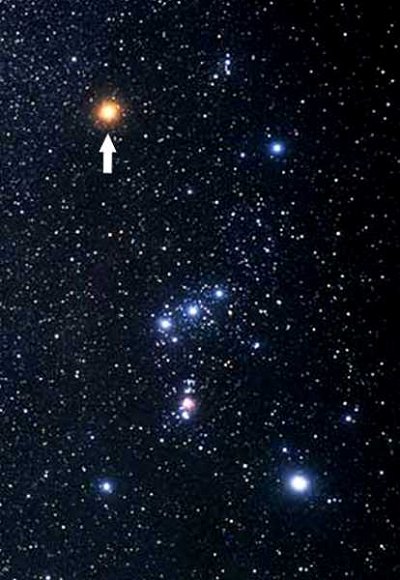
Orion. Betelgeuse is another red giant star.
Bootes. Arcturus is a relatively nearby star at 36 light years away.
Scorpius. Antares is a Red Giant, over 500 light years away from us.
Auriga. Capella is about 45 light years away and is the closest of the brightest stars to the (North) Pole.
Cygnus. Deneb is a Supergiant star, some 1600 light years away. Deneb along with Vega and Altair form the Summer Triangle.
Carina. Canopus is the second brightest star in our night sky, it is about 100 light years away.
Aquila. Altair is about 16 light years away.
Lyra. Vega is the brightest star in Lyra. It is about 25 light years away.
Canis Major. Sirius is the brightest star in our night sky. It is about 8 light years away.
Capricornus. The Goat Star. This is a wide double optical star. Another words, they are not physically connected.
Orion. Rigel is a very bright supergiant with a luminosity of 57,000 suns. And you can still see its companion in a medium sized scope!
Libra. Pronounce that again please! This is a very wide double star in Libra.
Cygnus. Albireo is a wider pair than Almach. The stars are a gold primary and a blue secondary (just like Almach).
|