|
Structure
Interesting Questions, Facts and Information
- There are a total of 40 general entries. We are selecting 30 for display.
Special Topics
|
Interesting Questions, Facts, and Information
U.K. Government
Anthony Charles Lynton Blair. He was born to Leo Blair and his late wife, Hazel.
Edinburgh. He was born on the 6th of May in 1953, making him a Taurus.
'Ugly Rumours'. They did not enjoy any chart success. Tony is still a keen musician, and likes to strum away on his guitar every now and again.
Cherie. Cherie is a top barrister.
Euan, Nicky, Kathryn and Leo.
2000. Little Leo was born on the 20th of May in 2000. He was the first baby to be born to a serving UK Prime Minister in 150 years!
Sir Alec Douglas-Home. As the then Lord Dunglass he played for Middlesex (1924-25), and toured South America with the MCC (1926-27). He became Prime Minister when Harold MacMillian retired.
William Gladstone. William Gladstone's character was that of reforming preacher, so the Queen much preferred the more subtle charms of his then rival Disraeli.
The Duke of Wellington. It can be seen among the exhibits at the Wellington Museum.
Arthur Balfour. As foreign secretary in 1917, he issued the Balfour declaration, which eventually led to the foundation of Israel in 1948.
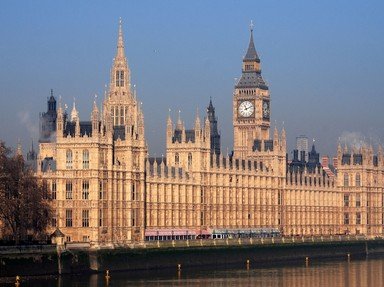
Of which Prime Minister did Winston Churchill say, "An empty taxi stopped outside the Houses of Parliament, and --- --- stepped out." Who stepped out of the taxi? | Odd Facts About British Prime Ministers
|
Clement Attlee. Churchill's animosity towards Attlee was in part, though not wholly, due to Attlee's victory in the first post war election, which saw Churchill reduced to sitting on the opposition benches.
Lord Rosebery. Archibald Philip Primrose Rosebery was the full name of Lord Rosebery. He once said he had three wishes for his life, to marry a rich wife, to win the Derby, and to become Prime Minister. He married the wealthiest woman in England, won the Derby three times, and he became Prime Minister. Three out of three, you can't beat that.
he foresaw his murder. John Williams was a Cornishman who had a dream where he saw the Prime Minister's murder. This is on record for he told many other people, he wanted to contact Spencer Perceval, but was talked out of doing so, when news reached Cornwall of the event he was devastated.
Anthony Eden. There was wide spread protest over his actions, it soured relations between Britain and the US for some time, and it was also the direct cause of Anthony Eden's resignation.
Harold McMillian. John Profumo was Minister of War when he had an affair with a working girl, who in turn was involved with a attache from the Russian Embassy. All very messy at the time.
James Callaghan. The Winter of Discontent occured in 1979, it was a time when it seemed everyone was on strike, rubbish piling up in the streets, people unable to bury their dead, at the next election the Conservatives won with a landslide, and the era of Margaret Thatcher began.
Benjamin Disraeli. Benjamin Disraeli was one of the Queen's favourite politicians. When he died in 1880, she wrote to her private secretary saying that she was devastated and she couldn't stop crying.
William Pitt. William Pitt the elder was in office from 1757-56 and again from 1766 to 1768. William Pitt the younger was Prime Minister from 1783-1801 and again from 1804 to 1806.
catastrophe. These two adversaries were always crossing verbal swords. On one occasion, William Gladstone said, "Mr Disraeli, you will probably die by the hangman's noose or a vile disease," to which Benjamin Disraili replied, "Sir, that depends whether I embrace you principles or your mistress."
P.S: I have been told by Jeffa, another funtrivia player, that this quote is attributed to an exchange between the Earl of Sandwich and John Wilkes, but as it doesn't affect the score of anyone playing the quiz I've decided to leave it as it is, sometimes it's difficult to pin down a particular quote to the relevant person.
John Major. The attack was suspected to be the work of the IRA. No one was injured.
Edward Heath. There was no love lost between the two politicians and to be honest, it was an apt description.
The Welsh Wizard. He had the reputation as a wonderful orator, especially on Welsh matters.
Earl Grey. How odd that the only Prime Minister to have a tea named after him should lose the monopoly on tea. Earl Grey tea is flavoured with bergamot.
Henry Campbell-Bannerman. The future Prime Ministers were Herbert Asquith, David Lloyd-George, and Winston Churchill.
Margaret Thatcher. This happened when Margaret Thatcher began her campaign to privatise previously nationalised industries, such as water, gas, and electricity. Her critic was a previous conservative Prime Minister, Harold MacMillian.
Lord Palmeston. Lord Palmeston called an election in 1865. He won with a good majority, but died in October of the same year after catching a chill. He was given a state funeral in Westminster Abbey.
The House of Lords came into being as a result of commoners being included in Parliament and the desire for the deliberations of commoners and nobles to be separate. Who first invited the participation of commoners in Parliament? | The Government of the UK: House of Lords
|
Simon de Montfort. After his accession to the English throne, William the Conqueror instituted the Curia Regis, an advisory council of Earls, Barons, Bishops and Abbots. John I was forced to sign The Magna Carta, among whose provisions required that the King summon the council to approve new taxation. Henry the Third's proclivity to appoint foreigners as ministers and custodians of English castles fueled the ire of the nobles and led directly to the Barons imposing The Provisions of Oxford upon the King. These provisions established a Baronial council with the authority to make the appointments the King previously made. Every three years the larger body, the Parliament, was to scrutinize the actions of the council. Significantly, during the ensuing civil war, Simon de Montfort extended representation in Parliament to groups beyond the nobility.
|