Quizzes at Fun Trivia Fun Trivia | quizzes Quizzes | games Games | community People | services Services | help Help | me Me
New Player - Log In
Currently 8024 players online.   Trivia games, quizzes, and contests - FREE !     Get Started! quiz register
Fun Trivia: P : Persian Empire

Special Sub-Topic: Ancient Persia


In Ancient Persia what were the "king's eyes"?

    Officials of the Persian Empire.. The "king's eyes" were officials of the Persian Empire who visited all the satrapies (provinces) and then reported to the king whatever information they gathered. Kings played a huge role in the Persian Empire, some good, some bad. Cyrus the Great set up one of the greatest empires of the ancient world; he conquered Babylon and freed the Jews held captive by the Babylonians. Then there was Darius the Great, who it is said was made king because his horse neighed first after the animal had seen a familiar mare, and Darius beat off his friends to become king because of this method.

Which Persian king was victorious at the Battle of Thermopylae?
    Xerxes I. King Xerxes I won the Battle of Thermopylae after defeating the Spartans of Ancient Greece. The Battle took place during the Greece Persia war in roughly the 5th century BC. The Greek strategy was to delay the land force and to defeat the Persians at sea, then starve the Persian army. Xerxes, however, was given some excellent information and knew that the Greeks were waiting for him. Camp was set up and the confidence of the Persian leader was apparent. His army was huge so he knew he had to move his men, as staying in one place was of no tactical advantage to him. The Greeks lost the battle. They had come hoping for a victory and instead had been routed. But Thermopylae was always hailed as a triumph for Greek arms because the Persian army was crucially delayed. Xerxes may have been victorious but too many of his men were killed and too much time was wasted with futile mini battles with determined, under-manned Spartans. The Greeks would have their day. addition on June 14th 2006 and kindly sent to me by cjd411 The Greeks came to Thermopyale hoping for a victory. Heroditus tells us otherwise - the Spartans that were selected to go to Thermopylae knew they were going to die, and so did those who sent them there (which is why it was an "all sire" army; so that family lines would go on).

Which ruler founded the city of Persepolis?
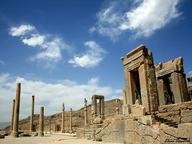
    Darius. King Darius founded the city where he built a huge palace of stone. The richly carved palace had ceremonial halls, treasury rooms and barracks for his huge army. It was built between 522-485 BC, and was developed further by successive kings. The various temples were as big as 450 metres by 300 metres and 20 metres in height. At the head of the ceremonial staircase leading to the terrace is the 'Gateway of All Nations' built by Xerxes I and guarded by two colossal bull-like figures.

Architecture played a huge role in the grand image of the Persian Empire. To this day the ruins of Persepolis can still be seen in modern day Iran, but what does Persepolis actually mean?
    City of the Persians. Persepolis means City of the Persians in the Greek Language. Originally it was known as "Parsa", the city then came to be referred to as Persepolis after coming in contact with Greek cultural values.

Which mythical animal, with the head and wings of an eagle and the body of a lion, was depicted in Persian architecture?
    Griffin. The griffin was often used by Persian sculptors to decorate the tops of columns and pillars. The griffin was a legendary creature with the head, beak and wings of an eagle, the body of a lion, and occasionally the tail of a serpent or scorpion.

Which breed of horse originated in ancient Persia?
    Caspian. The Caspian horse, believed to be one of the oldest breeds of domesticated horses in the world, can be traced back to ancient Persia. It was often depicted in ancient Persian seals and carvings.

What weapons did an Immortal carry?
    Short bow, spear and dagger. The Immortals were a special army of 10,000 soldiers from Persia. The name was given due to the strength of the army which was always kept at the 10,000 mark. If an Immortal died or was wounded in battle, he was replaced immediately. An Immortal carried a short bow, a spear and a large dagger. They would have metal plates under their tunics for protection. A wicker shield served to catch enemy arrows.

The Persians designed many artifacts that today are still being used in some shape or form by people everyday, but what was a rhyton?
    A drinking vessel. The drinking vessel was made into the shape of a horn. Craftsmen in Persia made beautiful gold and silver rhytons decorated with the heads of mythical creatures such as the griffin, ibex and lion.

The Persians believed in a supreme god called Ahura Mazda, who represented the wisdoms of goodness. Darkness and evil were represented by Ahriman, who was also known as Angra Mainyu. But which god protected the bridge of heaven?
    Rashnu. The Persian god Rashnu protected the bridge of heaven. It was believed that he carried a pair of golden scales to weigh the souls of dead people. Mithra was the god of life who killed the divine bull. The blood of the bull poured out with all plants and animals valuable to mankind. Bushyasta was the demon of laziness and idleness. He made people neglect their obligations and duties. And finally, Zurvan was the god of light and darkness. The god's two sons were Ahura Mazda and Angra Mainyu.

Alexander the Great led his troops to victory over the Persians at the Battle of Granicus which paved the way for the demise of the great Persian Empire. Many battles ensued, but which was regarded as the final battle, ending the Persian domination over Greece?
    Battle of Gaugamela. The historic Battle of Marathon was made famous due to the actions of the Greek messenger Pheidippides, who ran 26 miles from Marathon to Athens to warn the Greek army that the Persians were approaching, and the ensuing battle saw a great victory for the Greeks. The Battle of Salamis saw the Persians beaten due to the fact their ships were far too large to move rapidly, whilst the Greeks with faster and smaller vessels rammed the Persian fleet and sank every ship. The Battle of Plataea saw the Persians retreat from the rampaging Spartan army, which then led to the ultimate defeat at Gaugamela. Darius III was over thrown by Alexander the Great after the former thought his cavalry on plain land could out-fight the Greeks. Sadly for Darius III his soldiers were slaughtered and the Greeks had crushed the Persians.


Did you find these entries particularly interesting, or do you have comments / corrections to make? Let the author know!

  • Send the author a thank you or compliment
  • Submit a correction