Quizzes at Fun Trivia Fun Trivia | quizzes Quizzes | games Games | community People | services Services | help Help | me Me
New Player - Log In
Currently 9706 players online.   Trivia games, quizzes, and contests - FREE !     Get Started! quiz register
Fun Trivia: M : Man in Space

Special Sub-Topic: Apollo Bric a Brac - 1


Who was the NASA administrator at the time of the Apollo 11 mission?

    Thomas Paine. James Webb was administrator from 1961 to 1968 and oversaw the implementation of Project Apollo. He resigned in 1968 just before manned flight operations commenced when Thomas Paine took over. James Fletcher was administrator from 1971 to 1977 and Christopher Kraft was Director of Flight Operations in Houston at the time of the Apollo 11 mission.

Which of these options was selected to achieve the moon landings in 1962?
    Lunar Orbit Rendezvous (LOR). There was much debate in late '61 and '62 about which option was the most feasable to achieve the moon landing. The LOR option won after initial skepticism, most notably fron Werner Von Braun's team at the Marshall Space Centre, because it only involved the launch of one Saturn V class rocket. The EOR option required two Saturn V launches and a then unproven earth rendezvous with a tricky refuelling operation, and the direct ascent option would have required the development of a truely massive Nova class rocket.

How many times was Pad B at Launch Complex 39 used during Project Apollo?
    1. Pad B was used only once by Apollo 10 in May '69 when NASA was launching at a hectic pace of one mission every 2 months. Pad B was next used by by the three manned Skylab missions in '73.

How many rungs were there on the ladder of the Lunar Module?
    9. There were nine rungs on the ladder descending to the lunar surface. At the bottom there was a rather large meter plus drop to the LM footpad because of the shock-absorber. This led to the slightly framed Pete Conrad's exclaimation "That may have been a small step for Neil but it sure was a big one for me!" when he descended the ladder on the Apollo 12 mission.

The primary electrical power source for the Apollo Command and Service Module (CSM) was supplied by:
    Fuel Cells. There were three fuel cells in the Service Module (SM) supplying power during the coasting phases to and from the moon and in lunar orbit. Fuel cells exploit the energy released by the controlled reaction of Hydrogen and Oxygen producing water as a byproduct. Of course, this source was famously knocked out during the Apollo 13 emergency leading to some brilliant jury rigging utilising the storage batteries in the Lunar Module (LM) while preserving the batteries in the Command Module (CM) for the critical re-entry phase. A nuclear source was used to power the science experements on the Lunar surface and solar panels have been proposed as the power source for Shuttle replacement Crew Exploration Vehicle (CEV).

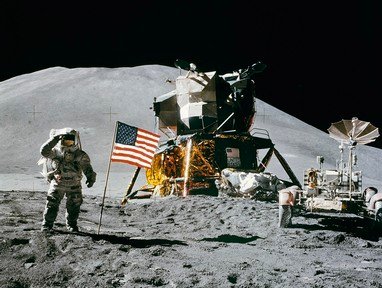
Three Apollo missions - 15, 16, and 17 - were extended three day explorations of the moon utilising the Lunar Roving Vehicle. By what letter were they known?
    J. NASA assigned letters to all Apollo missions which designated the type of mission it was. The final letter was "J" which described the mission of the last three expeditions. The "G" mission was the basic lunar landing accomplished by Apollo 11. The "F" mission was the full dress rehersal in lunar orbit to test all aspects of the system without actually landing and was accomplished by Apollo 10. The "C" mission was to demonstrate the capabability of the Command and Service Module in earth orbit and was accomplished by Apollo 7.

Part of the Environmental Control System (ECS) of Apollo spacecraft consisted of renewable cartridges containing lithium hydroxide LiOH. The purpose of these was to:
    Remove CO2 from the air. Lithium hydroxide has the ability to absorb large volumes of CO2. During the Apollo 13 emergency the build up of CO2 in the air was critical because the cannisters in the CM were unusable. The crew had rely on the air being circulated through the cannisters of the LM which soon became saturated. The only spares were in the CM, but there was a problem because the two vehicles had been built by different contractors they would not fit into the LM receptacles. It was the old problem of fitting a square peg into a round hole which was brilliantly solved by a hard working team at ground control. This episode is dramatically illustrated in the movie "Apollo 13".

How many main parachutes were deployed after re-entry to recover the Apollo Command Module?
    3. There was no greater thrill at the end of an Apollo mission than the sight of the command module gently swaying beneath three huge red and white parachutes to a gentle ocean landing. There were some very anxious moments during the Apollo 15 recovery when it was realized that only two chutes had deployed, however the astronauts survived the somewhat harder landing than normal. Subsequent investigations revealed that the shroud lines had been burnt through by the venting of excess corrosive fuel after re-entry, a practice which was modified for subsequent missions.

How many Saturn V rockets were built?
    15. A total of fifteen Saturn V's were built, thirteen of which were flown. Two were used for unmanned test flights, ten were used for Apollo 8 through 17, and one to launch the Skylab workshop. The two unused Saturns are on display at the Johnson Space Centre in Houston and at the visitors centre at the Kennedy Space Centre. Interestingly it was initially thought that up to ten unmanned flights would be needed before trusting the vehicle to a manned mission. The brilliant decision to introduce "all up testing" on on the very first flight, where all three stages were live, short circuted this and reassured planners that it was safe to proceed with a manned mission on only the third flight of Saturn V. This mission was of course Apollo 8.

An essential part of the equipment needed for an Apollo astronaut to walk on the moon was the PLSS. What do these letters stand for.
    Portable Life Support System. The PLSS provided water, oxygen, power and provided a comfortable temperature that enabled an astronaut to survive up to eight hours on thge lunar surface. A fully kitted up astronaut with spacesuit and PLSS weighed up to 350 lb but of course on the moon this was about 60 lb.


Did you find these entries particularly interesting, or do you have comments / corrections to make? Let the author know!

  • Send the author a thank you or compliment
  • Submit a correction