Register New Player - Log In
Welcome to our world of fun trivia quizzes and quiz games:     New Player quiz register Play Now! trivia game
Fun Trivia: A : Ancient Egypt

Special Sub-Topic: Egypt 5 - Dynasties 18 and 19


With which much later historical figure has Tuthmosis III of Egypt been compared?

    Napoleon. After about 20 years under the domination of Hatshepsut Tuthmosis III became probably the greatest conqueror in Egyptian history. There is a story how one of his generals, Djehuty conquered Joppa (modern Jaffa). After a direct attack failed he smuggled in 200 men in baskets disguised as the Prince of Joppa's loot.

Where was the body of Amenhotep II found?
    Where it should be - in his sarcophagus. The caches were made by late period priests in an effort to protect the mummies. The Deir-el-Bahari cache held 40 mummies, many of them royal. It was found in the 1870s. A few objects had been stolen. The three brothers who found it were forced to show it to archaeologists in 1881. In 1898 a further 16 mummies were found hidden in a cache in Amenhotep II's tomb (also known as KV35). In 1900/01 robbers broke into the tomb but their ancestors had taken everything worth stealing. He was moved to Cairo Museum in 1928.

Two statues of Amenhotep III are better known by the name of someone else. Who?
    Memnon. These colossi of Memnon are 20m high, seated statues, one of which made a moaning sound at dawn and dusk until it was repaired by the Roman emperor Septimus Severus. His official court poetess wrote a poem which was inscribed on the statue along with much other ancient graphiti. They are about all that survives of his mortuary temple (many mortuary temples were used as quarries after the king's death). About 400 metres behind the statues are a repaired stele and some fragments of statues including a crocodile tailed sphinx. Memnon was an Ethiopian prince who fought at Troy.He was the son of Eos the goddess of the dawn. Ramses II was a great thief of other people's monuments but he does not seem to have tried to steal these.

Which god did Amenhotep IV worship in particular?
    Aten. He changed his name to Akhenaton. The Aten had been increasing in importance before his time and there were still priests of the Aten some time after his death despite persecution. There is controversy over whether he had a co-regency with his father. If he did some of his radical changes may have taken place in the reign of Amenhotep III.

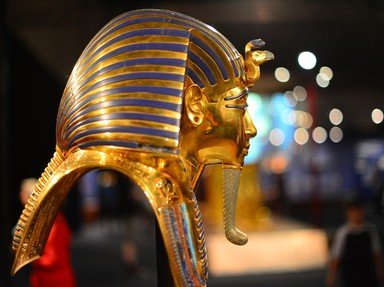
About the only work of Tutankhamen that is known is his tomb.
    True. For example he did extensive restoration work in Luxor temple and Karnak which was then claimed by his successors. Also his Viceroy of Kush built a temple at Faras just upstream of Abu-Simbel. It is widely, but falsely believed that his tomb was unrobbed but it was robbed twice. (Under an agreement with the Egyptian government Lord Caernarvon was entitled to a share of the contents of any robbed tomb). In the first robbery it seems various small items of jewellery were taken (seven gold rings were recovered and put back in the tomb still wrapped in the robbers kerchief). In the second robbery precious unguents were transferred into goatskins and taken.

There is a record of year 59 of the rule of Horemheb. What is the opinion of modern scholars on this high figure?
    He dated his rule from the death of Amenhotep III and ignored the intervening four rulers. Horemheb's tomb as a non-royal person was found in the 19th century. Carvings ended up in several museums but were then lost till found again by the British Egypt Exploration Society in 1975. Even though he did not use it he had royal uraeuses carved on all the representations of him. He also had a tomb as pharaoh in the Valley of the Kings.

Seti I was the first Egyptian ruler to fight which people?
    Hittites. Both his tomb and his mummy are considered to be finest known in Egypt. His tomb is also the longest and deepest (both figures are over 100 metres). His fine alabaster sarcophagus is in the Sir John Soane museum in London. (This museum is still organised as it was in the early 19th century).

The mummy of Ramses II was in good condition partly because his nose was packed. What with?
    Peppercorns. Noses were often flattened when the mummy was bound. His throne name was User-maat-re Setep-en-re which means roughly 'the justice of Re is powerful. Chosen of Re'. Re is the sun god and the word translated as justice is Maat, which is also translated as truth or the harmony of the universe. This throne name was remembered as Ozymandias which was used in the poem by Shelley.

Merneptah was a son of Ramses II and his successor. How many elder brothers did he have who predeceased his father?
    Twelve. One of his stele records that 'Israel is devastated, her seed is no more, Palestine has become a widow for Egypt'. This is the only reference to Israel in an Egyptian inscription. There are two inscriptions about his campaign against Libya. One says 6200 Libyans killed but another account of the same campaign another says 'Libyans slain whose uncircumcised phalli were carried off, 6359'.

What was the relationship of Queen Twosret to Seti II?
    Wife. Seti had three wives. Twosret was mother of an heir who predeceased Seti. He was succeeded by Siptah with Twosret as regent. When Siptah died after about six years Twosret declared herself king like Hatshepsut but only ruled for two years.


Did you find these entries particularly interesting, or do you have comments / corrections to make? Let the author know!

  • Send the author a thank you or compliment
  • Submit a correction