Register New Player - Log In
Welcome to our world of fun trivia quizzes and quiz games:     New Player quiz register Play Now! trivia game
Fun Trivia: P : Poe, Edgar Allan

Special Sub-Topic: Journey Through a Midnight Dreary


As "The Raven" opens, the narrator is clearly trying to distract himself from lamenting the death of a young woman. When reminiscing about her name, the narrator remarks that his lost love was named by certain supernatural beings. A Major League Baseball team (American League) is named after these creatures as well. What kind of beings does he mention?

    Angels. Not only does the narrator credit angels for naming his love, but he also believes that angels have been sent to him in order to ease his suffering over his grief for his lost love.

What is the name of this maiden for whom the narrator grieves?
    Lenore. "Lenore" is the name of an 1831 poem by Edgar Allan Poe (predating "The Raven") about a young girl who has died. It is thought that Lenore, the subject of "Lenore," is the same Lenore mourned in "The Raven." The following are a couple lines from this poem: "An anthem for the queenliest dead that ever died so young - A dirge for her, the doubly dead in that she died so young." (Quoted from www.online-literature.com)

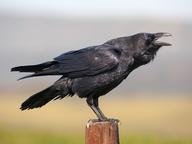
The narrator's lonesome reverie is disturbed when someone knocks first on his door, and then on his window. Upon investigation, he discovers that there is a raven outside of his window. When the narrator opens his window, the Raven sits upon a bust in the narrator's chamber. The bust is named for an epithet of the Greek goddess Athena. Upon whose bust does the Raven perch?
    Pallas. The precise origin of Athena's name (Pallas) is not known. Most traditions claim that Athena killed someone named Pallas and took on the name; however, her relationship to that person is disputed. Athena is also called Tritogeneia. Her realms of power include wisdom and war, and she was the patron goddess of Athens.

Now pondering his avian guest, the narrator begins to guess where his visitor is from. In another classical reference, the narrator wonders if the Raven hails from the "Night's Plutonian shore." To which Roman god does "Plutonian" refer?
    Pluto. Pluto is the Roman god of the underworld, as well as the god of riches. He is married to the goddess Proserpina, whom he kidnapped from her mother. Because of Pluto's association with death, the narrator believes that that Raven (assuming he does come from the Night's Plutonian Shore) will have information about the dead, namely his beloved Lenore.

Although the Raven does distract him from his mourning, the narrator's thoughts eventually return to his lost love. As he is grieving anew, he begins to feel a new presence in the room. What heavenly beings, which are thought to be the highest order of angels, does the narrator believe have come to give him relief from his mourning of his love?
    Seraphim. "Then, methought, the air grew denser, perfumed from an unseen censer/Swung by Seraphim whose foot-falls tinkled on the tufted floor." - "The Raven" The narrator speaks the lines above, believing that heaven has sent seraphim to make him forget his tragic loss. However, he still cannot resist asking the Raven about Lenore's fate.

In addition to the comfort provided by the presence of heavenly creatures, the narrator speculates that heaven has sent him an elixir he must drink that will prevent him from more lamentation. What drug does the narrator claim he needs to get over the loss of his love?
    Nepenthe. Nepenthe is the name of a drug causing forgetfulness that was created in Egypt, according to Greek mythology. It is now believed that nepenthe may have been derived from opium. Nepenthe is also mentioned in many other classical works, including Hawthorne's "The Scarlet Letter" and Pope's "An Essay on Man." Additionally, a restaurant in Big Sur (California) bears the name.

Just as the narrator begins to get some peace of mind (claiming he will drink the elixir and "forget this lost Lenore"), the Raven breaks in with his infamous "Nevermore." This interruption causes the narrator to continue his musings on the Raven's home. Which of the following is NOT one of the places the narrator suspects the Raven originates?
    His imagination. The narrator does indeed inquire whether the Raven comes from "the nightly shore" and "the Night's Plutonian shore." Additionally, he is desperate enough to seek a prophecy from the bird "Whether tempter sent, or whether tempest tossed thee here ashore." Although Poe does not qualify who the tempter is, the phrase usually refers to the Devil. In many religions, the Devil's main goal is to tempt humans into a life of sin. However, the narrator is so anxious about Lenore that he does not care from whom the information comes.

The narrator then asks the Raven a series of two questions. The first concerns whether he will ever be able to get over his love's death. In doing so, the narrator mentions a specific "balm" that will help him heal. Where does the narrator hope to find this balm to mend his broken heart?
    Gilead. The narrator queries "Is there - is there balm in Gilead? - tell me - tell me, I implore!" This line of questioning is influenced by the following quote from the Bible: "Is there no balm in Gilead; is there no physician there? Why then is not the health of the daughter of my people recovered? -Jeremiah 8:22. The phrase "balm of Gilead" has appeared in many works before and since "The Raven," including Twain's "The Adventures of Tom Sawyer" and a short story by Roald Dahl.

Upon hearing a negative reply to his last question, the narrator wants to know "Tell this soul with sorrow laden if, within the distant Aidenn/It shall clasp a sainted maiden..." Aidenn is an alternate name for what paradise?
    Eden. Although Poe uses an unusual spelling, "Aidenn" is an alternate name for Eden. The Garden of Eden is the place where Adam and Eve lived, shortly after the world was created (according to the Bible). Olympus is a locale in Greek mythology where the gods and goddesses reside. Valhalla, according to Norse mythology, is the hall of Odin for warriors who died bravely in battle. The narrator may dream of meeting Lenore again, but from the questions he asks of the Raven, he wishes for a physical meeting (although it might take place on a spiritual plane.) Because the Raven (whom he still believes is a prophet) has told him he will have a broken heart for the rest of his life, the narrator wants a guarantee that he will be with Lenore in heaven. The narrator flies into a rage upon hearing a second negative answer, and tells the Raven to leave. The ending of the poem reveals that the Raven remains on the "pallid bust of Pallas" and plans to stay there forever.

Some have speculated that the character of the Raven was inspired by a raven in Dickens' "Barnaby Rudge." Its name is also a term used to describe technicians on a film or theatre set. Which of the following is the name of this earlier feathered character?
    Grip. There are a couple of reasons why some believe that Poe borrowed his raven from Charles Dickens. One is that Poe apparently reviewed "Barnaby Rudge" and announced that the raven was not portentous enough. Also, the following exchange occurs in Chapter 5 of "Barnaby Rudge": "What was that? Him tapping at the door?" "'No,' returned the widow. 'It was in the street, I think. Hark! Yes. There again! 'Tis some one knocking softly at the shutter. Who can it be!'" (Quoted from www.online-literature.com) When compared with "The Raven," there are some similarities both in words and in context: "'Tis some visitor,' I muttered, `tapping at my chamber door - /Only this, and nothing more.'" Hope you enjoyed the quiz and/or learned something! Now you had better get going, or you'll be trapped here - for evermore!


Did you find these entries particularly interesting, or do you have comments / corrections to make? Let the author know!

  • Send the author a thank you or compliment
  • Submit a correction