Register New Player - Log In
Welcome to our world of fun trivia quizzes and quiz games:     New Player quiz register Play Now! trivia game
Fun Trivia: A : Arachnids

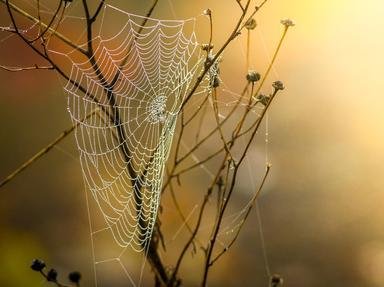
Special Sub-Topic: The Amazing Spider Web


Spiders produce thread from the spinneret glands. On which part of a spider's body are these glands located?

    Tip of the abdomen. Seven different types of these glands have been identified, although individual spiders usually only possess a few of each.

Making a web uses up a large amount of a spider's energy. Which particular substance is used in the manufacture of the silky strands of these webs?
    Protein. Webs allow spiders to gather their food source without having to use up too much energy in hunting and killing. It takes a lot of effort and time however, on the part of a spider, to manufacture these delicate and dangerous snares.

Web making is a very tiring business. What do some spiders do with the webs in order to re-boost their energy levels?
    Eat them. As the substance on the web strands looses its stickiness after a short time, and therefore its ability to capture and hold prey, webs have to be constantly re-made by the spider. Because the strands are made of protein, they are therefore recycled by the little creatures.

Surprisingly, not all spiders make webs to capture prey, nor anchor webs to fixed objects. How then do these spiders catch their food?
    All of these methods (Running prey down in an open chase, Weaving small webs on their feet, Pouncing from concealment). The most amazing of these methods is the one used by spiders that weave small webs on their feet, and then leap onto prey and wrap the web around their catch before paralysing and killing it. Astonishing.

How do web spinning spiders initially span large gaps that seem impossible to cross, ie, between two tall trees?
    Loose a fine strand into the breeze until it attaches. Many webs are between objects, such as across water, or between large tall spaces, that spiders cannot cross by walking. To overcome this, spiders send a fine thread into a slight breeze which is blowing in the right direction until it catches on the far side. Then they slowly and carefully walk across this single thread, spinning a second thread as they go - and build on from there.

What do spiders use as a measurement in making the patterns of a web?
    The length of their bodies. After initially completing the external boundaries, the spider spins five circular threads in the centre, then a spiral of non-sticky threads working from the inside out. On completing this stage, the spider replaces the initial spirals with more closely spaced sticky ones. The space between each spiral is in proportion to the length between the spider's back legs to its spinners. Finally it removes the non sticky strands altogether - and settles down to wait. Me, I'd want a long holiday.

Not all spiders wait in the centre of their webs for their prey to come along. Why is this?
    It makes them too visible for birds and other predators. Many spiders reduce the risk of being chomped up for dinner themselves by hiding at the edge of the web and keeping one leg on a signal line from the centre of their web which alerts them by its vibrations that their own lunch has arrived. Amazingly, another method they use as a safe guard is by disguising themselves so as to appear inedible or really unappealing to their predators.

In traditional medicine from the days of yore, and even today in some areas, to what use are spider webs put?
    Placed on wounds to stop bleeding. It's true. Within spider webs there is a substance which can help in the healing process of injuries on human beings. Spider webs are also rich in vitamin K which acts as a clotting agent, thereby helping to stop bleeding.

Spider webs have been used in which artistic pursuit?
    Cobweb Painting. Cobweb painting made its appearance in the 1500s in the Austrian Alps. The webs were layered and wound over fabric and reinforced by brushing with diluted milk. Then watercolours were applied over the top to create the painting, some of which still exist today in private collections. Even engravings were once made around the shape of cobwebs applied to a suitable surface.

What are spiders occasionally known to do together in groups?
    Combine and spin giant webs together. Spiders have indeed been known to combine their webs together into one giant web. In Texas in 2007, for example, a web of this kind was reported. It was an amazing 200 yards across. See, they really DO do things bigger 'n better in Texas.


Did you find these entries particularly interesting, or do you have comments / corrections to make? Let the author know!

  • Send the author a thank you or compliment
  • Submit a correction