Register New Player - Log In
Welcome to our world of fun trivia quizzes and quiz games:     New Player quiz register Play Now! trivia game
Fun Trivia: A : Ancient Greece

Special Sub-Topic: The Golden Age of Athens


The Golden Age of Athens occured after the formation of which league?

    Delian League. After defeating the Persians for the second time, the Greeks decided that they needed to form a league to promote the mutual protection of Greece. All members who joined the League were to pay a fee to help defray costs. The treasury of the League was located on the island of Delos, for which the League was named. At the time the Greeks were so determined to make the defensive alliance work, that they sealed the pact by throwing a piece of iron into the sea, and pledged to support each other until it rose back to the surface.

The Golden Age of Athens is also called The Age of _____?
    Pericles.. Pericles was the most prominent politician in Athens from 461 until 429 B.C. He encouraged his fellow Athenians to use the tribute money the League collected to underwrite the development of Greek culture. During this time Athens was known as the "school of Hellas." Pericles was so popular that there is some belief that the government of Athens at the time was more of a tyranny than a limited democracy. Sadly, Pericles was a victim of the plague that swept Athens at the beginning of the Peloponnesian War.

Athens used the money from the League to rebuild the city, rather than providing for the protection of the League members as planned.
    True. During the second Persian War, parts of the city of Athens had been destroyed. The Athenians used money from the League's treasury to rebuild their city, although some ruins were left standing so the people would not forget.

Many achievements were made during the Golden Age of Athens. In which of these fields?
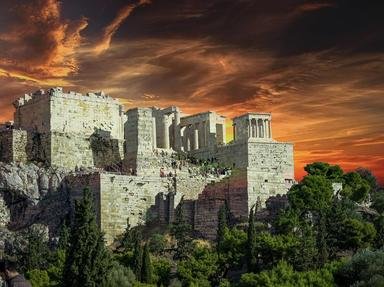
    all of these (architecture, drama, philosophy). Examples of architecture created during the Golden Age include the Parthenon, built to honor the patron goddess Athena, and the Erectheum, which has beautiful columns of caryatids. The great dramatists of the Golden Age included Aeschylus (Oresteian Trilogy), Sophocles (Oedipus Rex), and Euripides (Medea). The great philosophers Socrates, Plato, and Aristotle all contributed to a great age of Greek philosophy, which still influences Western thought.

During the Golden Age, the Parthenon was built under the general supervision of which sculptor?
    Phidias. The Parthenon replaced an older temple to Athena, which was destroyed during the Persian invasion of 480 B.C. Ancient sources tell us that the co-architects of the project were Iktinos and Kallikrates. Phidias was also believed to have designed and carved the enormous statue of Athena (it was 40 feet tall!) that was placed inside the temple, as well many of the sculptures that adorned the exterior of the building.

During the Golden Age, what kind of government did Athens have?
    limited democracy. As there was a long list of people who could not participate (women, children, slaves, foreigners, criminals, etc.) the government of Athens during the Golden Age is best described as a limited democracy. In fact, will there ever be a true democracy? Probably not!

What were the requirements of citizenship in Athens?
    All of these are correct (Free man, Born in Athens, 18 years old). The tyrant Cleisthenes is really the person who set the stage for the limited democracy practised during the Golden Age of Athens. Citizens of Athens were able to attend the daily meetings of the Assembly and vote on issues as long as they had been in attendance at all of the meetings where the issues were discussed. Citizens could also speak before the Assembly as long as they had not thrown down their shield in battle, and were not in debt to the state. In addition, they were able to participate in the lotteries held for the selection of some of the other official positions.

What government body prepared the agenda of topics that would be discussed by all citizens in the Assembly?
    Boule. The Boule consisted of 500 members, who were chosen by a lottery from citizens who were at least thirty years old. Within the Boule, there were ten governing committees, consisting of fifty members each. For one-tenth of the year each committee had full-time responsibility for the business of the Boule. Each day a new administrator was chosen, also by lottery, from the members of the group. Overall, the Boule prepared the agenda for discussions in the Asembly, prepared legislation to be debated by the Assembly, and administered policies enacted by the Assembly.

Sparta was one of the members of the Delian League.
    False. Although Sparta also had assisted in defeating the Persians, they would not join a league that was to be dominated by Athens. Anyway, Sparta had already formed the Peloponnesian League, which united all of the important city-states in the Peloponnesus. Each member was bound to Sparta by a separated one hundred year treaty.

What event ended the Golden Age of Athens?
    Peloponnesian War. Tensions between the Peloponnesian League and the Delian League eventually led to the Peloponnesian War. Thucydides believed that Sparta was afraid of the growing power of Athens, which had essentially resulted in the creation of an Athenian empire. Sparta felt that Athens was meddling in their business, and Athens would not agree to avoid interference. After twenty-seven years of war, and the participation in one way or another of many of the city-states belonging to the two Leagues, both Sparta and Athens were in ruins. Sparta claimed the victory, and the city-states continued their bickering and fighting. Phillip II of Macedonia, fully aware of the disunity among the Greeks, took advantage of the constant quarrels and prepared for a full scale invasion of Greece. The Greeks were about to lose something very dear to them: their independence!


Did you find these entries particularly interesting, or do you have comments / corrections to make? Let the author know!

  • Send the author a thank you or compliment
  • Submit a correction