Quizzes at Fun Trivia Fun Trivia | quizzes Quizzes | games Games | community People | services Services | help Help | me Me
New Player - Log In
Currently 12980 players online.   Trivia games, quizzes, and contests - FREE !     Get Started! quiz register
Fun Trivia: A : Asian Countries - Other

Special Sub-Topic: The Hashemite Kingdom of Jordan


Although normally referred to as Jordan, the full name of the country is The Hashemite Kingdom of Jordan, but what does Hashemite refer to?

    an early ancestor of the ruling family. The Hashemite kings of Jordan trace their ancestry in a direct line to Muhammad, the most important prophet of the Islamic religion. The prophet Muhammad's great grandfather was Hashim ibn Abd al-Manaf, and it is from him the Hashemite family take their name. Hashem in Arabic means pulveriser. This referred to the patriarch's habit of serving crumbled or pulverised bread broth to pilgrims, rather to any violent or warlike tendencies.

Which of these countries does not have a border with Jordan?
    Lebanon. The countries which have a land border with Jordan are Iraq, Syria, Saudi Arabia, and Israel. A small part of Jordan's border is on the Red Sea Gulf of Aqaba. The Palestinian Authority, set up in 1994 to administer territories on the West Bank and Gaza, also borders Jordan.

What was Jordan called, immediately prior to the establishment of the present day Hashemite Kingdom of Jordan?
    Transjordan. Transjordan was the western part of the British Mandate of Palestine, established after World War I. The eastern section of the Mandate was called Palestine, and comprises the area of modern day Israel and Palestine. The present day independent Hashemite Kingdom of Jordan was established in 1946, at first being called The Hashemite Kingdom of Transjordan, and shortened to The Hashemite Kingdom of Jordan in 1950.

In 1950, Jordan annexed the West Bank area of the Jordan River from Israel. This annexation was at first formally recognised and accepted by only two countries. Which were these countries?
    Great Britain and Pakistan. Most Arab states were opposed to the creation of the state of Israel, and the country was invaded in May 1948. An armistice agreement came into force on 3rd April, 1949, which gave control of the West Bank to Transjordan. Soon after this agreement, Transjordan changed its name to Jordan. Following the 1967 Arab-Israeli war, the West Bank was re-occupied by Israel.

Three seas form parts of Jordan's borders; these being the Red Sea, the Dead Sea, and the Sea of Galilee.
    f. Only two seas border Jordan, the Red Sea and the Dead Sea. The Gulf of Aqaba, which is part of the Red Sea, is on the south coast of Jordan, and the Dead Sea is an inland sea located on the western border with Israel. The Sea of Galilee, also known as Lake Tiberias, is actually a freshwater lake. Jordan does not border the Sea of Galilee, but under a joint treaty with Israel takes freshwater supplies from it.

What was the nickname of the British colonel, who during World War I, led daring raids on Turkish forces in Jordan?
    Lawrence of Arabia. Colonel Thomas Edward Lawrence was devoted to the cause of Arab independence, and lived and dressed as an Arab during his raids on Turkish forces and installations in the Middle East. In Jordan, he based himself mainly in Wadi Rum, an area of spectacular rock and desert formations, where concealment was relatively easy. His auto-biography, entitled 'The Seven Pillars of Wisdom' was named after one of the large rock formations in Wadi Rum.

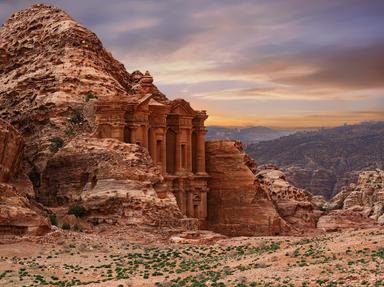
Perhaps the most famous of Jordan's many historic sites and monuments is the Nabatean city of Petra. By what other name is Petra commonly known?
    The Rose City. Petra's nickname comes from the deep colours of the rock from which the city's many monuments are carved. The Victorian traveller and poet, Dean Burgon, described the city in his poem 'Petra', with the closing lines 'Match me such a marvel, save in Eastern clime, A rose-red city half as old as time'.

The Dead Sea is situated on the border between Jordan and Israel. Why is this sea called the Dead Sea?
    No major life forms can survive in it.. Only small amounts of specialised bacteria can survive the high salinity levels of the Dead Sea, although at times of heavy rainfall and flooding, red algae has quickly formed for short periods. The Dead Sea is 67 kilometres long, and has a maximum width of about 18 kilometres, and its salinity is about nine times that of the oceans. Its surface is about 418 metres below sea level, and its shores are the lowest land points on Earth.

The River Jordan is Jordan's main source of fresh water, but where does this river end up?
    The Dead Sea. The River Jordan is initially formed by three tributary rivers, the Hasbani, the Banias, and the Dan. It flows through the freshwater Sea of Galilee, and forms part of the border between Jordan and Israel, before ending in the Dead Sea. Much of the area through which the Jordan flows is arid desert, and the river is the most important source of fresh water to several countries, including Syria, Israel, Jordan, Lebanon, and Palestine.

The Bible records that Jesus was baptized in the River Jordan by John the Baptist.
    t. The incident is recorded in Matthew 3.13, "Then cometh Jesus from Galilee to Jordan unto John, to be baptized of him". The River Jordan is mentioned often in the Bible, including when its flow miraculously ceased to allow Joshua and the Israelites to cross over on dry land and besiege Jericho (Joshua 3.17).

On the national flag of Jordan there is a seven point star. What do these seven points signify?
    the first seven verses of the Koran. The national flag of Jordan shows equally spaced, horizontal bands of black, white, and green, with a red triangle at the hoist. In the centre of the red triangle, there is a seven point white star, the points representing the seven opening verses of the Koran.

What is the capital city of Jordan?
    Amman. Oman is a country situated on the Arabian Sea, to the south east of Saudi Arabia. Beirut is the capital of Lebanon, and Damascus is the capital of Syria. Amman is an ancient city, inhabited by the Ammonites and called Rabbath-Ammon in old Testament times. It was conquered by king David of Israel in the 11th century B.C. and regained independence under his son Solomon.

During his rule, King Hussein of Jordan was known to his subjects as Al-Malik Al-Insan. What is the meaning of this Arabic title?
    The Humane King. Hussein bin Talal acceded to the throne of Jordan on his eighteenth birthday in 1953, having been proclaimed king in August 1952. King Hussein ruled Jordan for almost forty seven years, and introduced many reforms. He was a popular king, and a respected elder statesman throughout the world, who worked tirelessly for Arab reconciliation and Middle East peace. He died in 1999 aged sixty three, and was succeeded by his eldest son, Abdullah bin Al-Hussein.

Jordan is a major producer of oil and natural gas.
    f. Jordan has insignificant reserves of oil and gas, and is one of the poorest countries in the Middle East. In spite of this, living standards are relatively good, and literacy stands at about 85%. The economy depends on a variety of products, including phosphate production, tourism, agriculture, and expatriate income. Jordan's economy suffered as a result of the war in Iraq, and U.N. sanctions were applied when the country continued to trade with Iraq following the Iraqi invasion of Kuwait.

Which major U.S. city now has the same name as the present day Jordanian capital city had over 2,000 years ago?
    Philadelphia. The Greek ruler of Egypt, Ptolemy Philadelphus, renamed the city 'Philadelphia' in circa 218 B.C. The city has changed hands many times in its long history, being occupied by the Ammonites, Israelites, Assyrians, Persians, Greeks, Nabateans, and Romans in ancient times, and by Turks and British more recently.


Did you find these entries particularly interesting, or do you have comments / corrections to make? Let the author know!

  • Send the author a thank you or compliment
  • Submit a correction