Quiz Answer Key and Fun Facts
1. Sherlock Holmes, who is a geologist in this alternate universe, is going for a walk with his good friend Dr. Watson. They observe a conglomerate in which many of the cobbles are well-rounded, the size of a fist and have small chips and fracture marks. Dr. Watson asks, "What was the likely depositional environment of this sediment?" What does Sherlock reply?
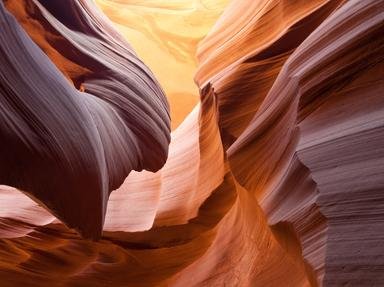
2. A friend is showing you slides from his vacation. One of them is a picture of him standing next to a reddish cross-bedded sandstone, where the individual beds are about three times as tall as he is. "That must have been a really awesome beach!" he says. But you know better. Where did that sand come from, really?
3. You're out hiking with family and friends when you discover sets of asymmetric ripples in a sandstone. You know that geology is "great at parties! thrill your kids!" material, so what information can you wow them with?
4. A group of investigators from CSI have heard of your geological superpowers and want your help in solving a crime. The murder happened on a picturesque beach on the island of Hawaii. One of the murder suspects was arrested as he was getting off the plane, claiming to have done his sunbathing only on the picturesque beaches of Hippie Hollow in Austin, TX. You know that Hawaii is made mostly of basalt, and that the Austin area is located in a region of limestone. Black sand was discovered in the suspects' sandals and swimming trunks. Is he lying?
5. An "expert" is being interviewed on TV about the recent Mars missions. He says, "Experiments have shown that most of the sand grains on Mars are made up of the mineral olivine. This does not disprove my theory that there were extended periods of liquid water on Mars in the not-too-distant past." Why is this so-called "expert" wrong?
6. Dramatic geology statement time: You are walking along an exposure of limestone, and stop to pick up a few fossils of crinoid columnals. What dramatic, attention-grabbing statement can you make?
7. It's hard to think about geology without thinking of paleontology, and paleontology without dinosaurs. But your interest in dinosaurs is geological, not biological. You don't want to see dinosaur bones in a museum, you want to see them "in their natural habitat," in the rock matrix! Where would be the best place to do this?
8. A geology quiz would not be a geology quiz without a question about volcanoes. So here it is. You hear about volcanoes like Mount St. Helens or Vesuvius that blow up explosively and destroy everything with floods of burning hot volcanic ash. You also hear about volcanoes, like the Hawaiian volcanoes, that never seem to do that, and contentedly pour out runny lava to the end of their days. What accounts for the difference?
9. Once again, you're out hiking with your spouse and kids. You see some gigantic, maybe one meter in diameter, spherical rocks in a sandstone matrix. Your son asks, "Daddy, daddy, what's that?" So you tell him in a very serious and informative tone, "Junior, those are called concretions." He asks, "How did they get there?" You explain that they eroded out, that they were harder than the surrounding sandstone. "No, daddy," Junior says, "Why did they form?"
What do you tell him now?
10. You're in Philadelphia, visiting the cemetery where old Ben Franklin is buried. You notice that many of the tombstones, which are made out of sandstone, are not in very good condition, and that the writing is hardly legible. You can easily brush loose sand grains out of the rock. One of the docents explains that the deterioration happened when Philadelphia was heavily industrialized, and there were not yet environmental regulations in place about acid rain. Wait-- acid rain is sulfuric acid, which must not be very effective at dissolving SiO2, because it is usually stored in glass containers. What is going on?
Source: Author
pu2-ke-qi-ri
This quiz was reviewed by FunTrivia editor
crisw before going online.
Any errors found in FunTrivia content are routinely corrected through our feedback system.