Quiz Answer Key and Fun Facts
1. Lisbon -- or Lisboa, as the locals call it -- has been many things over the centuries. Once, its position near the Atlantic made it the launching point of an empire. What is the Portuguese name of the broad river that runs through Lisbon and gives it access to the sea?
2. We'll begin our tour just west of the city, in the pleasant riverside neighborhood of Belem. Though the area's custard tarts are justly famous, the main attractions are all related to exploration: a tower to guard the river mouth, a monastery to commemorate Vasco da Gama's voyage to India, and a 1960 monument (Padrao dos Descobrimentos) to two centuries of Portuguese explorers. What historical figure, father of the Portuguese tradition of exploration, stands at the prow of the monument, gazing across the river?
3. From the shores of Belem, we have an excellent view of the river as well as one of the most famous bridges across it. This two-kilometer suspension bridge is now known as Ponte 25 de Abril, after the 1974 date when a coup brought an end to dictatorship in Portugal. But when it was built in 1966, the bridge was named after the man who was dictator here for some 36 years. Who was he?
4. Like Rome, Lisbon was built on seven hills -- a fact that's easy to remember (and lament) on the steep hikes between neighborhoods! Luckily, the city planners have provided several lifts to connect one area to another. Most of these are funiculars (similar to cable cars), but one is a vertical elevator, built entirely of iron in a style reminiscent of Gustave Eiffel. What is the name of this lift, which we'll take to get from downtown to Carmo Square in the Bairro Alto neighborhood?
5. Just after crossing the footbridge into the Bairro Alto, we come upon what was once one of the most beautiful churches in Lisbon. Its walls still stand, but are missing above the rose window frames; the roof above the nave is gone entirely, leaving only eerily perfect arches between the heart of the church and the sky. The Convent of Carmo remains in ruins as a monument to what disaster that devastated Lisbon and destroyed nearly every church therein?
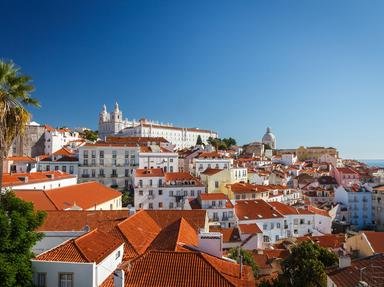
6. Let's move on to another popular, highly-placed attraction. The Lisboetas of old knew their city needed fortification, and the resulting Castelo de Sao Jorge adds martial flair to the skyline. It sits amidst the winding, cobbled streets of what neighborhood, Lisbon's last surviving medieval district?
7. While we're looking down from the castle walls, take a moment to examine downtown. Almost completely destroyed in 1755, it was subsequently completely rebuilt -- giving it a feature rare in the old quarters of European cities. What makes Lisbon's downtown different?
8. Walking through old Lisbon, you've probably noticed fancy tilework on a number of the buildings. Some have full facades of colored tiles, glinting in the sunlight; others display rectangular mosaics of hand-painted tiles, depicting scenes of love, history or faith. We'll spend some time in a museum devoted to these tiles, which have become a symbol of Portugal. What is their name, derived from the Arabic word for "polished stone"?
9. North of the museum is the Parque das Nacoes (Nations Park), built on reclaimed industrial land to host the 1998 World's Fair. It must have been a success: the fair had more visitors than the population of Portugal! The pavilions are gone now but a lovely park remains, as does what attraction where visitors can learn about marine life?
10. We'll wrap up our tour with dinner and fado, a uniquely Portuguese musical form that dates to the early 19th century. What is the closest English translation of the word "fado"?
Source: Author
CellarDoor
This quiz was reviewed by FunTrivia editor
minch before going online.
Any errors found in FunTrivia content are routinely corrected through our feedback system.