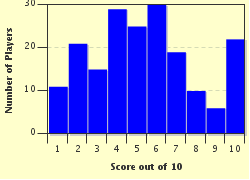
Quiz Answer Key and Fun Facts
1. Which mathematician proved the famous formula e^(i*pi) + 1 = 0?
2. Which mathematician had worked with number theory and claimed to have found that x^n + y^n = z^n has no positive integer solutions if n is greater than 2?
3. Which mathematician had published "The Elements", and has influenced the study of geometry for around 2000 years?
4. Which mathematician had developed the "method of indivisibles" and published "Geometria Indivisibilis"?
5. Which mathematician had studied the involute of a circle, and used this knowledge to patent the first pendulum clock?
6. Which mathematician, at the age of 18, proved (or to be more precise, reproved) that for every n there is a prime between n and 2n.
7. Which mathematician had studied binomial coefficients, published a book on it, and had a "triangle" named after him?
8. Which mathematician is remembered for his theorem (cos x + i sin x)^n = (cos nx + i sin nx)?
9. Which mathematician was the first to factor out (2^67 - 1) using quadratic remainders?
10. Which mathematician's most famous work is a formula that can be used to find the area of a triangle with just the lengths of the sides?
Source: Author
dijonmustard
This quiz was reviewed by FunTrivia editor
DakotaNorth before going online.
Any errors found in FunTrivia content are routinely corrected through our feedback system.