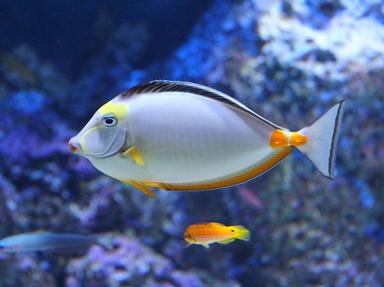
Quiz Answer Key and Fun Facts
1. Haiku is a major form of Japanese verse written in 17 syllables divided into 3 lines of 5,7,5, and usually having a natural theme. Sometimes haiku are coupled into strings of two or more. What is the subject of the following haiku string?
Opalescent rush
Of milky iridescence
Red-flush arms abound
Crimson tinctures call
Filmy white - silken candles
Fall on shallow ground
2. Haiku are usually not rhymed, but you'll notice that I've experimented with rhyming techniques in this collection. Read the following string carefully. The creature described is commonly found washed up on South African shores. Determine which sea creature this string is referring to.
Filmy shadow blues
Colonize the speckled strand
Tenderly deflate
Upper margin hues
Pink and green catch the sun, and
Signal thus their fate
3. Haiku are short poems, but that doesn't mean they have to be simple. A carefully constructed haiku can convey an incredible amount of meaning. There isn't much room to work with, so careful word choice is important. Read the following haiku, and notice the choice of wording. Which sea creature is being described?
Dorsal spurs beware
Let not brindled feather looks
Malice thus belie
4. The purpose of this haiku collection is two-fold. First, it is meant to encourage the reader to explore the wonders of the deep, and to learn something about the diversity, beauty, and complexity of life in our oceans. Second, it is to involve the reader in the process of education. It is by no means a straightforward description, but a colorful use of language that will require the reader to engage in the process to solve the mysteries. Solve this mystery: what type of creature is being referred to in the haiku that follows?
Vermilion fringe
On sluggish bottom dweller
Showy Spanish shawl
5. Since we know there isn't much room to work with in merely 17 syllables, it often requires a fair amount of creative skill to capture the subject in a way that does it justice. The lines below highlight three important characteristic features of the sea creature described. What is the subject?
Ternion pulse, this
Marvel of (flam)buoyancy
Sea chameleon
6. One very effective creative device to think about when writing haiku is to choose words that accomplish multiple tasks at once. In this next haiku for example, one word in particular functions to express two important descriptive meanings. Keep that in mind as you make your choice for which creature is being described.
Supernally this
Cerulean nebula
Radiates the deep
7. The form of Haiku might seem restrictive to some, but there really are endless possibilities. New poets might even find that it actually provides a nice framework to get the creative juices flowing. It's also an excellent way to pick up some new vocabulary, if you do your homework. You might know something about the next subject. It is, after all, considered one of the most venomous known sea creatures. Read the haiku and make your choice.
Prognosticating
Death 'gainst shades of umber hue
Cobalt circlets flash
8. Interestingly, the type of creature described in this next haiku was the subject of an entire series of over 1,000 haiku translated from Japanese into English for a book in 2003. What type of creature is it?
Benthal candy cane
Herringbone-like redlined white
Holothurian
9. Haiku are often epigrammatic, meaning witty or pithy. The following haiku is an attempt at a sort of epigrammaticsm. See if you can catch the wit, and in doing so, determine which creature is being described.
Rooty tentacled
Yellow namako scavenge
Celebesian reef
Found in a pickle
Sticky threads (eviscerates)
Grants itself relief
10. Notice the rhyming in the following haiku. This is a very descriptive haiku, and each word is an important clue as to the identity of the subject. The creature described has been noted for some very unique behavior. What creature am I referring to?
Backward bipedals
Sulawesi mimicry
Tiptoe coconut
Warily settles
Fabricated gimmickry
Oval-shelled field hut
Source: Author
JCSon
This quiz was reviewed by FunTrivia editor
crisw before going online.
Any errors found in FunTrivia content are routinely corrected through our feedback system.