|
Structure
Interesting Questions, Facts and Information
- There are a total of 85 general entries. We are selecting 30 for display.
Special Topics
|
Interesting Questions, Facts, and Information
Roman History
What was the last name of the two brothers who argued for land reform, antagonizing the wealthy and resulting in their own deaths? | Roman History, Part II
|
Gracchus. This was the first time that Romans solved purely internal political disputes by violence, setting a terrible precedent for the years to come.
What Roman general reorganized the army, modifying the old 'maniple' system, and admitting the landless poor into the army? | Roman History, Part II
|
Gaius Marius. This change in the makeup of the army made the soldiers dependent on their general for pay, not on Rome or the Senate. This would cause a few problems later.
Who was the first Roman general to march his troops on the city itself, causing civil war? | Roman History, Part II
|
Cornelius Sulla. Sulla became dictator for two years after he conquered the city.
Which general fought against pirates in the Mediterranean, a rebellion in Spain, and was ultimately defeated by Julius Caesar? | Roman History, Part II
|
Pompeius Magnus. Pompeius adopted the name 'Magnus' or, 'The Great' at an absurdly young age, exhibiting a cockiness he (mostly) justified.
Pirates. Caesar was insulted when he heard the amount he was being ransomed for, and made the pirates ask for more.
Had them crucified. The entire time the pirates held him, Caesar, then barely an adult, joked and kidded with his captors. He told them he would have them all crucified when he was freed. They thought he was joking. He wasn't.
Pompey and Crassus. At the time, Caesar was sort of a 'junior member' of the group. Crassus was extremely rich, Pompey was a celebrated general and Caesar was yet to make his impact on Rome.
What was the name of the large battle Caesar fought in Gaul to cement Roman rule over the area? | Roman History, Part II
|
Alesia. Caesar fought against two huge groups of Gauls in this battle, laying siege to one group, while being attacked by the other. Caesar sandwiched his own army between two lines of fortifications, and smashed the Gauls.
Vercingetorix. He was still a young man when he fought Caesar, and was Caesar's most gifted enemy in the Gaullic war.
March 15, 44 B.C.. Beware the Ides of March.
Gaius Octavianus (Octavian). Octavian was only 19 years old when he found out that he was heir to the most powerful man in the world. Ptolemy Caesarion was Caesar's son by Cleopatra.
Octavian, Antony, and M. Lepidus. The Second Triumvirate, unlike the first, was an official creation.
Cleopatra . According to ancient sources, she was not particularly beautiful but did have great charm, as well as political savvy.
Actium. It was a naval battle.
She killed herself by the bite of an asp (or cobra).. The asp and the cobra are both very poisonous snakes.
What was the name of Octavian's right hand man and general, the victor at the battle in which he defeated Antony and Cleopatra? | Roman History, Part III
|
Agrippa. Octavian was unusual in that he was the first person to gain ultimate power in Rome without being a good general (though he was competent.) He had his friend Agrippa to thank for that!
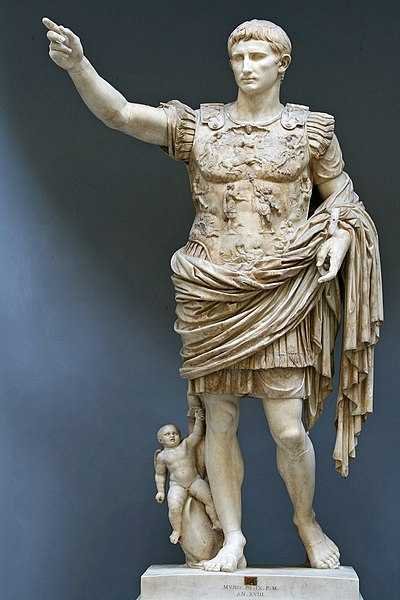
Augustus . The month of August was named after him (as July was for Caesar.) It had previously been called 'Sextillis'.
27 B.C.. It took him 17 years after his adopted step-father's assassination to secure his rule over Rome.
What name is given to the two centuries of largely unbroken world peace which Octavian ushered in? | Roman History, Part III
|
Pax Romana . It is Latin for 'Roman Peace', and was the longest time period without major wars in World History, until after WWII.
Tiberius. He was not Augustus' first choice as an heir, but the other choices had all died by the time Augustus died.
Pliny the Elder recommended placing a brassiere on one's head for what purpose? | Miscellanea Romana
|
Curing headaches. See A. Richlin, 'Pliny's Brassiere' in J. P. Hallett and M. B. Skinner, eds. 'Roman Sexualities' (1997), pp. 197-220.
Which Emperor was said to enjoy spending his leisure time alone catching flies and killing them with a sharp stylus? | Miscellanea Romana
|
Domitian. This story is recounted in Suetonius. For an explanation of this hobby, see D. Page. 'Two Things Which Occupied Domitian.' in J. P. Bews, I. C. Storey, and M. R. Boyne, eds. Celebratio (1998), 106-115.
Homer's Iliad. This is recounted by Pliny.
Sweaters. Trousers were worn especially by Gauls, as the Romans knew, and gloves and socks were worn by the Romans themselves when it was cold, as we find in numerous sources. As far as I know, there is no ancient evidence for sweaters.
Early Romans supposedly wore beards until barbers started coming to Rome from Sicily around 300 B.C. When did wearing beards become fashionable again? | Miscellanea Romana
|
In the early second century A.D., under the Emperor Hadrian. Hadrian, a great philhellene, started the beard-wearing trend.
Gades (near modern Cadiz, Spain). The dancing girls of Gades are mentioned by Martial among other authors.
Which author from the second century A.D. wrote a work involving an adventure-filled trip to the land across the Atlantic? | Miscellanea Romana
|
Lucian. This is Lucian's 'True Stories'.
Which poet recounts that he once had a wet dream as he stayed overnight at a villa near Trivicum during a trip to Brundisium? | Miscellanea Romana
|
Horace. Horace, Satires, 1.5.84-85.
The legend of Remus and Romulus. Remus and Romulus were the two twins who founded Rome in 753 BC according to a legend. They were sons of a Latin princess.
146 BC. Rome was at war with the Phoenicians between 264 BC and 146 BC. During this period Rome fought three wars (the Punic Wars) against Carthage. In effect, Carthage had been left extremely weak at the end of the second Punic War.
Pompeii. Pompeii perished when the nearby Mount Vesuvius erupted in 79AD.
|