FREE! Click here to
Join FunTrivia. Thousands of games, quizzes, and lots more!

Acts Bible Trivia Questions and Answers
Fun Facts & Interesting Information
Fun Trivia Question Usage
You are welcome to use the questions in this section for non-commerical purposes: quizzing friends/coworkers, classrooms, newsletters, trivia nights, events, etc. Questions may
not be used for websites or in apps, and may not be resold. You use the questions at your own risk, and FunTrivia is not responsible for errors, etc in the content.
Please
link to or
credit FunTrivia textually (http://www.funtrivia.com) if you use any of these questions. Thanks!
Visit our
Trivia Question Store to buy question packs for commercial or for-profit ventures.
1. Just before His Ascension into Heaven, Jesus promised a gift to his disciples, which they later received on the day of Pentecost. What was this gift?
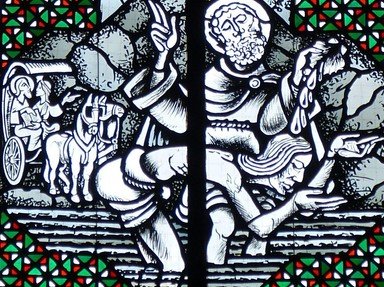
Answer: The power of the Holy Spirit
Interesting Information:"'But you will receive power when the Holy Spirit has come upon you; and you will be my witnesses in Jerusalem, in all Judea and Samaria, and to the ends of the earth.' When he had said this, as they were watching, he was lifted up, and a cloud took him out of their sight." (Acts 1:8-9 NRSV)
The second chapter describes the visiting of the Holy Spirit upon the apostles and followers who had gathered for Pentecost. For this reason, many denominations and Christian scholars consider Pentecost as the birth of the church. In Western liturgical calendars, the feast of Pentecost is observed fifty days after Easter.
Difficulty: Very Easy.
From Quiz: Let's Build a Church!
Some incorrect choices:
Immeasurable wealth, The ability to strike down their enemies, Knowledge of the future
2. In Acts 9, where was Saul coming from when the light came down from Heaven?
Answer: Jerusalem
Interesting Information:Saul went to the high priest in Jerusalem and asked for letters to the synagogues in Damascus so that if he found any Christians he could take them as prisoners. He then left Jerusalem and set out for Damascus. When he had almost reached Damascus the light came down and he heard Jesus speaking to him. This can be found in Acts 9:1-4.
Difficulty: Hard.
From Quiz: Blinded by the Light
Some incorrect choices:
Damascus, Ephesus, Corinth
3. Stephen is first mentioned in Acts 6:5 as one of seven men chosen to be disciples for the Grecian Jews as this group felt their widows were being overlooked in the daily distribution of food by the 12 Hebraic disciples. How is Stephen described?
Answer: Full of faith and of the Holy Spirit.
Interesting Information:The correct answer is Stephen was "a man full of faith and of the Holy Spirit." There is no disputing the fact he was the acknowledged leader among the Grecian Jews. For example, his name appears first when the names of seven Grecian disciples are listed. What's more, a major part of chapters 6 and 7 of Acts is devoted to Stephen. Out of the Grecian disciples, Philip is the only other one to be mentioned after the list of names is given in Acts. After Stephen's death, Philip rose to the forefront of the Group of Seven.
Difficulty: Easy.
From Quiz: Stephen -- First Recorded Martyr in Early Church
Some incorrect choices:
Lacking both faith and knowledge of God., Contrite, humble and very serious., Full of knowledge and exuberant.
4. Acts 3:1-2 tells of Peter and John going to the temple at the time of prayer -- three in the afternoon -- when they saw a crippled man being carried to the temple gate to beg for money. For how long had he been crippled?
Answer: Over 40 years
Interesting Information:It states in Acts 3:2 that the man was paralyzed from birth, although no further details are given in the chapter. However, Acts 4:22 states the crippled beggar was more than 40 years old. This is the first documented account of a specific miracle performed by the disciples in Acts, a chapter which documents the growth of the early church after the resurrection and ascension of Jesus. However, Acts 2:43 states "many wonders and miraculous signs were done by the apostles", but no further information is given.
Difficulty: Easy.
From Quiz: Peter, John and the Crippled Beggar
Some incorrect choices:
About five years, About ten years, Seven years and seven months
5. According to Acts 27:27, for how many days had Paul's ship been battered during a storm on the Mediterranean Sea?
Answer: 14
Interesting Information:Yes, Paul's ship was battered for 14 days, or two weeks. Scripture leaves no doubt the storm was severe. In Acts 27:18, it states the ship took "such a violent battering from the storm" the crew began to throw the cargo overboard. Acts 27:19-20 tells of the despair felt by the people on the ship: "On the third day, they threw the ship's tackle overboard with their own hands. When neither sun nor stars appeared for many days and the storm continued raging, we finally gave up all hope of being saved."
Difficulty: Average.
From Quiz: Move Aside Molly Brown, Make Way for Paul
Some incorrect choices:
3, 9, 77
6. Acts 15:22 tells of the council at Jerusalem appointing Silas and another man to go with Paul and Barnabas to present a special letter of instructions to Gentile believers in Antioch. What was the name of the other man?
Answer: Judas, called Barsabbas.
Interesting Information:The correct answer is Judas, called Barsabbas. Acts 15:29, in the NIV Bible, makes it clear the church council did not want to burden the Gentile believers with a long list of rules. The verse states "You are to abstain from food sacrificed to idols, from blood, from the meat of strangled animals and from sexual immorality. You will do well to avoid these things. Farewell." Verse 31 states the people who read the letter "were glad for its encouraging message." Verse 32 goes on to state Judas and Silas, "who themselves were prophets, said much to encourage and strengthen the brothers."
Difficulty: Hard.
From Quiz: Short Sketch of Scripture's 'Selfless Silas'
Some incorrect choices:
Luke the physician., Philip the disciple., Cornelius the centurion.
7. According to Acts 16:12, in what city were Paul and Silas when they were put in jail?
Answer: Philippi
Interesting Information:The correct answer is Philippi. Prior to their arrest, Paul had converted Lydia, believed by many to be the first Christian believer in Europe. Philippi was a city in eastern Macedonia and was abandoned in the 14th century during the Ottoman conquest, according to Wikipedia.
Difficulty: Hard.
From Quiz: Paul and Silas in Chains for the Gospel of Christ
Some incorrect choices:
Troas, Antioch, Rome
8. According to Acts 16: 11, in what city did the apostle Paul encounter Lydia?
Answer: Philippi
Interesting Information:The correct answer is Philippi, an ancient city in eastern Macedonia. Notes in the New King James Study Bible state "Philippi owes its name to Philip of Macedon (father of Alexander the Great) who took it from the Thracians and named it after himself." The notes go on to state Philippi was "strategically located on the east-west Egnatian Highway between Rome and Asia and served as a starting point for Alexander the Great when he began his military campaigns to conquer the world." According to Wikipedia, the modern day municipality of Filippoi is near the ruins of the ancient city.
Difficulty: Hard.
From Quiz: A Quick Look at the Conversion of Lydia
Some incorrect choices:
Antioch, Neapolis, Troas
9. The story of Eutychus is told in Acts 20: 7-12. Meanwhile, Acts 20: 6 tells where the apostle Paul was when this highly-unusual event took place. What's the name of the community?
Answer: Troas
Interesting Information:The correct answer is Troas. According to the Thompson Chain Reference Study Bible, Troas was a city 10 miles southwest of the ancient city of Troy in what is now present day Turkey. The ruins of Troas are known today as Eski Stamboul.
Difficulty: Easy.
From Quiz: Sleepy Eutychus Falls from Window and Dies
Some incorrect choices:
Rome, Jericho, Athens
10. The story of the Peter reviving Dorcas from the dead is told in Acts 9: 36-43. According to verse 36, in what community did Dorcas live?
Answer: Joppa
Interesting Information:The correct answer is Joppa. The community is now known as Jaffa and is part of Tel Aviv, on the Mediterranean Sea.
Difficulty: Easy.
From Quiz: Peter Revives 'Dead as a Door Nail' Dorcas
Some incorrect choices:
Rome, Athens, Antioch
11. According to Acts 10: 1, where did Cornelius live?
Answer: Caesarea
Interesting Information:The correct answer is Caesarea. It is an ancient city on the coast of the Mediterranean Sea, about 60 miles northwest of Jerusalem. It was the Roman capital of Judea.
Difficulty: Hard.
From Quiz: Cornelius: Minor Character, Major Impact
Some incorrect choices:
Antioch, Capernaum, Ephesus
12. The day of Pentecost is often described as the birth of the Christian Church. What is often forgotten is that, like the Passover, this was one of the three central feasts of the Jewish calendar. Pentecost comes how many days after Passover?
Answer: 50
Interesting Information:Pentecost is the Greek name for the Jewish Feast of Weeks, which celebrates the harvesting of barley. The Greek word from which Pentecost derives actually means fiftieth. Jesus had told the disciples to wait in Jerusalem for "in a few days you will be baptized with the Holy Spirit" (Acts 1 v. 5). On the day of the Pentecost festival, they were gathered together praying when the Holy Spirit was manifested in phenomena such as a mighty wind, tongues of fire and speaking in different languages (Acts 2 v. 1-4).
Difficulty: Hard.
From Quiz: Quizzing the New Testament : Acts
Some incorrect choices:
15, 135, 90
13. What is the first word of Acts (KJV)?
Answer: The
Interesting Information:It says in Acts 1:1, "The former treatise have I made, O Theophilus, of all that Jesus began both to do and teach."
Scholars are not 100% sure, but they believe that the book of Acts was written by Luke, the Physician who also wrote the book Luke, which is one of the four Gospels.
Difficulty: Hard.
From Quiz: What Were the Acts of the Apostles?
Some incorrect choices:
In, Paul, When
14. In Acts Chapter 13, the church at Antioch sent Paul and Barnabas off on a missionary journey to Asia Minor. They set sail from Seleucia and landed at a place called Salamis. On what island in the Mediterranean did they land?
Answer: Cyprus
Interesting Information:While the church at Antioch prayed and fasted, the Holy Spirit asked for Paul and Barnabas to be "set apart". After the church laid hands on the two missionaries, they set sail across the Mediterranean. On Cyprus they visited the town of Salamis and went to the synagogue to preach the good news of Jesus. (Acts 13:2-5)
Cyprus lies to the south of modern-day Turkey.
Difficulty: Hard.
From Quiz: Paul's Missionary Journeys
Some incorrect choices:
Crete, Rhodes, Corfu
15. Who was this book addressed to as found in Acts 1:1?
Answer: Theophilus
Interesting Information:The Gospel of Luke is also addressed to Theophilus. It means "one who loves God", and there has been some discussion whether this means it was directed toward a general audience, anyone who loves God, or a particular individual. Some put forth the theory that Theophilus was a patron or publisher. In any event, the address seems to show that the book of Acts was a sequel to the Gospel of Luke.
Difficulty: Average.
From Quiz: The Book of Acts
Some incorrect choices:
Caesar, Pilate, Peter
16. What Christian holiday does the holiday of Pentecost follow?
Answer: Easter
Interesting Information:Pentecost comes fifty days after Easter. Because it was time for the celebration of the first fruits to be harvested, a celebration was held. Pentecost is a holiday in Christianity and in Judaism, but in the latter it is often called Shavuot.
Difficulty: Easy.
From Quiz: The Day of Pentecost
Some incorrect choices:
Christmas, New Year's Day, Memorial Day
17. Whom does the Book of Acts record as preaching the first Gospel sermon?
Answer: Peter
Interesting Information:Peter, one of the Apostles, preached the first sermon. Since this was preached after Jesus ascended back into heaven, this sermon is noted as the sermon that launched the Christian faith. You can read about this in second chapter of Acts.
Difficulty: Hard.
From Quiz: Acts of the Apostles
Some incorrect choices:
John, Paul, Noah
18. To what city was Saul traveling when he was blinded by a great light?
Answer: Damascus
Interesting Information:Acts 9:1-4
Difficulty: Very Easy.
From Quiz: The Conversion of Saul
Some incorrect choices:
Philippi, Rome, Antioch of Pisidia
19. Who did the remaining eleven disciples choose to replace Judas Iscariot after his betrayal of Jesus?
Answer: Matthias
Interesting Information:"Then they prayed and said, 'Lord, you know everyone's heart. Show us which one of these two you have chosen to take the place in this ministry and apostleship from which Judas turned aside to go to his own place.' And they cast lots for them, and the lot fell on Matthias; and he was added to the eleven apostles." (Acts 1: 24-26 NRSV)
Matthias was chosen when the disciples, along with Mary and some of Jesus's other followers, gathered in Jerusalem to pray for God's guidance. Barnabas was a Levite who sold his land, donated the proceeds to the ministry, and chose to dedicate his life to the new church. Zebedee was the father of James and John.
Difficulty: Average.
From Quiz: Let's Build a Church!
Some incorrect choices:
Barnabas, Zebedee, No one was chosen
20. What time was it when the bright light came from Heaven and shone on Saul?
Answer: Noon
Interesting Information:While Paul (the name Saul was to take as a Christian) was on trial after his arrest in Jerusalem he told the court his story including his conversion. He said it was about noon and he was almost to Damascus when the light came from Heaven and he heard the voice of Jesus speaking to him. This can be found in Acts 22.
Difficulty: Hard.
From Quiz: Blinded by the Light
Some incorrect choices:
The ninth hour, The sixth hour, The third hour
21. Aeneas, a man who had been ill with palsy for eight years, was healed when a man simply spoke to him. Who was the person who told him, "Aeneas, Jesus Christ maketh thee whole; arise and make thy bed."? (King James Version)
Answer: Peter
Interesting Information:Peter was in a town called Lydda, just prior to going to the seacoast town of Joppa, on the Mediterranean Sea. The man Aeneas did as he was instructed in Acts 9:34 and arose immediately. People in Joppa had heard that Peter was "in the neighborhood", and sent for him to come because a woman in that town had died. When Peter arrived, he raised Tabitha (who was also called Dorcas), from the dead.
Difficulty: Hard.
From Quiz: BBB Bible Series: The Acts Of The Apostles
Some incorrect choices:
John, Paul, Jesus
22. After Philip started on his journey, Scripture says he met an Ethiopian eunuch, "an important official in charge of all the treasury" of the queen of the Ethiopians. According to Acts 8:27, what was the name of the queen?
Answer: Candace
Interesting Information:The correct answer is Candace. According to notes in the NIV Study Bible, "Candace was the traditional title of the queen mother, responsible for performing the secular duties of the reigning king, who was thought to be too sacred for such activities."
Difficulty: Average.
From Quiz: Philip and the Ethiopian Eunuch
Some incorrect choices:
Carmel, Casiphia, Claudia
23. According to Acts 6:6, what happened almost immediately after Stephen and the six other Grecian Jewish disciples were chosen?
Answer: The seven men were presented to the apostles, who prayed and laid their hands on them.
Interesting Information:The correct answer is the seven Grecian disciples were presented to the apostles, who prayed and laid their hands on them. At this point in time the early church consisted almost entirely of Jewish believers. The Grecian believers were those who were born in lands other than Palestine and spoke the Greek language, according to notes in the NIV Study Bible.
Difficulty: Hard.
From Quiz: Stephen -- First Recorded Martyr in Early Church
Some incorrect choices:
Scripture doesn't say., They were overcome by the Spirit of the Lord and started speaking in tongues., They became seriously ill and some of them almost died.
24. According to Acts 3:3, how did the crippled beggar react when he saw Peter and John about to enter the temple?
Answer: He asked them for money.
Interesting Information:The crippled beggar had only one thought on his mind when he saw Peter and John: he wanted money. Verse 3 states the man asked the two disciples for money and they responded by looking "straight at him" and asked the man to look at them. Verse 5 goes on to state: "So the man gave them his attention, expecting to get something from them." The beggar, however, would receive something much more valuable than money. He would soon be able to walk for the first time in his life.
Difficulty: Easy.
From Quiz: Peter, John and the Crippled Beggar
Some incorrect choices:
He started singing hymns of praise., He started screaming hysterically., He turned his head and refused to look at them.
25. During the storm, Scripture states an angel of God appeared before Paul. According to Acts 27:23, what did the angel tell him?
Answer: He must stand trial before Caesar and no one on the ship would perish.
Interesting Information:The correct answer is that the angel told Paul he must stand trial before Caesar and no one on the ship would perish. It's quite a prediction because verse 37 indicates there were 276 people on the ship. Surely not every single one was a skilled swimmer and, considering the severity of the storm, it would appear that even skilled swimmers wouldn't stand much of a chance of surviving in the storm-tossed waters.
Difficulty: Hard.
From Quiz: Move Aside Molly Brown, Make Way for Paul
Some incorrect choices:
He must stand trial before Caesar although most of the people on the ship would perish., He must accept the fact he is prone to trouble and learn from the experience., The storm was part of a grand design so he would not have to appear before Caesar.
26. According to Acts 12:4 (NIV), how many soldiers were assigned by Herod to guard Peter in prison?
Answer: Four squads of four soldiers each.
Interesting Information:It's abundantly apparent Herod wasn't taking any chances and was doing everything possible to prevent an escape by Peter. According to notes in the NIV Study Bible, four squads of four soldiers would result in one company of four soldiers for each of the four watches of the night.
Difficulty: Hard.
From Quiz: Peter's Miraculous Escape from Prison
Some incorrect choices:
Two squads of four soldiers each., Four soldiers working 12-hour shifts., Two soldiers and a centurion.
27. Acts 15:36-41 tells of Paul having a disagreement with Barnabas and deciding to take Silas with him on a missionary journey. Who did Barnabas want to go on the trip with Paul?
Answer: John, also called Mark
Interesting Information:The correct answer is John, also called Mark. Paul, however, wanted no part of having Mark go on the trip due to past experience. Acts 15:36-41, in the NIV Bible, states: "Some time later Paul said to Barnabas, 'Let us go back and visit the brothers in all the towns where we preached the word of the Lord and see how they are doing.' Barnabas wanted to take John, also called Mark, with them, but Paul did not think it wise to take him, because he had deserted them in Pamphylia and had not continued with them in the work.
They had such a sharp disagreement that they parted company. Barnabas took Mark and sailed for Cyprus, but Paul chose Silas and left, commended by the brothers to the grace of the Lord. He went through Syria and Cilicia, strengthening the churches." However, the fractured relationship between Paul and Mark was eventually healed. In 2 Timothy 4:11, Paul advises Timothy to bring Mark to him "because he is helpful to me in my ministry." 2 Timothy is believed to have been written not long before Paul was executed.
Difficulty: Easy.
From Quiz: Short Sketch of Scripture's 'Selfless Silas'
Some incorrect choices:
Luke the physician., Cornelius the centurion., Peter the disciple.
28. Paul and Silas were put in jail after they drove a spirit from a slave girl. Why did this lead to their arrest and imprisonment? (Acts 16:19)
Answer: She earned a great deal of money for her owners by fortune-telling. With the spirit driven out, she could no longer tell fortunes and the hope of making money was gone.
Interesting Information:The correct answer is the slave girl was no longer able to tell fortunes when the spirit was driven out and her owners were no longer able to make money from her. Specifics aren't given, but verse 16, in the NIV Bible, states she made a "great deal" of money for her owners by telling fortunes.
Difficulty: Average.
From Quiz: Paul and Silas in Chains for the Gospel of Christ
Some incorrect choices:
When the spirit left the girl she became paralyzed and was unable to speak. As a result, her owners could no longer have her working from them., With the spirit driven out, the slave girl was no longer obedient to her owners and they were livid., When the spirit left the girl, other demons inhabited her body and she ended up killing herself.
29. What did Lydia do for a living? (Acts 16: 14)
Answer: Was a dealer in purple cloth
Interesting Information:Lydia was a dealer in purple cloth. In Biblical times, the color purple was associated with royalty and kingship and was in demand by the elite. The production of purple cloth was a painstaking and tedious process and required thousands of shells from an ocean mollusk to make a couple yards of cloth, according to information from SermonCentral.com.
Difficulty: Very Easy.
From Quiz: A Quick Look at the Conversion of Lydia
Some incorrect choices:
Told fortunes of others, Was a dealer in sandals, Scripture doesn't say
30. According to Acts 20: 7, Paul and his group came together on the first day of the week for what common purpose?
Answer: To break bread.
Interesting Information:The correct answer is they came together to break bread. In a number of different Christian churches, bread is broken, or communion served, in remembrance of Jesus. Other terms include The Eucharist, Sacrament of the Table, the Blessed Sacrament, or The Lord's Supper.
Difficulty: Easy.
From Quiz: Sleepy Eutychus Falls from Window and Dies
Some incorrect choices:
To baptize members., To sit and gossip., To plan their next trip.
31. In addition to being a widow, Dorcas is described in verse 36 as being a disciple. In the same verse, it states Dorcas is the translation of another name. What was that name?
Answer: Tabitha
Interesting Information:The correct name is Tabitha. According to information on the Web, Tabitha is of Aramaic origin and means 'gazelle.'
Difficulty: Easy.
From Quiz: Peter Revives 'Dead as a Door Nail' Dorcas
Some incorrect choices:
Mary, Lydia, Priscilla
32. What was the occupation of Cornelius, as per Acts 10: 1?
Answer: Centurion
Interesting Information:The correct answer is centurion. Scripture states that he was a centurion in what was known as the Italian Regiment. As the name implies, a centurion was in charge of 100 soldiers. Cornelius is one of several centurions mentioned in Acts.
Difficulty: Easy.
From Quiz: Cornelius: Minor Character, Major Impact
Some incorrect choices:
Tax collector, Fisherman, Doctor
33. Cornelius was eagerly anticipating a visit from the apostle Peter. What actions did he take that might convince us of his sincerity and his earnest desire to hear from Peter, according to the 24th verse of the 10th chapter of Acts?
Answer: he invited his friends and relatives to come and meet Peter
Interesting Information:While Cornelius was waiting for Peter's arrival, he had assembled his relatives and neighbors at his home. No person who was merely casually expecting company would have gone to such great lengths in preparation. It was with faith that he was eagerly expecting Peter; he was not merely hoping that he would show up.
Difficulty: Hard.
From Quiz: A Look At Peter; A Look At Paul (Acts 10 and 19)
Some incorrect choices:
he prepared a pond for the baptism of his household, he killed a fatted calf to offer as a sacrifice to God, he prepared a great feast for Peter and his entourage
34. On Paphos on the same island in Acts 13, the missionaries met a man described as a magician and false prophet. His Greek name was Elymus. What was his surprising Jewish name?
Answer: Bar-Jesus
Interesting Information:"Bar-Jesus" meant that his father's name was Jesus. He was associated with the pro-consul Sergius Paulus but tried to prevent the official from listening to the Gospel. Paul described Elymus as "you enemy of all righteousness, full of all deceit and villainy" in Acts 13:10. Paul then called down temporary blindness on him and, at seeing the miracle, the pro-consul believed in Paul's message.
Difficulty: Average.
From Quiz: Paul's Missionary Journeys
Some incorrect choices:
Paulus, Eli-Abraham, Judas Joseph
35. Who took the office formerly held by Judas at the end of the first chapter of Acts?
Answer: Matthias
Interesting Information:After the Ascension and community prayer, Peter announced the need to have one replace Judas, quoting Scripture. Two men were put forward as qualified candidates, Matthias and Barsabbas. The group then prayed before casting lots, which fell to Matthias.
Difficulty: Average.
From Quiz: The Book of Acts
Some incorrect choices:
Barsabbas, Philip, Stephen
36. According to the Book of Acts, how many days after Jesus ascended into Heaven did the disciples celebrate Pentecost?
Answer: Ten
Interesting Information:The disciples were accompanied by Jesus' mother Mary and the other members of His family as they traveled to celebrate the Pentecostal feast. The celebration was held early in the morning at Mount Zion where Jesus celebrated his last supper. On that day, one hundred and twenty people were gathered in the room.
Difficulty: Hard.
From Quiz: The Day of Pentecost
Some incorrect choices:
Five, One, Three
37. Who was the first recorded Gentile who became a Christian?
Answer: Cornelius
Interesting Information:The conversion of Cornelius is recorded to show that this is in God's plan to redeem ALL mankind. Acts says that God's plan to save mankind was always meant for all human beings. After all, Genesis says we were all created in his image and we are ALL descendants of Adam and Eve. Please see the tenth chapter of Acts for this exciting story.
Difficulty: Average.
From Quiz: Acts of the Apostles
Some incorrect choices:
Adam, Mark, Caesar
38. What was the purpose of Saul's journey during which he was blinded by a great light?
Answer: To arrest and persecute Christians
Interesting Information:Acts 9:1-2
Difficulty: Very Easy.
From Quiz: The Conversion of Saul
Some incorrect choices:
To meet with the High Priest, To speak at the synagogue, To attend the School of Gamaliel
39. As Peter and John were entering the temple for prayer, a lame man asked them for money. What was their reaction?
Answer: Peter commanded the man to walk, and he was healed of his lameness
Interesting Information:"But Peter said, 'I have no silver or gold, but what I have I give you; in the name of Jesus Christ of Nazareth, stand up and walk.' And he took him by the right hand and raised him up; and immediately his feet and ankles were made strong." (Acts 3:6,7 NRSV)
When the three entered the temple, Peter spoke to the people and made sure that they knew that it was not him, but God, who had healed the lame beggar. He reminded them that they were the ones who had encouraged Pilate to crucify Jesus and free the murderer, but that by repenting, they would be healed of their wickedness, just as the beggar had been healed.
The Bible tells us that as a result of the healing of the lame man, about five thousand people became believers that day.
Difficulty: Very Easy.
From Quiz: Let's Build a Church!
Some incorrect choices:
John gave money to the beggar, The disciples sent him to Tabitha for help, They ignored the beggar's pleas, telling him that those who do not work should not eat
40. A young lady named Rhoda was visiting someone when Peter appeared at the door of the gate outside the house. Whose home was Rhoda visiting, according to Acts 12:12-17? (King James Version)
Answer: Mary, the mother of John Mark
Interesting Information:Peter had just been released from prison by... an angel. His crime? Believing in and speaking of Christ as the Messiah, or Saviour. Many people, not just Rhoda, were at the house, praying, and they were likely stunned and amazed when Peter arrived, knowing that the last they had heard, he was still in prison.
(John Mark is the author of the gospel of Mark, and this happened at his mother's home.)
Difficulty: Hard.
From Quiz: BBB Bible Series: The Acts Of The Apostles
Some incorrect choices:
Mary Magdalene, Mary, Martha and Lazarus, Mary, the mother of James and John
Please remember to credit FunTrivia.com, add links on your website or newsletters, or otherwise spread the word about our website. Thank you very much, and we hope these questions have been useful!
|