
|
|
|
Structure
Interesting Questions, Facts and Information
- There are a total of 30 general entries.
Special Topics
|
Interesting Questions, Facts, and Information
Australia
New South Wales. The name 'waratah' comes from the language of the Eora people, the traditional owners and caretakers of the Sydney region.
The species name of one state emblem was changed in 2002 to 'phalaenopsis' from the previous, and much more amusing, name 'bigibbum var. superbum'. The group of plants this emblem belongs to is infamous in horticultural circles for its frequent name changes and taxonomic splitting. Which state? | Australian Botany: The Floral Emblems
|
Queensland. The older name 'phalaenopsis' was reinstated for the Cooktown orchid by orchid botanists Mark Clements and David Jones in 2002. In 2005, the same botanists changed the genus name from the well known Dendrobium to their new genus Vappodes. Name changes for orchids are very common and often controversial.
Tasmania. The national floral emblem genus Acacia contains about a thousand Australian species. The genus of Tasmania's emblem, Eucalyptus, is runner-up with about 850 species.
the emblems of Australia, Queensland, New South Wales, and Western Australia. Golden wattle, the Cooktown orchid, the New South Wales waratah (Telopea speciosissima) and the red and green kangaroo paw are endemic to their regions: Australia, Queensland, New South Wales and Western Australia respectively. Tasmanian blue gum (Eucalyptus globulus), Victoria's emblem pink heath (Epacris impressa) and the royal bluebell are all found in at least two states/territories in the south-east, and both Sturt's desert pea and Sturt's desert rose are found in multiple arid-zone states and the Northern Territory.
Two-thirds of the Australian continent is arid or semi-arid land. The emblems of which regions grow naturally in the deserts of the continent's interior? | Australian Botany: The Floral Emblems
|
South Australia and the Northern Territory. Sturt's desert pea and Sturt's desert rose both grow widely through central Australia. Golden wattle's distribution approaches the arid zone, growing on the margins of semi-arid areas like the Eyre Peninsula, but doesn't quite make it. The rest are temperate species, except for the Cooktown orchid, which is tropical.
Some floral emblem species are related to commercial agricultural crops. The emblem of which state or territory belongs to the same genus as cotton? (Hint: cotton is also related to the genus Hibiscus.) | Australian Botany: The Floral Emblems
|
Northern Territory. Sturt's desert rose (Gossypium sturtianum) is the emblem of the Northern Territory. Gossypium hirsutum is the main species of cultivated cotton. The flowers of Sturt's desert rose indeed resemble small Hibiscus flowers.
South Australia. South Australia's emblem, Sturt's desert pea (Swainsona formosa), and the national emblem, golden wattle (Acacia pycnantha), are both legumes, belonging to the order Fabales. Legumes are characterised by their fruit: a single-chambered elongate pod. These two species belong to different families of legume though: Sturt's desert pea belongs to the family Fabaceae, and golden wattle to the Mimosaceae.
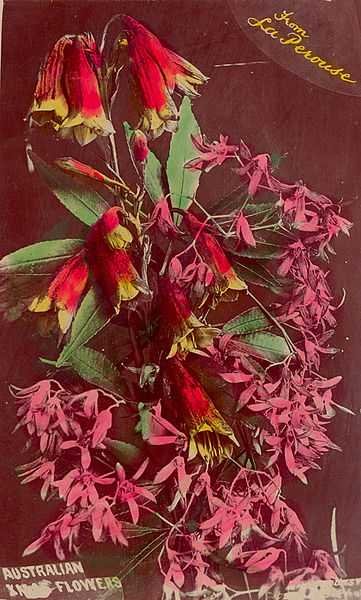
Queensland and Western Australia. Western Australia's emblem, the red and green kangaroo paw (Anigozanthos manglesii), and Queensland's, the Cooktown orchid (Vappodes phalaenopsis), are the only monocots. The Australian Capital Territory's emblem, the royal bluebell (Wahlenbergia gloriosa) is often mistaken for a monocot because of its herbaceous habit and slender leaves, but the five-petalled flowers are a giveaway that it is a dicot.
A common sight in the understorey of temperate forests and woodlands are native pea flowers, which comprise about five percent of all Australian plant species. The largest genus of Australian pea is Pultenaea. Most Pultenaea flowers are small and yellow with red or brown markings. What is their collective common name? | Australian Plants and Vegetation
|
egg and bacon. There are several native pea genera that have small yellow and red/brown flowers, similar to Pultenaea, including Dillwynia, Bossiaea, Daviesia and Gastrolobium (although none of them are called oranges and lemons, canaries, or sun peas). Most people find it difficult to tell the difference. Perhaps luckily for them, Australian taxonomists recently proposed that as many as 19 genera be lumped under the name Pultenaea, which would turn Pultenaea into the third largest genus in Australia.
One of the most biodiverse vegetation types in Australia is the Queensland wet tropical rainforest. Unlike most Australian forests, which are dominated by eucalypts, the rainforest canopy is made up of diverse genera, many affiliated with tropical species from southeast Asia. The wet tropics biome is patchily distributed over the landscape though, and is thought to have been much more extensive 50,000 or more years ago. Partly, the forest has been destroyed by land clearing since European invasion. But what is hypothesised by some to be the main reason for the rainforest's demise over the past 50,000 years? | Australian Plants and Vegetation
|
increased bushfires. Many of the sclerophyllous ('stiff-leaved') Australian plants that typify the Australian bush are fire-tolerant, and many even require regular bushfires to survive and reproduce. This includes the plants commonly found in eucalypt forests and woodlands - Eucalyptus itself, Acacia, Melaleuca, Leptospermum, many native peas, and Proteaceae genera such as Banksia and Grevillea. But most rainforest plants are susceptible to fire. Some scientists think that increased burning promoted by humans led to the retreat of rainforests in favour of sclerophyllous vegetation. Ironically, since Europeans have historically been heavily focused on preventing fires, vegetation types susceptible to fire are now increasing in area in some places on the continent, threatening existing patches of fire-tolerant vegetation.
swampy areas. Some swampy coastal regions, particularly in the Gulf of Carpentaria in northern Australia, are dominated by expanses of Melaleuca. The genus is very common in other wet places like river courses in tropical and temperate Australia too. Some species of paperbark have been introduced elsewhere in the world to dry up swamps. One such species, Melaleuca quinquenervia, has become a terrible weed in the Florida everglades in the USA.
This plant species is one of the most widespread eucalypts in Australia, common even in dry areas because it follows watercourses, and takes advantage of periodic flooding events. The Barmah-Millewa Forest on the Murray River is the largest forest of this species in the world. What is the common name of this plant? | Australian Plants and Vegetation
|
river red gum. The river red gum, Eucalyptus camaldulensis, is also one of the most widely grown plantation eucalypts in the world. In Australia, its wood is used for firewood and furniture making. Sadly, most of the unique floodplain red gum forests along the Murray and its tributaries are not well protected, and still face harvesting by firewood cutters and other threats, such as cattle grazing and a lack of natural flood regimes because of rivers being dammed.
The jarrah and marri forests of south-western Australia are famous worldwide for the spectacular wildflowers that grow in the understorey, and the south-west is one of the world's biodiversity hotspots. Unfortunately, these forests have been attacked in recent decades by a micro-organism which causes extensive dieback. The micro-organism is often spread from one location to another in the mud crusted on machinery used for road-making and logging. What is the little horror's scientific name? | Australian Plants and Vegetation
|
Phytophthora cinnamomi. Phytophthora cinnamomi has attacked vegetation on other continents too, as well as on island systems such as Hawaii. It is related to Phytophthora infestans, the pathogen that caused potato blight at the time of the Irish potato famine. Corymbia calophylla is the scientific name of the marri eucalypt, and Banksia brownii (feather-leaved banksia) and Xanthorrhoea preissii (balga or grasstree) are two Australian understorey species that are particularly susceptible to Phytophthora infestation.
The Great Victoria Desert is Australia's largest desert. It is a sandy desert, and some of the vegetation is scrubland dominated by mulga - a species complex belonging to the genus Acacia. But the more open areas are dominated by a distinctive hummock grass that typifies arid Australian vegetation. What is this type of grass commonly called? | Australian Plants and Vegetation
|
spinifex. Spinifex is a collective term for a number of species of grass in the genera Triodia and Plectrachne. Many urban people in Australia mistake tussock grasses for spinifex, but once you have seen a spinifex hummock, you will never make the same mistake again - they are very cute, making neat rounded or elongate hummocks, not messy tussock sprays. The cosmopolitan coastal grass belonging to the genus Spinifex is not a close relation, which makes the situation all the more confusing.
Shallow limestone soil and minimal precipitation prevent any trees from growing on the Nullarbor Plain on the southern coast of Australia. This extraordinary and magnificent ecosystem is dominated by shrubs of which plant genus? | Australian Plants and Vegetation
|
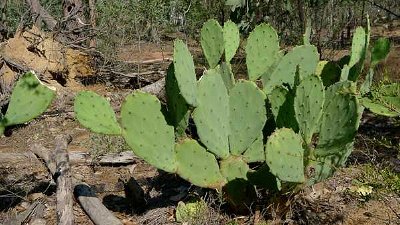
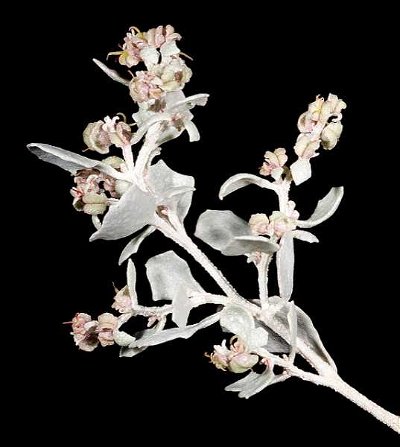
Atriplex (saltbush). Atriplex and other genera of the Chenopodiaceae family cover the Nullarbor. Atriplex nummularia, or old man saltbush, is a dominant feature because of its large size - the species can grow up to three metres tall and form clumps several metres across. One of the most spectacular chenopods on the Nullarbor is Maireana erioclada, whose fruits in spring are a bright magenta colour, and show up brightly against the blue-grey foliage. Artemisia and Opuntia are both common in North American deserts, and Artemisia is also common in South African arid areas, but they are not indigenous to Australian deserts. Leptospermum is generally a more temperate genus.
The tallest flowering plants in the world dominate the canopies in the wet tall forests of south-eastern Australia. The scientific name for this species of plant is Eucalyptus regnans. What is its common name? | Australian Plants and Vegetation
|
mountain ash. Mountain ash forests are common in Tasmania and in patches of Victoria. Some of the large expanses of vegetation destroyed in the Black Friday bushfires of 1939 were mountain ash forest. Though there are living mountain ash trees over 90 metres high, it is thought that the species is capable of growing even taller, surpassing the height of the world's tallest trees, Californian redwoods, but that the very tallest trees were destroyed after European settlement by logging or bushfires.
There are numerous varieties of another orchid found in Western Australia. Named for the creature they resemble, they are the ? | Western Australian Wildflowers
|
Spider orchid. Spider orchids belong to the Caladenia species. There are around 180 species found in Australia, including about 140 unique to Western Australia.
This next is not really a flower, but does flower occasionally usually after a fire. The early settlers gave it another name, but we know it botanically as various species of Xanthorrhea. What is its present common name ? | Western Australian Wildflowers
|
Grass tree. This amazing plant is found in the south of Western Australia, and grows very slowly at the rate of about one metre every hundred years. The indigenous people of Australia had numerous uses for this unusual plant.
In the Stirling Ranges, there are a number of varieties of "bell" flowers, including Cranbrook bell, pink mountain bell, and Gillam's bell. What is their botanical genus ? | Western Australian Wildflowers
|
Darwinia. The Cranbrook bell is botanically known as Darwinia meeboldii, the Gillam's bell as Darwinia oxyledis and the pink mountain bell as Darwinia squarrosa.
Kangaroo Paw. Wattle is the Australian floral emblem. The Sturt desert pea is the emblem of the Northern territory, while boronia is found in Western Australia, but is not the floral emblem. There are several types of kangaroo paw, but the floral emblem is the red & green kangaroo paw.
There are around 1500 different types of wildflowers found in the Stirling Ranges. In what part of Western Australia are these ranges found? | Western Australian Wildflowers
|
Great Southern. The Stirling Ranges are located in the Great Southern region of Western Australia, and of the 1500 or so varieties found here, 87 are unique to the area. The ranges are located north north east of Albany.
|