Quizzes at Fun Trivia Fun Trivia | quizzes Quizzes | games Games | community People | services Services | help Help | me Me
New Player - Log In
Currently 7873 players online.   Trivia games, quizzes, and contests - FREE !     Get Started! quiz register
Fun Trivia: A : Apollo Missions

Special Sub-Topic: Apollo 14


Apollo 14 experienced the first launch delay of the Apollo program.

    t. Apollo 14 experienced unsatisfactory weather conditions at the time of launch which resulted in a 40-minute delay. Commander Alan Shepard, Lunar Module Pilot Ed Mitchell, and Command Module Pilot Stuart Roosa lifted off on January 31, 1971.

When retrieving the Lunar Module from the S-IVB, how many attempts were necessary for the Command and Service Module to dock with the Lunar Module?
    6. Inflight examination of the docking probe revealed no problems. It is assumed that a piece of debris must have been preventing successful docking, or that the capture-latch assembly was not in the locked configuration during the first five attempts.

ESP experiments were conducted on Apollo 14.
    t. No one at NASA knew about it beforehand, but Ed Mitchell had made arrangements to "send" randomly selected symbols that he was concentrating on during his sleep period. Test subjects on earth would try to "receive" them. Due to the 40-minute launch delay, the people on earth were trying to "receive" forty minutes before Mitchell was "sending". A footnote in Andrew Chaikin's book "A Man On The Moon", states that, according to Mitchell, the test subjects were wrong more often than chance would dictate, that their subconscious minds knew that something wasn't right, and therefore the experiment was not a failure.

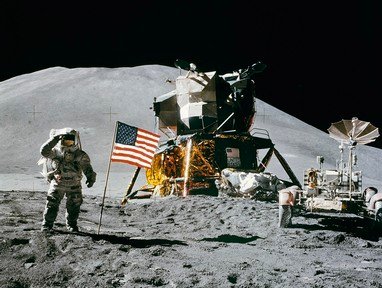
Apollo 14 was the first of two lunar landing missions to use the Modularized Equipment Transporter (MET).
    f. The MET was a two-wheeled cart, which weighed about 26 pounds, that was pulled by the astronaut. Tools, samples, and other equipment were carried in the MET. Apollos 15-17 used the Rover.

Apollo 14 was the first lunar landing mission to include which of these surface experiments?
    Active Seismic Experiment. Apollo 12 had performed Cold Cathode Ion Gauge, Suprathermal Ion Detector and Lunar Dust Detector Experiments. They had also performed Passive Seismic Experiments. The Active Seismic experiment used an astronaut-activated thumper device to generate seismic signals. Detectors, which were laid out on the surface, could measure the velocity of seismic waves.

During the second EVA of Apollo 14, what crater were the astronauts trying to find the rim of?
    Cone Crater. The climb proved steep, and Shepard and Mitchell had to take frequent rests. With time running out on the EVA, it was decided they wouldn't go any further and they took samples from where they were. As it turned out, they were only 20-30 meters south of the rim.

Who was on the backup crew that didn't get to fly an Apollo lunar mission?
    Joe Engle. The backup crew consisted of Gene Cernan, Joe Engle and Ron Evans. Normal rotation made them prime crew of Apollo 17. Jack Schmitt replaced Joe Engle on the prime crew of Apollo 17, because NASA was under pressure to put a scientist on the moon, and Apollo 17 was the last lunar landing mission. Joe Engle later flew on the Space Shuttle. Vance Brand was backup on Apollo 15, and flew the ASTP mission. William Pogue and Bruce McCandless were on the support crew of Apollo 14. Pogue flew on a Skylab mission and McCandless flew in the Shuttle program.

Who said, "That looked like a slice to me, Al", after Alan Shepard's second swing at the first golf ball barely connected?
    Fred Haise. Fred Haise was the landing and EVA-2 CapCom for Apollo 14. Bruce McCandless was the EVA-1 and LM launch CapCom, and Gordon Fullerton was the goodnight and wake-up CapCom. Alan Shepard took three swings to hit the first golf ball and one to hit the second. According to Al, they went for "miles and miles and miles".

How many pounds of lunar samples did Apollo 14 return?
    94 pounds. The lunar samples and the Command Module remained in quarantine until April 4, 1971. The crewman were in quarantine until February 27, 1971. This was the last Apollo crew to be quarantined.

Which was the recovery ship for Apollo 14?
    USS New Orleans. Splashdown occurred on February 9, 1971 in the Pacific Ocean.


Did you find these entries particularly interesting, or do you have comments / corrections to make? Let the author know!

  • Send the author a thank you or compliment
  • Submit a correction