Fun Trivia | Quizzes | Games | People | Services | Help | Me
Register - Log In
Sign up NOW for your free FunTrivia account. Compete, join teams, and meet people!
Index: N : New York

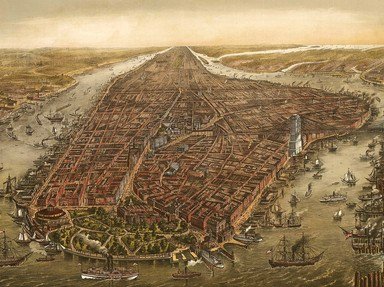
Special Sub-Topic: New York City History: Part 1


What major corporation colonized New York in 1624 and named it New Amsterdam?

    The Dutch West India Company. Five years after Henry Hudson stumbled upon it, the Dutch set up a bussiness post there to get a jump on England in opening up the West. The Ducth set the tone of the city by founding it to make money. They created the first real estate deal of NY by buying it from the Indians, using it to export beaver skins, spent most of the time drinking, and didn't even get around to building a church for 17 years.

Besides the natives, the Dutch were the first settlers of NY. (Actually most of them weren't Dutch, but French-speaking Huguenots from what is now Belgium). What was the next group to show up - in 1626?
    Africans. Eleven slaves from Angola were shipped in to help build the fort and stretch the former Indian trail "Breedaway" (now Broadway) up to Harlem. They also built the huge wall which Wall Street now stands.

The settlers named the island after an old Indian word "Manahatta." Which was to mean "island of hills" or ...?
    place of inebriation. That really stands true to this day as well. If you don't belive me, then just stand on Bleeker and Sullivan and watch for 10 minutes.

In 1647, he was sent in as new Director-General to lick the island into shape?
    Peter Stuyvesant. He made order out of chaos and ensured the city's future. He also, reluctantly, allowed anyone from any country in, as long as they were willing to work. Before he knew it, the city had become tremendously diverse in nationality, language, and religious belief.

What year was the Roshashana service held in New York, making it the first in North America?
    1654. Peter Stuyvesant petitioned the board directors not to allow Jews into New York. But the Dutch West India Company reminded him he was "running a business colony, not a religious establishment; and for the sake of that business no-one should be turned away." That's why I love New York.

When the English took over New Amsterdam, how many colonists took them up on the offer for a free passage home?
    0. Even the one man who did want to fight, Peter Stuyvesant, stayed and retired to what is now Greenich Village.

During the revolutionary war, the Battle for New York was fought mostly in Brooklyn. The Americans were losing badly, and George Washington was forced to sneak across the East River at night in complete silence to stay alive. How many soldiers did he have with him during this dangerous journey?
    10,000 - 12,000. That is why this move is so important. He could have lost the war that night. But this vast number of survivors, which could easily have been caught carried out this impossible task with such intense discipline, that they stayed alive to win another day.

What was the tallest structure in New York in 1776?
    Trinity Church. The church is still there. Well, it was burnt down in the great fire in 1776. And was again ruined in 1839. The third one was built in 1846 stands today - and is the resting place of the quintessential New Yorker, Alexander Hamilton.

What tough New Yorker created the stock exchange and allowed Thomas Jefferson to move the country's political capital from New York to Virginia (knowing fully New York would become the world capital of commerce, economics, culture and intellect)?
    Alexander Hamilton. He was the Secretary of the Treasury and started us on our path of commerce and maufacture, instead of slavery and plantations. He pushed the New York ideal on the government. Jefferson, on other hand, hated New York and urban ideals. Can you see the Civil War starting here?

What revolution in trading by the New York shipping company "The Black Ball Line" attracted bussiness from all over the world to Manhattan?
    regular scheduled departures. Full or not, this company's ships sailed, and business from around the world flocked to Manhattan to trade with and invest in America.


Did you find these entries particularly interesting, or do you have comments / corrections to make? Let the author know!

  • Send the author a thank you or compliment
  • Submit a correction