FREE! Click here to Join FunTrivia. Thousands of games, quizzes, and lots more!
Quiz about The Strategy of Titanium

The Strategy of Titanium Trivia Quiz


If iron is the metal of the present, then titanium is the metal of the future. Take this quiz to find out more about this "strategic metal". Good luck and have fun! Original quiz by namastheg, adopted by MotherGoose.
This is a renovated/adopted version of an old quiz by author namastheg

A multiple-choice quiz by MotherGoose. Estimated time: 3 mins.
  1. Home
  2. »
  3. Quizzes
  4. »
  5. Science Trivia
  6. »
  7. Chemistry
  8. »
  9. Specific Elements

Author
MotherGoose
Time
3 mins
Type
Multiple Choice
Quiz #
123,690
Updated
Jun 11 26
# Qns
10
Difficulty
Easy
Avg Score
9 / 10
Plays
27
Last 3 plays: Rizeeve (10/10), Guest 98 (6/10), masfon (10/10).
- -
Question 1 of 10
1. The density of pure water is 1 gram per cubic centimetre. Titanium is a light-weight metal. What is its density? Hint


Question 2 of 10
2. Who is credited with the discovery of titanium in 1791? Hint


Question 3 of 10
3. Titanium is well-known for its applications in areas of medicine, shipping aeronautics and the military but it also is a surprising inclusion in many everyday consumer products. Which of the following is *NOT* an example of its everyday use? Hint


Question 4 of 10
4. Which famous building is clad in over 33,000 paper-thin sheets of titanium? Hint


Question 5 of 10
5. Titanium is a metal with a periodic table number of 22. What type of metal is it? Hint


Question 6 of 10
6. Titanium is mostly obtained from its chief ore - rutile. In what form does titanium exist in this ore? Hint


Question 7 of 10
7. With which metal is titanium most commonly alloyed? Hint


Question 8 of 10
8. Titanium is used in the manufacture of propeller shafts and some other parts of ships and marine equipment. Which property is made use of here? Hint


Question 9 of 10
9. What term describes the revolutionary biological process where living bone tissue bonds with a titanium implant? Hint


Question 10 of 10
10. Titanium has been given many sobriquets, including "wonder metal", "strategic metal", and "the metal of the future". Why is this? Hint


(Optional) Create a Free FunTrivia ID to save the points you are about to earn:

arrow Select a User ID:
arrow Choose a Password:
arrow Your Email:


Most Recent Scores
Today : Rizeeve: 10/10
Today : Guest 98: 6/10
Today : masfon: 10/10
Today : Jdoerr: 8/10
Today : chrisatlas: 6/10
Today : thomas1975: 6/10
Today : Guest 146: 5/10
Today : elfharry: 6/10
Today : japh: 10/10

Quiz Answer Key and Fun Facts
1. The density of pure water is 1 gram per cubic centimetre. Titanium is a light-weight metal. What is its density?

Answer: 4.5 g/cc

Titanium is one of the lowest density metals - only lithium, potassium, magnesium and aluminium are lower in density. Titanium is also one of the strongest metals in terms of tensile strength, second only to tungsten. Tungsten, however, is very brittle. Titanium is prized for having the highest "strength to weight ratio" of any commonly used structural metal.

It offers the same strength as many heavy-duty steels but weighs about 45% less, has higher tensile strength and can handle greater stress and impact without bending or deforming.

This makes them the industry standard for aerospace and military applications.
2. Who is credited with the discovery of titanium in 1791?

Answer: Reverend William Gregor

William Gregor was an English vicar and amateur "rockhound" (a hobbyist who studies rocks and minerals). He discovered titanium in 1791. While looking at black sand in a riverbed in Cornwall, England, he noticed the sand was magnetic and contained an unidentified white metallic oxide, which led him to discover the element we now know as titanium, although he named it "menaccanite" after the local village, Manaccan. Four years later, unaware of Gregor's find, German chemist Martin Heinrich Klaproth identified the same metal oxide while analyzing the mineral rutile.

He named it titanium after the Titans of ancient Greek mythology.
3. Titanium is well-known for its applications in areas of medicine, shipping aeronautics and the military but it also is a surprising inclusion in many everyday consumer products. Which of the following is *NOT* an example of its everyday use?

Answer: cotton clothing

Titanium is a "secret ingredient" in just about everything we use and consume because of its biocompatibility, non-toxicity, optical brightness and other properties. It is in processed foods, sweets, chocolate, cosmetics, toiletries, sunscreen, chewing gum, toothpaste, clothing, jewellery, cookware and paint. Titanium is added to these products in the form of titanium dioxide, a naturally occurring mineral.

Fabric made entirely from plant fibers, such as cotton, is unlikely to contain
titanium but it is used in the production of synthetic fibres. It is an essential additive introduced during the fiber-making process to deluster the fabric (reduce or remove the shine) and prevent static.

Fresh fruits, vegetables, lean meats, and whole grains do not usually contain titanium but processed foods almost always do. Titanium is used as an anti-caking agent and to whiten items like frostings, icing, sweets, icing sugar, and non-dairy creamers.

In fact, it was extremely difficult to come up with an example of an everyday consumer product that doesn't contain titanium.
4. Which famous building is clad in over 33,000 paper-thin sheets of titanium?

Answer: the Guggenheim Museum (Bilbao, Spain)

The Guggenheim Museum in Balbao, Spain, is clad with glass, limestone and over 33,000 paper-thin sheets of titanium, approximately 0.39 mm thick (about 1/64th of an inch) arranged like the scales of a fish.

The architect, Frank Gehry, chose titanium because of its high strength to weight ratio, its ability to catch and reflect light, and its ability to withstand extreme weather conditions. It was also lucky for him that a huge supply of Russian titanium hit the market at that time and its price actually dropped below that of stainless steel.

The incorrect answer options are also metal-clad buildings but they are clad in stainless steel, not titanium.
5. Titanium is a metal with a periodic table number of 22. What type of metal is it?

Answer: transition metal

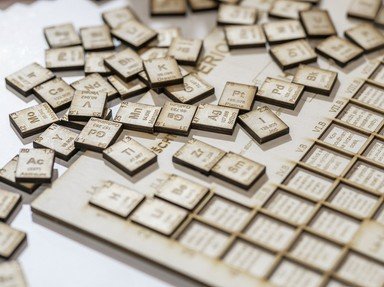
Titanium is a transition metal. Transition metals are the largest group of elements in the periodic table. They are called transition metals because they are located in the middle of the periodic table, transitioning between the highly reactive alkali metals on the left hand side of the table and the less reactive basic metals and non-metals on the right hand side.

As well as titanium, transition metals include iron, copper, zinc, gold and silver. Titanium is located in Group 4 (the fourth column) and Period 4 (the fourth row) of the periodic table.
6. Titanium is mostly obtained from its chief ore - rutile. In what form does titanium exist in this ore?

Answer: titanium dioxide

Rutile typically contains 92% to 95% titanium dioxide (TiO2). The ore is concentrated to increase the percentage of TiO2. Then it is crushed and mixed with carbon and heated to around 800 deg. Celsius (1400 deg. Fahrenheit) in a special type of furnace. Chlorine is passed through the furnace and titanium tetrachloride (TiCl4) is obtained.

This is then reduced using magnesium or similar elements. The metal obtained is called 'sponge titanium' and is then purifed by a special electro-thermo-chemical process called the 'Van Arkel Process'.
7. With which metal is titanium most commonly alloyed?

Answer: aluminium

All of the answers are metals that titanium can be alloyed with but the most common is aluminium. The most common titanium alloy consists of 90% titanium, 6% aluminum, 4% vanadium, and traces of iron and oxygen. It is commonly abbreviated to Ti-6Al-4V and accounts for over 50% of global titanium usage.

NB: Canadians and Americans say aluminum but the rest of the English-speaking world says aluminium. Aluminium is the preferred spelling according to IUPAC (International Union of Pure and Applied Chemistry). IUPAC is the global authority that standardises chemical names, symbols, classification and measurements.
8. Titanium is used in the manufacture of propeller shafts and some other parts of ships and marine equipment. Which property is made use of here?

Answer: Resistance to corrosion

Titanium is remarkably resistant to corrosion. Iron starts rusting and copper, aluminium and zinc will corrode when exposed to moist air. This is not the case with titanium so it is very useful in the manufacture of marine equipment, propeller shafts and some other parts of ships. Because of its lack of reactivity, it is used in chemical industries and in chemical plants to make storage tanks. Because of its high melting point, it is used to make jet engines and in nuclear reactors.
9. What term describes the revolutionary biological process where living bone tissue bonds with a titanium implant?

Answer: osseo-integration

In 1952, Per-Ingvar Branemark, a Swedish orthopaedic surgeon, accidentally discovered that titanium fuses with bone. He was studying blood flow in the legs of rabbits, using titanium chambers inserted into their femurs. When he tried to remove them later, he found the bone had fused with the metal, making it impossible to remove the chambers.

He named this process osseointegration. "Osseo" is derived from the Latin "osseus" meaning bone or bony. Because of this property, as well as its non-toxicity, titanium is now the leading component of most medical and dental implants.
10. Titanium has been given many sobriquets, including "wonder metal", "strategic metal", and "the metal of the future". Why is this?

Answer: Because of its special properties and uses

It is because of its properties and uses, such as its high strength-to-weight ratio, its exceptional resistance to corrosion and its biocompatibility. Titanium is not highly lustrous compared to other metals such as silver, platinum, gold and copper. Nor is it that rare. On the contrary, it is the ninth most abundant metal in the Earth's crust.

At present though, it is somewhat expensive but extraction technology is improving and titanium's price is likely to reduce so that it will doubtless become as common a metal as iron and aluminium.
Source: Author MotherGoose

This quiz was reviewed by FunTrivia editor rossian before going online.
Any errors found in FunTrivia content are routinely corrected through our feedback system.
6/11/2026, Copyright 2026 FunTrivia, Inc. - Report an Error / Contact Us