Pick the genuine cricket terms while ignoring the figments of my imagination.
There are 15 correct entries. Get 3 incorrect and the game ends.
Bad jutting Round folly JubliesStrasvinsky technique Boundary cutter Strike rate King pair Jamming the bat Tail-ender Square leg CrackerboxOff spin Gully Googly Follow on Silly mid-on Overthrows Golden duck Duckworth-Lewis method Dot ball Bails Sundries
Left click to select the correct answers. Right click if using a keyboard to cross out things you know are incorrect to help you narrow things down.
Cricket terminology is truly delightful. To the experienced, these unique terms allow us to quickly communicate the action and state of the game. To the uninitiated, it can sound like absolute nonsense. So much so that I had no trouble (and a lot of fun) coming up with my own gibberish to distract from the real terms.
For those curious about what it all means:
"Off spin" is a type of spin bowling where a right-arm bowler imparts spin with their fingers as they release the ball, causing it to deviate from left to right when it bounces. It is a counterpart to the less common "left-arm orthodox" which achieves spin in the opposite direction with the same technique using the left arm. "Leg spin" is a different type of spin where a right-arm bowler imparts spin with their wrist as they release the ball, causing it to deviate from right to left when it bounces. Its opposite-arm counterpart is "left-arm unorthodox".
A "googly" is a ball bowled by a right-arm leg spin bowler with the opposite spin to what is expected (left to right instead of right to left). It is also called a wrong 'un in Australia, as featured in the title of this quiz. Skilled batters can often pick a googly before it's even left the bowler's hand as it requires an altered wrist action, however it can be very effective at bamboozling less skilled batters.
"Square leg" is a fielding position in line with the batter perpendicular to the line the bowl is bowled in, on the "leg/on side" (the side the batter's legs are positioned on, as opposed to the "off side" on the side of the bat). It is also where a "square leg umpire" stands, as it is an ideal vantage point to judge run outs, stumpings, and high no-balls.
"Silly mid-on" is a fielding position that derives from two terms. "Mid-on" refers to a sector of the field from the batter towards the boundary on the leg side in front of the batter. "Silly" is a modifier meaning 'very close to the batter', so-named because of the danger of doing so. Fielders in this position are well placed to catch shots that have popped up off the bat, particularly from spin bowling. However, they don't have much time to react and dodge the shot if it is hit with force in their direction. Thus they will typically wear a helmet and extra padding for protection.
"Gully" is a fielding position behind the batter, almost square to the batter on the off side of the batter. They are in perfect position to catch a thick edge where the ball skims off the outside of the bat.
A "tail-ender" is a player who bats towards the end of the batting order (the "tail-end", typically in positions 8 to 11 (there are 11 players in a cricket team). They tend to be specialist bowlers with poor batting skills compared to the rest of the team. They usually get out with a low score, but can sometimes score more runs than the higher order batters, and when they do it is sometimes said that the "tail wagged".
A statistic called "strike rate" exists for both batters and bowlers. For batters, strike rate is the number of runs scored per 100 balls. For bowlers, it is the number of balls bowled per wicket (each time they get a batter out). Strike rates are particularly important in formats of the game with a limited number of balls bowled.
"Sundries" is an Australian term for "extras" - runs scored by the batting team but not attributed to the batter facing the ball. This may be due to a "no-ball" (illegal bowling action), "wide" (ball delivered too far from the batter for them to hit it), "bye" (run(s) taken by the batter despite not hitting or touching the ball at all), "leg-bye" (run(s) taken by the batter after it hits their body but not their bat or glove), and "penalty runs" where umpires add runs after the fielding team breaches one of the Laws of the game.
A "duck" is when a batter gets out with a score of 0 runs. It becomes a "golden duck" when a batter gets out on the first ball they face. It is the most feared fate for batters in a single innings (perhaps aside from a "diamond duck", where they are run out without even facing a single ball).
A "king pair" is two golden ducks in a single match by the same player. This is perhaps the worst fate for batters (it has happened, on a number of occasions, but is rare).
The "Duckworth-Lewis Method" is a mathematical method to determine a target score for the team batting second when rain or other circumstances delay the game and limit the number of balls able to be played. It allows a more fair comparison of scores achieved by teams who have faced a different number of balls.
"Overthrows" are runs scored after the ball is thrown back from the outfield to the centre but not collected by the fielding team, allowing the batters to run again as the ball runs back into the outfield. It most commonly occurs when the fielding team attempts to run out a batter by throwing the ball at the stumps with no one behind the stumps to collect the ball if it misses.
A "dot ball" is a ball bowled where no runs are scored. It is so-named because dot balls are typically recorded in the score book as a single dot rather than a "0" to save time.
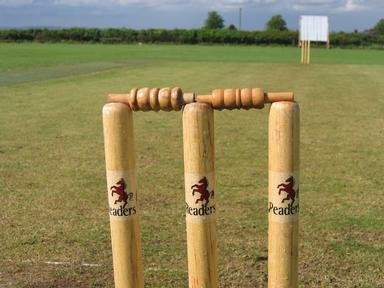
"Bails" are two small sticks placed on top of the three stumps (collectively called the "wicket"). When they are removed from the stumps, the wicket is considered broken. This is used to determine if a batter is out by being bowled, stumped, run out, or hitting the wicket.
A "follow on" is where a team that batted second is forced to also bat third (usually one team will bat first and third and the other second and fourth). This occurs if they are too far behind at the end of the first two innings of the match (at least 200 runs in a 5 day game) and the opposition decides to send them in to bat again, though it is not compulsory for them to impose this.
This quiz was reviewed by FunTrivia editor gtho4 before going online.
Any errors found in FunTrivia content are routinely corrected through our feedback system.