FREE! Click here to Join FunTrivia. Thousands of games, quizzes, and lots more!
It Is What It Is, and It Is What It Isn't Quiz
Extinct or Not?
Six pairs of closely related, vertebrate animals are listed below. Six of them are living species (IS) in the 2020s while the other six are recently extinct ones (ISN'T). Can you place each of these creatures in the correct box?
A classification quiz
by LadyNym.
Estimated time: 3 mins.
Also known as the Asiatic wild ass, the onager (Equus hemionus) is a native of the deserts, steppes and grasslands of Asia. Its specific name means half-donkey (mule) in Greek, while onager means wild donkey in the same language. The onager has six recognized subspecies, two of which (the Syrian wild ass and the European wild ass) are extinct; two of the extant species are endangered and two are classified as Near Threatened. The largest of the remaining onager populations inhabits the Gobi Desert in Mongolia.
The onager is a smallish equid, the size of a pony. Its coat is reddish-brown with a white-edged black stripe down the back. It is also one of the fastest mammals, capable of reaching a speed of 64-70 km/h (40-43 mph). Like other wild equids, the onager is difficult to tame and quickly retaliates by kicking and biting if attacked. Because of that, the Romans named a torsion-powered siege weapon after this feisty wild donkey.
2. quagga
Answer: isn't
The quagga (Equus quagga quagga) was a subspecies of the plains zebra (Equus quagga), though in the past it was believed to be a separate species. This equid was endemic to South Africa, where it inhabited the arid Karoo region of the Cape Province and the southern part of the Orange Free State. Unlike in other zebras, its stripes were limited to the front part of the body, while its hindquarters were mostly brown like those of a horse. As the quagga was found south of the Tropic of Capricorn, it also had a thicker winter coat that the animal shed every year.
Often depicted in cave art by the indigenous San people of Southern Africa, the quagga was hunted extensively for its meat and skins by European settlers from their arrival in the 16th century. By the 1850s, the quagga had disappeared from much of its range; the last known wild individual died in 1878. Various specimens of this zebra subspecies were held by European zoos: a mare held by London Zoo was photographed several times between 1863 and 1870. The last captive quagga, held at the Artis Zoo in Amsterdam, died in 1883. In recent times, the Quagga Project has been developed in South Africa to create a population of zebras resembling the quagga with a view to reintroducing them into the wild.
3. Indian leopard
Answer: is
The Indian leopard (Panthera pardus fusca) is one of the seven living subspecies of leopard and the most abundant in Asia, with nearly 14,000 individuals estimated to live in India alone. The subspecies is also found in Nepal, Bhutan, parts of Pakistan and southern Tibet, where it occurs in forested habitats as well as grasslands. The Indian leopard is somewhat smaller than other subspecies, particularly the rare Persian leopard. Melanistic individuals, known as black panthers, are relatively frequent, especially in dense forests where a dark coat gives predators an advantage.
Classified by IUCN as Near Threatened (2022), the Indian leopard is hunted for its beautiful fur and other body parts. It is also threatened by habitat loss and fragmentation. Indian leopards tend to avoid habitats where tigers are common, which often drives them close to human settlements, leading to conflict with humans. Leopards are often killed in retaliation for livestock predation; man-eating leopards are rare, though attacks do occur.
4. Caspian tiger
Answer: isn't
The Caspian tiger was a population of Panthera tigris tigris native to parts of West, Central and East Asia, in particular the region around the Caspian Sea. Though not as large as the Siberian tiger, it was, on average, larger than the Bengal tiger and had particularly thick fur, especially during the winter. In fact, modern zoologists believe that Caspian and Siberian tigers were once a single contiguous population until the Industrial Revolution, when they became isolated from each other due to habitat fragmentation.
In the 20th century, Caspian tigers were protected in some parts of their range, such as Iran and the former Soviet Union. However, the damage done to the population by overhunting, natural disasters and disease, as well as habitat loss due to desertification (as Caspian tigers favoured habitats close to water sources) eventually led to gradual extinction. The last known sightings of Caspian tigers in the wild occurred in Tajikistan and Afghanistan in the 1990s. The population was assessed as Extinct by IUCN in 2003.
5. hyacinth macaw
Answer: is
The hyacinth macaw (Anodorhyncus hyacinthinus) is the largest species of flying parrot, a member of the tribe Arini (the New World parrots) of the family Psittacidae, which includes macaws and parakeets. It is a striking bird, over 1 m (about 40 in) long, with a wingspan of up to 1.2 m (47 in); its plumage is a stunning shade of blue, with bright yellow areas around the eyes and below its strong, hooked beak. The hyacinth macaw is native to South America, where it is found primarily in three areas: the Amazon basin, the vast wetland region of the Pantanal, and the cerrado (tropical savanna) of the interior of Brazil. It feeds mostly on nuts and seeds, which it can easily crack with its powerful beak, as well as fruits and other plant matter.
Though protected in Bolivia and Brazil, the hyacinth macaw is classified by IUCN as Vulnerable (2025), as the species' numbers in the wild are decreasing. The biggest threat to this magnificent parrot is habitat loss, in particular the introduction of cattle ranching and plantations in its native range. Because of their striking appearance, these birds are also highly sought after as cage birds - even if they are not recommended for inexperienced bird keepers. Birds taken from their natural environment are vulnerable to disease and other factors when in captivity, and mortality is very high.
6. Carolina parakeet
Answer: isn't
Also known as Carolina conure, the Carolina parakeet (Conuropsis carolinensis) was a member of the tribe Arini of the family Psittacidae, the neotropical (New World) parrots. It was one of three parrot species native to the US and the only one indigenous to the central and eastern states of the country. The Carolina parakeet was a small, colourful bird, with a green body, bright yellow head, orange face and pale pink beak. These birds lived in huge flocks of over 300 individuals, nesting in trees and feeding on seeds, fruits, flower buds and occasionally insects.
Though Carolina parakeets are thought to have once been abundant throughout their range, their decline started as early as the 19th century because of the clearing of deciduous forests in the east and south of the US. By the turn of the 20th century, they were only found in the swampy areas of central Florida, where the last wild specimen was killed in 1904. The last captive Carolina parakeet died ten years later in Cincinnati Zoo. The species' final extinction occurred so quickly that its mechanics remain somewhat of a mystery. Along with habitat loss, hunting is also believed to have played a role in the extinction, which was officially declared in 1939.
7. Atlantic puffin
Answer: is
The Atlantic puffin (Fratercula arctica) belongs to the family Alcidae of the order Charadriiformes, which mostly includes birds that live near water. Because of its distinctive appearance - a sturdy, black and white body, large, orange and black bill and webbed orange feet - it is occasionally referred to as sea parrot or clown of the sea. Though it looks clumsy on land, the Atlantic puffin is an excellent flyer and diver. It feeds primarily on fish: its beak, which turns duller in colour during the winter, is hinged in such a way as to allow the bird to hold multiple small fish at a time.
As both its common name and specific name suggest, the Atlantic puffin is native to the northern Atlantic Ocean and is mainly found in colder regions, where it nests on rocky islands. It is estimated that about 60% of the world's Atlantic puffins live in Iceland. Though this bird has a wide distribution and its populations are still relatively large, its numbers have been declining, especially in Europe, due to pollution, predation by introduced species such as rats, and the effects of climate change. For this reason, the species is classified by IUCN as Vulnerable (2018).
8. great auk
Answer: isn't
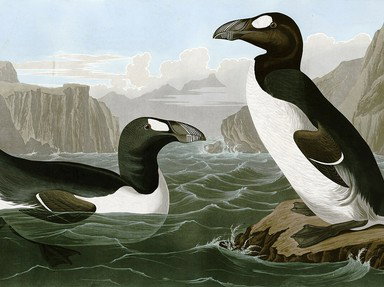
Depicted in the cover photo (an illustration by famous American artist and ornithologist John J. Audubon), the great auk (Pinguinus impennis) was the only flightless member of the family Alcidae. Despite its generic name, it was not related to penguins - which, in fact, were named for their resemblance to this seabird. One of the largest members of its family and the order Charadriiformes, the great auk had a black back and white belly, with short wings and legs and a heavy, hooked black beak. Like all members of the family Alcidae, the great auk was native to the Northern Hemisphere, where it nested and bred on remote islands of the North Atlantic. Although found as far south as northern Spain, it usually lived in colder coastal waters, where it could find plentiful fish to feed on.
Hunted for centuries for their meat and eggs, great auks are believed to have once numbered millions of individuals throughout their range. However, when Europeans started hunting them for their down feathers (used to make pillows), these numbers were drastically reduced. To make matters worse, their eggs and skins were also considered highly collectible by wealthy Europeans. By the 1830s, only one colony of great auks was left on a small island off the coast of Iceland. The last accepted sighting of a live bird occurred in 1852 in Newfoundland; later sightings are believed to have been hoaxes.
9. alligator snapping turtle
Answer: is
The alligator snapping turtle (Macrochelys temminckii) belongs to the family Chelidrydae of the order Testudines, which includes turtles and tortoises. This reptile, endemic to the US, is the largest freshwater turtle in North America and one of the world's heaviest, with some very large specimens weighing over 100 kg (220 lb). It owes its common name to its extremely powerful jaws and heavily ridged carapace, reminiscent of the rough skin of an alligator. The alligator snapping turtle inhabits bodies of freshwater in the southeastern US, in particular rivers that flow into the Gulf of Mexico. Though mainly carnivorous, it also feeds on a wide variety of plants in the wild. Like other turtles and tortoises, this species is long-lived and believed to be capable of reaching 200 years of age.
The alligator snapping turtle is classified by IUCN as Endangered (2023), as its numbers have declined sharply due to habitat destruction overharvesting for its meat, and the exotic pet trade. Though potentially dangerous for its bite force and only suitable for experienced keepers who know how to handle it, this turtle is popular as a pet and has become an invasive species in various parts of Europe.
10. Pinta giant tortoise
Answer: isn't
The Pinta Island giant tortoise (Chelonoidis niger abingdoni) was one of the 15 subspecies of the Galápagos giant tortoise (Chelonoidis niger) endemic to Pinta (Abingdon) Island, one of the islands in the Pacific archipelago visited by Charles Darwin in 1835. The existence of this tortoise was unknown until the late 18th century; the animal was first described in 1877 by British herpetologist Albert Günther. Like the other subspecies of the Galápagos tortoise, the Pinta Island tortoise was a large animal, which could reach a weight of over 400 kg (882 lb). It was herbivorous, drank a lot of water that was stored in its body for later use, and spent most of the day resting.
The Pinta giant tortoise is one of three extinct subspecies of the Galápagos tortoise; all extant ones are endangered. Population decline began around the 17th century because of visits to the islands by buccaneers and whalers, who hunted these animals for their meat. The arrival of goats on the island in the late 1950 caused much damage to the habitat, depriving the tortoises of food. Though the goat population was subsequently eradicated, it was not enough to save the tortoises. The last known individual of this subspecies, a male known as Lonesome George, died of natural causes on 24 June 2012. He was estimated to be 101 or 102 years old. His taxidermied body is on display at Galápagos National Park, a UNESCO World Heritage Site.
11. beluga sturgeon
Answer: is
The world's largest freshwater fish and one of the largest species of bony fish, the beluga sturgeon (Huso huso) is a member of the family Acipenseridae of the order Acipenseriformes. Its common name comes from the Russian word for "white", referring to its pale flanks and belly. It is a massive fish, with an elongated body and very large head; a distinguishing feature are the scutes (bony plates) that replace scales on the fish's upper body. Beluga sturgeon can grow as long as 7 m (23 ft) and weigh over 1,500 kg (3.307 lb) - though there are claims of even bigger specimens, which is not unlikely, as this fish tends to be long-lived. Females are typically larger than males.
The beluga sturgeon is anadromous (migrating from the sea to fresh water to spawn); its presence is now limited to the Black Sea and Caspian Sea basins. Knowing that this fish is the source of one of the world's most expensive delicacies - the prized roe known as caviar - it will not come as a surprise that the species is classified by IUCN as Critically Endangered (2019). Even though the species is protected, poaching, pollution and habitat disruption pose a serious challenge to the survival of this iconic fish, despite
12. Chinese paddlefish
Answer: isn't
Paddlefish belong to the family Polyodontidae of the order Acipenseriformes, which also includes the family Acipenseridae (the sturgeons). Of this family's eight species, six died out in prehistoric times. Now only the American paddlefish (Polyodon spathula) remains, as the Chinese paddlefish (Psephurus gladius) went extinct in very recent times. This species was considerably larger than its American relative, reaching lengths of about 4 m (13 ft) and weighing up to 500 kg (1,100 lb). Its skeleton was largely made of cartilage; its most distinctive feature was the elongated rostrum, which allowed the fish to detect prey in murky water. The Chinese paddlefish was native to the Yangtze River basin, though its presence was also recorded in the Yellow River basin.
Although overfishing contributed to the Chinese paddlefish's disappearance, the main cause of its extinction was the construction of the Gezhouba Dam in the Chinese province of Hubei. The dam, which became operational in 1981, split the fish population in two, preventing those that lived downstream from migrating upriver to spawn. The last two sightings of Chinese paddlefish occurred in 2002 and 2003. The species was officially declared extinct by IUCN in 2022.
This quiz was reviewed by FunTrivia editor rossian before going online.
Any errors found in FunTrivia content are routinely corrected through our feedback system.