Last 3 plays: Guest 101 (4/10), mandy2 (10/10), miner8265 (8/10).
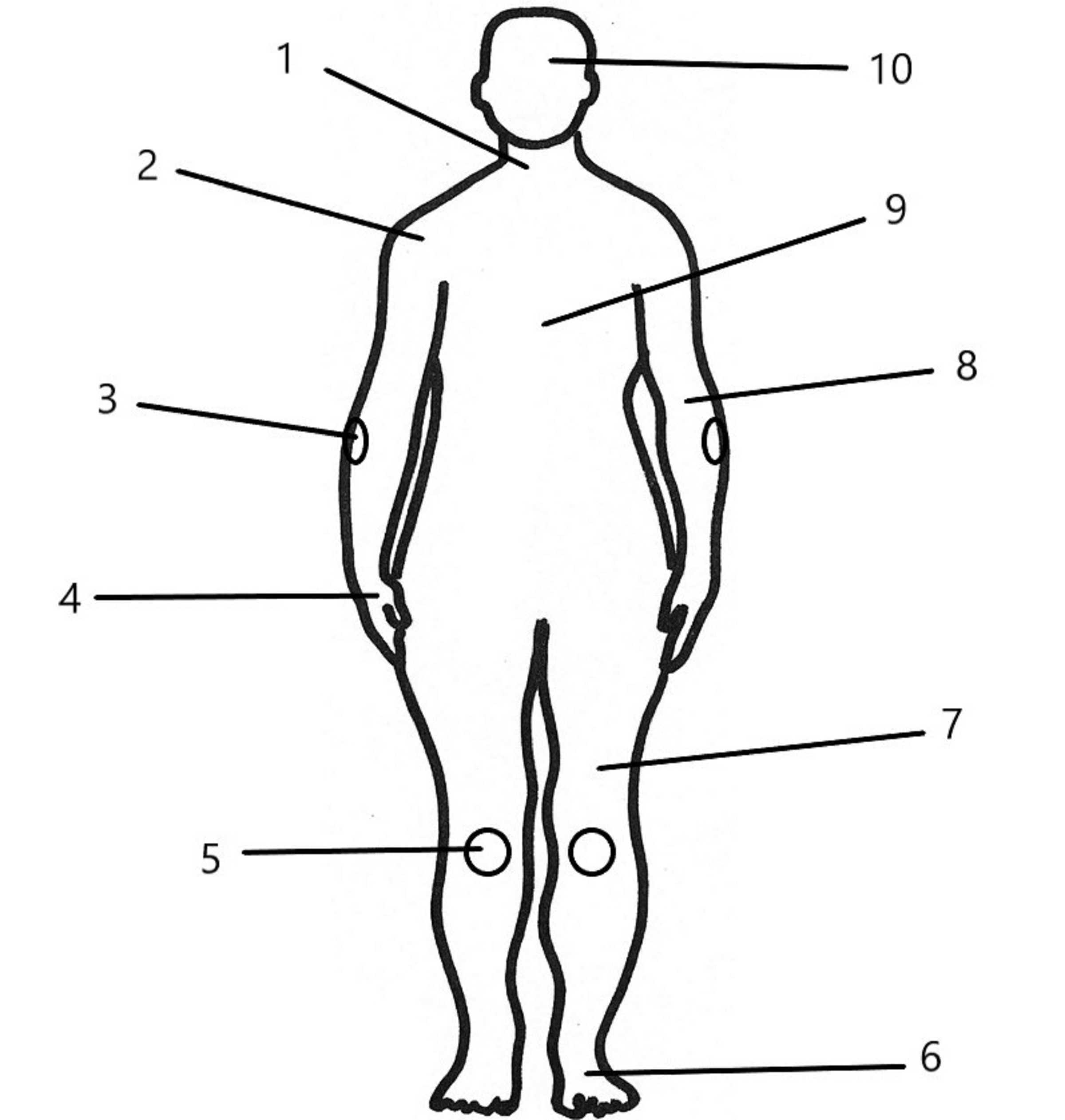
Label the body with the name of the body part in French. Bonne chance!
Click on image to zoom
GenouCoudeCouTêteJambePoitrineBrasMainPiedÉpaule* Drag / drop or click on the choices above to move them to the answer list. View Image Attributions for This Quiz
The neck is a very important bridge that connects your head to the rest of your body. It is filled with strong muscles and bones that allow you to look up at the clouds, down at your shoes, or side to side when you are crossing the street. Inside your neck, there are also tubes that help you breathe air and swallow your favourite snacks, while also providing blood for your brain to work. Since it supports your heavy head all day long, it is important to keep your neck flexible and strong so you can move easily.
2. Épaule
L'épaule bouge quand je lance le ballon.
Your shoulder is a special kind of joint called a ball-and-socket joint, giving it the flexibility to move in all different directions. It connects your arm, the limb that makes us useful, to your torso and allows you to reach high up on a shelf, throw a ball, lift a suitcase, or give someone a big hug. It is one of the most flexible parts of your body! When you carry a backpack to school, your shoulders do the heavy lifting to help you move your books around. These shoulders are essential for almost every move your arms make.
3. Coude
Aïe! Je me suis cogné le coude contre le mur.
The elbow is the handy joint in the middle of your arm. Just like the hinge on a door, it allows your arm to fold and unfold so you can bring food to your mouth or scratch the top of your head. Maybe you want to pretend to be a monkey? Without your elbows, your arms would stay straight, making it very hard to get dressed or play an instrument. It is a bony spot that stays tough, though it can feel quite funny if you accidentally hit your "funny bone" on a table or a chair!
4. Main
Je tiens mon crayon dans ma main.
Your hand is one of the most talented parts of your body. With five fingers, including our opposable thumb, and a palm, it can do everything from writing a story to playing a piano, perhaps giving a high five or building a tall tower of blocks. Hands are very sensitive, they're the masters of the sense of touch. They help you feel if something is hot, cold, soft, or prickly. Your thumb is extra special because it helps you grip objects tightly, like a pencil or a baseball bat. We humans use our hands to communicate, create art, and show kindness by holding hands with others.
5. Genou
J'ai mal au genou. Je suis tombé de vélo, ouf!
The knee is the largest joint in your body. It allows you to bend your leg so you can sit down, stand back up, crouch, or tuck your legs in for a cannonball jump into a pool. Since it supports so much of your weight when you move, it has a special bone to protect it called a kneecap. Knees are very important for balance, helping you stay steady while you are standing on one foot or running fast. They are also one of the first body parts to get scraped if you fall. Don't worry, they heal quickly.
6. Pied
Je porte une chaussure bleue sur mon pied.
Your foot is a masterpiece of evolution that helps you stay balanced and upright. Even though they are at the very bottom of your body, they have quite a few small bones that work together to absorb the shock of every step you take or keep your balance while you stand in place. Your toes help you grip the ground, which is especially useful when you are walking barefoot on sand or grass. To protect our feet and keep them warm, we often wear socks and shoes, or even boots, but I love when it's warm and I can break out my sandals!
7. Jambe
Je marche sur le chemin avec mes jambes.
Your legs are the powerful pistons that propel you wherever you want to go. They are home to the largest muscle groups in your body. They give you the strength to dance, run, jump, stand, and climb stairs. Whether you are walking to the park or pedalling a bicycle, your legs are doing the hard work of moving your weight. They are built to be very sturdy, but they are also flexible so you can sit cross-legged on the floor or stretch out during a long sports game.
8. Bras
Mon bras est long et fort.
Your arm is a wonderful body part that helps you interact with everything around you. It is made up of several parts, including the upper arm and the forearm, which work together to help you lift, pull, and push. Without your arms, it would be very difficult to climb a jungle gym, swim in the pool, hold a baby, or paddle a canoe. They are powered by strong muscles that get even tougher when you play sports or help out with chores. Your arms give you the reach you need to explore your environment.
9. Poitrine
Ma poitrine se gonfle quand je respire.
The chest is like a protective cage made of ribs (that are both strong and flexible) that keeps your most vital organs safe. Inside this sturdy area, you will find your heart and your lungs working hard every single second of the day. When you take a giant breath, you can feel your chest expand as your lungs fill up with air. It is a very strong part of your body that provides a solid frame for your shoulders and arms. Keeping your chest upright helps you breathe better and stand tall and confident.
10. Tête
La tête tourne pour regarder le monde.
The head is like the control tower for your whole body. It holds your brain, which does all your thinking, and it is also home to four of your main senses: sight, hearing, smell, and taste. Your skull is a very hard bone that acts like a helmet to keep everything inside safe. Whether you are nodding "yes" to a friend or wearing a cozy and warm hat in the winter, your head is a very important part of your body. It is perched right on top of your neck so you can turn and see the world.
This quiz was reviewed by FunTrivia editor looney_tunes before going online.
Any errors found in FunTrivia content are routinely corrected through our feedback system.