FREE! Click here to Join FunTrivia. Thousands of games, quizzes, and lots more!
Quiz about Imagine Theres No Heaven

Imagine There's No Heaven Trivia Quiz

An Introduction to Non-Religion

Inspired by John Lennon's classic song "Imagine", let's explore some of the fundamentals of the rich, yet often misunderstood and maligned, world of non-religion. This quiz was written for the 2026 "Dreaming of Peace" author challenge.

by patrickk. Estimated time: 5 mins.
  1. Home
  2. »
  3. Quizzes
  4. »
  5. Religion Trivia
  6. »
  7. Atheism and Agnosticism

Author
patrickk
Time
5 mins
Type
Quiz #
424,494
Updated
Jun 16 26
# Qns
15
Difficulty
New Game
Avg Score
12 / 15
Plays
9
Last 3 plays: ceetee (12/15), Taltarzac (11/15), Cymruambyth (13/15).
Non-religion, also called , is a broad umbrella term encompassing a range of viewpoints related to the or rejection of religious belief or practices.

First we have - broadly speaking, this is the absence of belief in the existence of gods or deities. There is a form where there is an absence of belief in gods but no clear assertion that there are none, and a form where there is an explicit belief that no gods exist. There is also some overlap with , the position that the truth or untruth of the existence of gods is unknowable, and thus no claim to belief or disbelief is made. All forms of these positions feature an absence of belief in gods, but differ in the extent to which they accept or reject the possibility of their existence.

Next we have , which is more than the absence of belief in gods - it is a direct opposition to religion and its byproducts. Though its exact meaning varies, this can include opposition to organised religion, religious practices and . Some nations through history have adopted this as an official position, most notably the with its ideology of Marxism-Leninism and state atheism. This contrasts with the principle of , which aims to separate religious institutions and practices from the civil affairs of the state, but does not seek to eliminate or act in opposition to religion entirely.

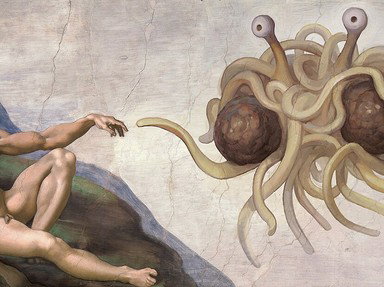
Some choose to lampoon religion through the psuedo-religious movement of , also known as the Church of the Flying Spaghetti Monster. This is an open satire of religion that serves many functions in highlighting some of the idiosyncrasies of organised religion and religious thinking, and the special consideration and exemptions that religious organisations take advantage of. There is also the phenomenon of , originating when email chains led hundreds of thousands of people to record their religion as that of the quasi-religious order of knights from the "Star Wars" franchise during the 2001 censuses in , New Zealand and the United Kingdom. This joke or protest answer is now a regular feature in censuses taken across the world.

People of all walks of life across Earth have come to hold these types of views. Many come to a non-religious position early in their childhood, never feeling compelled into religious belief. Others lose faith or renounce their religion later in life, perhaps through self-introspection and/or exposure to the ideas of philosophers and thought leaders. Leaving a religion is called , which is often used as a pejorative term by those remaining in the religion. Many people will not disclose their non-belief due to fear of stigma and from their family and community. Regardless, non-religious views are common and most people are likely to know someone with such views, even if they are not open about it.
Your Options
[apostasy] [strong] [secularism] [irreligion] [absence] [Pastafarianism] [religious institutions] [antireligion] [weak] [atheism] [agnosticism] [Australia] [Soviet Union] [Jediism] [excommunication]

Click or drag the options above to the spaces in the text.


Most Recent Scores
Today : ceetee: 12/15
Today : Taltarzac: 11/15
Today : Cymruambyth: 13/15
Today : thomas1975: 15/15
Today : SueLane: 15/15
Today : bernie73: 13/15
Today : DavidD13: 12/15
Today : xchasbox: 9/15
Jun 16 2026 : WesleyCrusher: 15/15

Quiz Answer Key and Fun Facts
Answer:

Non-religion in its various forms has existed since antiquity, and very likely originated at the same time that religious thinking emerged in the evolving early hominid brain. As we saw in the main text, non-religion is not a monolith, but rather a broad set of perspectives and philosophies loosely linked by a common thread of challenging the religious orthodoxy present through most of history.

Historically, the majority of people have been religious or spiritual in one way or another. Until recently, most empires, kingdoms, and institutions of power have had implicit or explicit religious undertones. Even scientific discovery and exploration were traditionally paid for and conducted by religious people and institutions. Thus scientific and philosophical ideas that challenged religious orthodoxy were often punished severely, sometimes setting back the advancement of human knowledge by centuries.

Numerous arguments have been developed that challenge various aspects of religion and superstition, some of which pose significant challenges to religious apologists. Many scientific theories have been developed over the centuries to explain phenomena previously only attributable to divine intervention, with evolution by natural selection and the Big Bang model of the origin of the universe being prime examples. This has lessened the need for religious explanations in our everyday lives. Of course, there are some counter-arguments in support of religion and the existence of gods that still give non-religious people some pause for consideration.

Non-religion appears to have grown substantially over the 20th and 21st centuries, though exact data is often difficult to interpret due to the wide variety of positions that are captured by the term. The increasing abundance of scientific and "rational" explanations for phenomena is likely one factor, as is the increase in access to information via books, audiovisual media, formal education, and now the internet. Higher levels of education correlate with higher levels of non-religion, with the encouragement and development of critical thinking giving people the tools to challenge religious ideas. Increasing individualisation and loss of trust in institutions may drive people to more loose and unaffiliated belief systems, which they may record as "non-religion" despite still holding superstitious or quasi-religious beliefs. Finally, an increase in awareness of non-religion, and a reduction in the stigma associated with it, has removed some of the social cost and isolation of coming out as non-religious in a religion dominated family or community.

Sadly, non-religious people still face persecution and mistrust in many areas of the world. The fallacious belief that non-religious people lack morality is still prevalent, and a failure to espouse religious belief can be a significant impediment in certain areas of public life, particularly in the United States of America and theocracies around the world. On the flip side, prominent non-religious figures are often overly aggressive in their advocacy, treating religious people with unnecessary disdain and arrogance. Sometimes even well-meaning criticism of religious institutions can unwittingly come across as a personal attack on their adherents. A lack of understanding, listening, and empathy on both sides can lead to a vicious cycle where both parties become further entrenched in their worldviews.

This quiz was written for the 2026 "Dreaming of Peace" author challenge. The title is taken from the first line of the classic 1971 song "Imagine" by John Lennon. It is probably the most hauntingly beautiful song I know. It is not an anti-religious song, but Lennon challenges us to do away with the hateful division we often see justified along the lines of religion, country, and possessions. Though his vision is strikingly simple, with each passing decade I grow less optimistic that anything resembling it will ever be reflected in the world we all share. My hope is that whatever our creed or lack thereof, we can all treat our fellow humans with dignity and respect, live and let live, and make the world a place for everyone to flourish.
Source: Author patrickk

This quiz was reviewed by FunTrivia editor looney_tunes before going online.
Any errors found in FunTrivia content are routinely corrected through our feedback system.
6/17/2026, Copyright 2026 FunTrivia, Inc. - Report an Error / Contact Us