FREE! Click here to Join FunTrivia. Thousands of games, quizzes, and lots more!
Quiz about Popes Places of Birth

Popes' Places of Birth Trivia Quiz


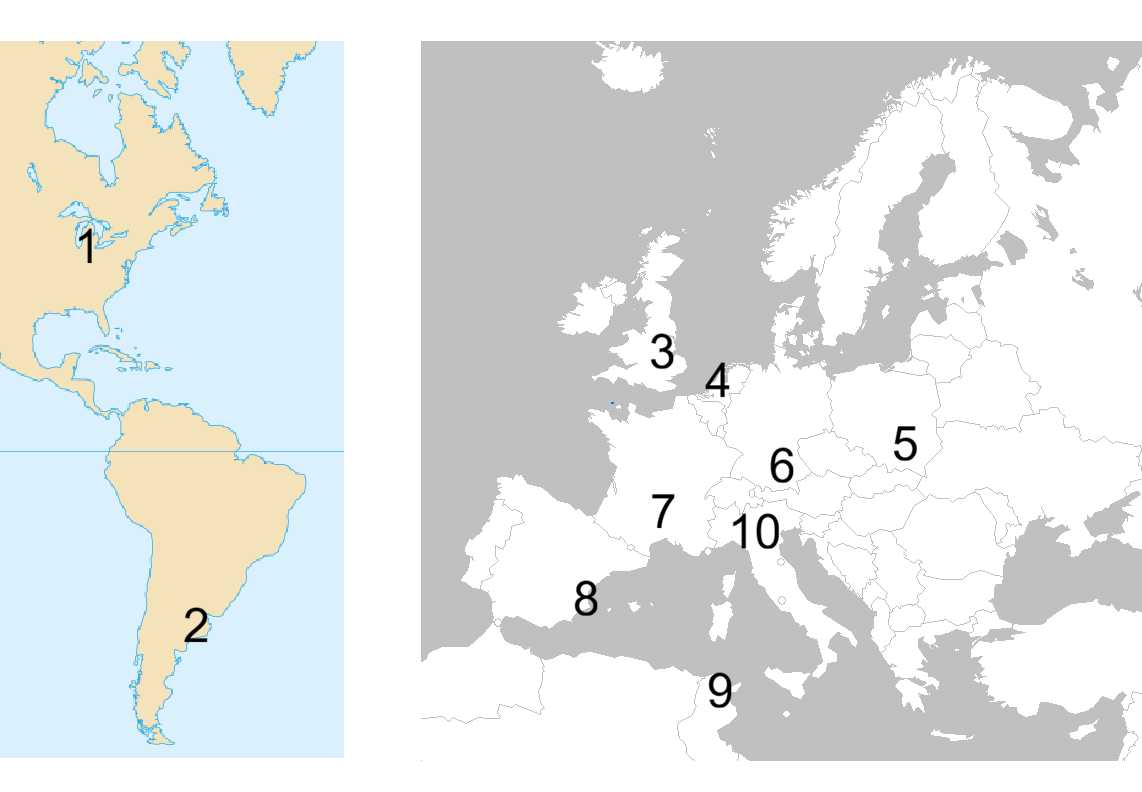
While the majority of the popes of the Roman Catholic Church have been Italian by birth, there are a number of other countries which claim that honour. Can you locate the birth place of these ten popes? Birth names are included with papal names.

A label quiz by looney_tunes. Estimated time: 3 mins.
  1. Home
  2. »
  3. Quizzes
  4. »
  5. Religion Trivia
  6. »
  7. Christian People / Saints
  8. »
  9. Popes

Author
looney_tunes
Time
3 mins
Type
Label Quiz
Quiz #
424,397
Updated
Jun 07 26
# Qns
10
Difficulty
New Game
Plays
6
Last 3 plays: rivenproctor (10/10), mulligas (7/10), Dorsetmaid (10/10).
While the map has current countries outlined, these do not necessarily reflect the historical name for the site. Locations are as close as possible (sometimes from incomplete records) to the site of each pope's birth.
Click on image to zoom
Alexander VI (Roderic Llançol i de Borja) Gregory XI (Pierre Roger de Beaufort) Benedict XVI (Joseph Alois Ratzinger) Adrian IV (Nicholas Breakspear) Adrian VI (Adriaan Florensz Boeyens) John XXIII (Angelo Giuseppe Roncalli) Militiades (Melchiades the African) John Paul II (Karol Józef Wojty?a) Leo XIV (Robert Francis Prevost) Francis I (Jorge Mario Bergoglio)
* Drag / drop or click on the choices above to move them to the answer list.
View Image Attributions for This Quiz
1.   
2.   
3.   
4.   
5.   
6.   
7.   
8.   
9.   
10.   

Most Recent Scores
Today : rivenproctor: 10/10
Today : mulligas: 7/10
Today : Dorsetmaid: 10/10
Today : CAPugLuvr: 10/10
Today : harley74: 4/10
Today : dmaxst: 8/10

Quiz Answer Key and Fun Facts
1. Leo XIV (Robert Francis Prevost)

Our pilgrimage to visit the places where various popes of the Roman Catholic Church were born begins with the most recent pope, one of only two born in the Americas. Born 14 September 1955 in Chicago, Robert Francis Prevost was raised in a family that was very active in their local church, and was eighth grade when he decided to focus his aspiration to the priesthood into specifically joining the Augustinians. After graduating from St Augustine Seminary High School, he earned a BSc in Mathematics at Villanova University (an Augustinian university located in suburban Philadelphia), where contemporaries recall him as being extraordinarily community-spirited. This was followed by formal entry into the Augustinians, then a return to Chicago to complete a Master of Divinity while teaching high school physics and maths.

In 1985 he joined the Augustinian mission in Peru, teaching canon law while holding various administrative posts. He returned to Chicago on his election as Prior Provincial in 1998, then served as the (global) Prior General from 2001 until 2013. In 2015 he was appointed Bishop of the diocese of Chiclayo, in northern Peru. Prior to taking up that position, he became a naturalized Peruvian citizen. A decade of work there was highlighted by a growing friendship with Pope Francis I, the man he was to succeed. When he was elected to the papacy in 2025, he set a number of 'firsts': first pope from the Order of Saint Augustine, first pope from North America, first pope with Peruvian citizenship, first pope born after World War II. And quite possibly the first Chicago White Sox fan in the position.
2. Francis I (Jorge Mario Bergoglio)

If this quiz had been written before 2013, there would have been no need to include North and South America on the maps - all previous popes had come either from Europe or from a region of Africa or Asia that bordered the Mediterranean Sea. Jorge Mario Bergoglio was born in Buenos Aires in 1936, to a family of Italian origin - his father migrated in 1929, and his mother's family also came from northern Italy. At the age of 21 he was inspired to begin training as a Jesuit priest, and finished that training in 1973. He was appointed as Auxiliary Bishop of Buenos Aires in 1992, becoming the Archbishop of Buenos Aires in 1998. This was the position he held in 2013, when he was elected to be the 266th Pope (according to most numerations; there are divided opinions about this numbering).

Pope Francis was the first pope from Latin America, as well as being the first Jesuit to be elected to the position. He took his papal name as a tribute to St Francis of Assisi, marking his commitment to caring for the poor. He explicitly stated his admiration in his book 'On Heaven and Earth', published in 2011: "He brought to Christianity an idea of poverty against the luxury, pride, vanity of the civil and ecclesiastical powers of the time. He changed history."
3. Adrian IV (Nicholas Breakspear)

Nicholas Breakspear (or Brekespear - spelling was not consistent in the 12th century) was born around 1100CE, somewhere in Hertfordshire, probably near St Albans. As he came from an obscure family, little is known of his early life - and what is recorded may well be mythologised in the writings of clerics in the St Albans abbey, the first of which were written 30 years after his death. He appears to have travelled to France to get an education, becoming abbot of the Abbey of Saint-Ruf in Avignon. Pope Eugenius III appointed him as Cardinal-Bishop of Albano (a region close to Rome), and sent him to Scandinavia as a papal legate in 1152. On returning to Rome, he discovered that his patron, and also his successor Anastasius IV, had died, and the College of Cardinals was looking for a new pope.

On election to the papacy in 1154, he assumed the name of Adrian (or Hadrian) IV, and became the first (and until 2025 the only) pope from a predominantly English-speaking background. The name may have been a tribute to Adrian I, who had been instrumental in the establishment of the Abbey of St Albans as a significant ecclesiastical venue. Unlike most popes of the time, he did not need to be consecrated as a bishop (the official title of the pope being Bishop of Rome), having already reached that position. The political situation at the time was more than a little dicey - Adrian was not accepted by the commune that ran Rome, and he was in conflict with both the Holy Roman Emperor Frederick I and King William of Sicily. Things were still not settled when he died in 1159, and had a significant impact on the election of his successor. A member of the Sicilian faction was elected Pope Alexander III, while the Emperor's supporters elected Victor IV, usually designated as an anti-pope, a status he had also held under Innocent II for a few months in 1138.
4. Adrian VI (Adriaan Florensz Boeyens)

The election of Adriaan Boeyens as Adrian VI in 1522 marked the first time a Dutchman was pope, and the last time the pope was a non-Italian for over 450 years, until the appointment of John Paul II in 1978. He was born in Utrecht, then part of the Holy Roman Empire, in 1459, and studied at the University of Leuven, where he became rector before being appointed as tutor to the future Holy Roman Emperor Charles V in 1507. In 1516 Charles, as King of Castile and Aragon, appointed him Bishop of Tortosa, and Grand Inquisitor of the kingdom.

The death of Pope Leo X in 1522 saw Adrian elected as a compromise candidate when the Spanish and French factions could not otherwise come to an agreed candidate. It was a time of crisis both within the church - with Lutheranism a growing force in the northern parts of Europe - and politically - with the Ottoman Turks invading the Papal States from the east. While Adrian staunchly opposed Lutheranism, he did attempt to instigate some of the essential church reforms that Luther had pointed out, but with little success. After less than two years as pope, he was succeeded by Giulio di Giuliano de' Medici, who assumed the papal name of Clement VII.
5. John Paul II (Karol Józef Wojty?a)

Born in the town of Wadowice (near Krakow in southern Poland) in 1920, Karol Wojtyla was an avid football/soccer player in his youth, and formed friendships with the Jewish students against whom his team often played. At university, he showed a flair for languages, becoming fluent in 15 different languages: Polish, Latin, Italian, English, Spanish, Portuguese, French, German, Luxembourgish, Dutch, Ukrainian, Serbo-Croatian, Czech, Slovak, and Esperanto. After this father died in 1941, he started to seriously consider the priesthood, starting his studies at a clandestine seminary in Krakow. Following the end of World War II, the persecution from Nazis was replaced by oppression under Stalin, but he maintained his work, keeping a low profile as necessary.

Following his appointment as Bishop of Krakow in 1958, he participated in the Second Vatican Council (1962-5), making significant contributions to a number of the encyclicals that emerged from the council, including 'Humanae Vitae, which took a strong stand against abortion and birth control. He was appointed Archbishop of Krakow in 1964, and promoted to the College of Cardinals in 1967 by Paul VI. Following the death of Paul VI in 1978, he was part of the conclave that elected Pope John Paul I, who died in office after only 33 days. The subsequent conclave made Wojtyla the third pope of the year. One of the prominent characteristics of his time as pope was work towards increased ecumenism - bringing churches together to assert hat they have in common, rather than focussing on their differences. He held atheism to be the 'real' enemy, so sought closer ties, not only with other Christian groups, but also with Judaism and Islam.
6. Benedict XVI (Joseph Alois Ratzinger)

Born in the Bavarian town of Marktl am Main in 1927, Joseph Ratzinger succeeded John Paul II in 2005, and in 2013 became the first pope since Celestine V in 1294 to voluntarily relinquish the position, assuming the title of Pope Emeritus until his death in 2022. He was five years old when, after being part of a group of schoolchildren greeting Munich's Cardinal Archbishop Michael von Faulhaber and finding the garments appealing, he announced that he wanted to be a cardinal one day. Not every five-year-old gets to achieve those (often whimsical) dreams! World War II interrupted his studies, but he was ordained in 1951 (by Cardinal von Faulhaber), going on to earn a Doctorate of Theology, and become a professor at the University of Bonn, then in Tubingen. During his participation in Vatican II, he was seen as part of the reformist contingent, although he later grew to be more conservative in his theological position.

In 1981 Pope John Paul II appointed Cardinal Ratzinger as Prefect of the Sacred Congregation for the Doctrine of the Faith, an appointment formerly known as Chief Inquisitor. In this post he took a clear stance against the more liberal ideas being promulgated within the church, reaffirming the traditional stance on issues such as birth control and indifferentism (the idea that many faiths have validity, that not only is Roman Catholicism not the only valid Christian faith, but also that faith in Christ can be seen as one of many roads to God), and somewhat more controversially asserting the confidentiality (in a legal sense) of internal church investigations into accusations made against priests. This was at a time when horrendous examples of sexual abuse by priests were being brought to light in courts around the world.
7. Gregory XI (Pierre Roger de Beaufort)

Pierre Roger de Beaufort, born in Maumont, France around 1330, was the last of the seven 'Avignon popes' - those who ruled from Avignon rather than Rome, between 1309 and 1376. In 1377 he returned the court to Rome, but his death in 1378 saw a schism in the church that led to the establishment of two popes - one based in Rome, one in Avignon - who disputed their authority. The schism eventually resulted in the Avignon-based bishops (Clement VII and Benedict XIII) being decreed to be anti-popes, while the Romans (Urban VI, Boniface IX, Innocent III, Gregory XII and Martin V) retained their place in the official list of popes when a single papacy was re-established in 1417. (This was not the only time there were two claimants to the papacy - the list is lengthy, and offers fascinating insight into the politics of church and state over the centuries, but that is for another quiz.)

Pierre Roger benefited from being the nephew of Pope Clement VI (whose name he shared), being appointed a cardinal deacon at the age of 18. As a cardinal, he was part of the church hierarchy, and eligible to be named pope even before he had been ordained a priest. He was elected to the papacy in December 1370, ordained on 4 January 1371, and consecrated as Bishop of Rome on 4 January. His attempts to settle conflicts between the various feudal states in the church's domain suffered from his tendency to appoint Frenchmen as papal delegates, which the mostly Italian disputants found offensive. He did manage, however, to settle the dispute between the fiefdoms of Sicily and Naples.
8. Alexander VI (Roderic Llançol i de Borja)

The Italianised form of his name, Roderigo Borgia, may sound more familiar. The second member of his family to be Pope, following his uncle who ruled as Callixtus III between 1455 and 1458, was born around 1431 in the town of Borja, located in the municipality of Xàtiva, part of the Kingdom of Valencia, itself a constituent of the Crown of Aragon. Let's call it Spain. His family was wealthy and powerful, but also more than a bit scandalous - does the name Lucrezia Borgia ring bells? She was only one of his illegitimate children, along with Pier Luigi, Girolama, Isabella, Cesare, Giovanni, Gioffre and some more disputed names, of offspring from several different mistresses.

While nepotism was the trademark of a number of popes in this era, Alexander VI not only benefited more than most, but also passed the favour on to many of his relatives, ensuring that they would have positions of power in the church. He began his church career at 14, appointed sacristan at the Cathedral of Valencia by his uncle, who organised swift promotions. By the age of 25 he was a cardinal, and shortly afterwards his uncle appointed him a vice-chancellor of the Holy Roman Church, a powerful position he held until his election to the papacy in 1492.
9. Militiades (Melchiades the African)

As his designation indicates, Melchiades was born somewhere in Roman Africa (probably near Carthage, in modern Tunisia), in an unknown year that allowed him to progress to ascending to the papacy in 311CE. His life before that is poorly referenced, but he is thought to have been a Roman citizen of African descent. He served as a priest in Rome during the pontificate of of Pope Marcellinus, who was accused of apostasy (rejecting Christianity and adopting the worship of Roman deities). The reign of the Emperor Diocletian was one of serious persecution, and many Christians did obey the orders to hand in their sacred texts to be destroyed or revised to show the Romans in a better light.

In 311, the Edict of Toleration officially ended the persecution of Christians, and Melchiades was elected to the papacy, which had been vacant since the death of Pope Eusebius in 310. Two years later, in 313, Emperor Constantine the Great issued the Edict of Milan, making Christianity legal (not just tolerated without active persecution) throughout the Roman Empire. This also led to the restoration of confiscated property.
10. John XXIII (Angelo Giuseppe Roncalli)

One of the 217 popes out of 260 (so far) for have been born in Italy, Angelo Roncalli was the fourth child in a family of 13, born in the Lombardy village of Sotto il Monte on 25 November 1881. He came from a farming family, albeit with lesser nobility in their background. This deeply affected his views on the role of the church in society, as demonstrated by his calling the Second Vatican Council (1962-1965) to review and update Church policies and procedures. Although he had a steady series of significant posts during his career, he was not considered a serious contender for the papacy when Pius XII died in 1958 - primarily because of his age. When he was elected, he was expected to take on a caretaker role, keeping things ticking over for a few years to give others time to get themselves into position.

When he declared that he would be called John, citing his personal connection with that name in his life, it was a surprise; that name had been studiously avoided since Baldassarre Cossa had assumed the title of John XIII in 1410, during yet another time of two papal claimants. When Angelo Roncalli declared that he was to be known as John XXIII, the previous claimant to the name became officially designated as an anti-pope.
Source: Author looney_tunes

This quiz was reviewed by FunTrivia editor LeoDaVinci before going online.
Any errors found in FunTrivia content are routinely corrected through our feedback system.
6/7/2026, Copyright 2026 FunTrivia, Inc. - Report an Error / Contact Us