FREE! Click here to Join FunTrivia. Thousands of games, quizzes, and lots more!
Quiz about Elevator Action

Elevator Action! Trivia Quiz


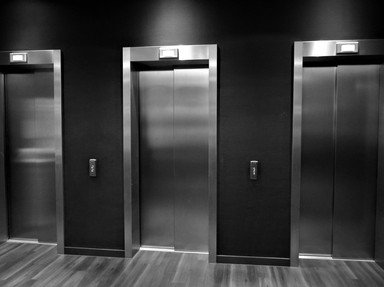
For those in need of a pick-me-up, this adopted quiz explores the workings of elevators. What happens when cables snap? Why are they always out of order? And why doesn't the elevator come any faster when I push the button 20 times?
This is a renovated/adopted version of an old quiz by author Tristan.

A photo quiz by etymonlego. Estimated time: 3 mins.
  1. Home
  2. »
  3. Quizzes
  4. »
  5. Science Trivia
  6. »
  7. Machines
  8. »
  9. Elevators

Author
etymonlego
Time
3 mins
Type
Photo Quiz
Quiz #
6,599
Updated
Mar 14 26
# Qns
10
Difficulty
Average
Avg Score
7 / 10
Plays
67
Last 3 plays: Guest 67 (9/10), Guest 136 (9/10), Guest 90 (5/10).
-
Question 1 of 10
1. Statistically, what's the safest way to get to the top floor of a building?


Question 2 of 10
2. The Otis Elevator Company was founded by Elisha Otis. What did he invent that brought elevators into vogue? Hint


Question 3 of 10
3. Most elevators use cables to drive motion. Named for the specific principle that causes them to function, what are these elevators called? Hint


Question 4 of 10
4. The other common type of passenger elevator is the hydraulic elevator, driven by a piston. What limitation makes them the less popular than those driven by cables? Hint


Question 5 of 10
5. Which of these parts of an elevator is used to improve its energy efficiency? Hint


Question 6 of 10
6. Automatic buttons elevators quickly made old-fashioned elevator operators obsolete. Before buttons, what sort of control did most commercial elevators use? Hint


Question 7 of 10
7. What is the mechanism on top of the elevator that detects if the elevator is going too fast? Hint


Question 8 of 10
8. In 1945, the elevators at the Empire State Building entered freefall during a fire. The safety mechanisms failed and all passengers were killed.


Question 9 of 10
9. In the U.S. (unlike other countries), which elevator button is limited in its functionality to comply withthe Americans with Disabilities Act? Hint


Question 10 of 10
10. It was once thought that elevators can't extend above 500 meters (1640 feet). But recent developments have made it possible! What was (and if you go high enough, still is) the main limiting factor for building the tallest elevator possible? Hint


(Optional) Create a Free FunTrivia ID to save the points you are about to earn:

arrow Select a User ID:
arrow Choose a Password:
arrow Your Email:


View Image Attributions for This Quiz

Most Recent Scores
Today : Guest 67: 9/10
Today : Guest 136: 9/10
Today : Guest 90: 5/10
Today : Guest 86: 7/10
Today : Baldfroggie: 9/10
Today : briarwoodrose: 9/10
Today : AmandaM: 9/10
Today : Guest 72: 0/10
Today : Guest 166: 4/10

Quiz Answer Key and Fun Facts
1. Statistically, what's the safest way to get to the top floor of a building?

Answer: The elevator

Elevators are even safer than walking down the street, let alone the stairs. In the U.S., stairs are the second-leading cause of injury in the home, and they kill about 12,000 people a year. Elevators are only responsible for about 30 deaths per year in the States.

Cases of people dying in elevator freefalls are unheard-of. Otis has gone so far as to call the free-falling elevator a "technological impossibility," per NPR. Injuries are usually caused by unattended open elevator shafts, doors closing on limbs, or by people being stuck in a stopped elevator.

Elevators are installed with incredible precision. The clearances for the guide rails that run the entire length of the elevator are a matter of inches. Each sill (the rails on each landing that the automatic door runs along) must be installed at a perfect 90 degree angle. They are heavily regulated, frequently inspected, and incredibly safe.
2. The Otis Elevator Company was founded by Elisha Otis. What did he invent that brought elevators into vogue?

Answer: A brake that automatically stopped the elevator

There are ancient accounts of Archimedes inventing an elevator powered by animals. But what distinguishes an elevator from a crane or a hoist isn't its cargo or its direction - it's the countless safety mechanisms that keep it operating safely. So some, myself included, would go so far as to call Elisha Otis the inventor of not only the e-brake, but of the modern elevator as we know it.

What made his elevator brake so ingenious was that it could be demonstrated before a crowd. At the 1853 World's Fair, Elisha himself rode up in an open lift, then had an assistant cut the cable. The lift cable of the elevator was connected to a kind of brace held in tension. When tension was released by the breaking cable, the mechanism sprang out to catch teeth on either side of the shaft, stopping the elevator.

The design made an impression. Building buildings higher than a few stories no longer seemed like such a bad idea.
3. Most elevators use cables to drive motion. Named for the specific principle that causes them to function, what are these elevators called?

Answer: Traction elevators

"Traction elevator" is the right term. At the top of the elevator, the tractive force generated within the sheaves (the cylinders the cables wrap around) is thus redirected vertically, and the cab can be moved up and down. Hypothetically, even a sheave made of ice would generate some (small) amount of traction that the pulley could then redirect. Strangely, no one has used ice in this way.

A physicist will probably tell you that traction is but one form of friction (specifically, traction is friction generated at one point of a wheel or tire). Good luck convincing an engineer of that.
4. The other common type of passenger elevator is the hydraulic elevator, driven by a piston. What limitation makes them the less popular than those driven by cables?

Answer: They can't reach as high.

Hydraulic elevators work via pistons and fluids. Literally, a large piston underneath the elevator pushes you up or down a few floors. They work well for buildings shorter than six stories, but we're talking about a metal pole acting by force of fluid alone. As you can imagine, it quickly becomes untenable for a hydraulic system to generate sufficient pressure. The pistons also need to be supported by large supports drilled deep underground. For taller buildings, cable is still king.

Hydraulics do have their advantages, though. They actually have higher weight capacities than traction elevators, and they don't need to install heavy sheaves above the shaft. Their grounded design means they provide a smoother ride. The famous "stretching room" at the beginning of Disneyland's Haunted Mansion is so smooth, many people who've ridden it have no idea that it IS an elevator.
5. Which of these parts of an elevator is used to improve its energy efficiency?

Answer: The counterweight

Imagine a plumb bob tied to a shoelace. Picture it draped over your finger and try moving it up and down, just by turning your finger. You would have to hold it down with your thumb, or wrap it around your finger a few times to generate traction. Now imagine that instead of holding it down at the point of contact, you tied a weight to the opposite end. You would be able to fully control it easily! With the counterweight, gravity does the work for you of easing the amount of energy needed.

Typical elevator counterweights weigh between 40% to 50% of the elevator's maximum rated weight (i.e., its weight with a full cab of passengers).
6. Automatic buttons elevators quickly made old-fashioned elevator operators obsolete. Before buttons, what sort of control did most commercial elevators use?

Answer: A lever

Though safety devices were in place to control the elevator's speed, it still required skill to move the elevator at a comfortable speed and stop at the correct point of the landing. Since doors weren't automated, either, the operator helped ensure safe boarding and disembarking. Operating the elevator was a skilled position that could still be performed by the disabled.

Technically speaking, they are still around. After automatic elevator buttons, elevator operators became a symbol of opulence, and were hired at many department stores as greeters. Many Japanese department stores feature elevator operators to this day.
7. What is the mechanism on top of the elevator that detects if the elevator is going too fast?

Answer: Overspeed governor

Like many other safety mechanisms in the elevator, governors are analog mechanisms. A governor cable runs the complete length of the shaft, plumb-straight. Underneath the cab is an arm on a spring called the actuator. If the elevator gains so much speed that the actuator can overpower the spring, the governor cable will jerk, activating a flywheel brake at the top of the operations, initiating the brakes under the cab, and stopping the elevator.

The overspeed governor is usually designed to trip if the elevator exceeds its rated speed by about 20%. And yes, that means exceeding it for any amount of time for any reason - including if someone is jumping up and down inside the elevator. Don't do that.
8. In 1945, the elevators at the Empire State Building entered freefall during a fire. The safety mechanisms failed and all passengers were killed.

Answer: False

In 1945, Ms. Betty Lou Oliver was indeed riding the elevator when it plummeted 70 stories and crashed. Due to opaque fog, a B-25 bomber accidentally flew into the building, resulting in a fire and 17 casualties. Amazingly, Oliver was not one of them.

How did it happen? Good luck and good engineering. The very bottom of an elevator shaft has an "oil buffer," a type of spring designed as a last-resort safety feature in the event the cab is travelling even slightly too fast. Although the oil buffer was working *far* beyond its rating, it helped absorb some of the energy from the fall. Luckily, the elevator's steel cable also collected in the pit of the shaft. Finally, the air in the shaft naturally cushioned the descent. (I say "cushioned" - Oliver still suffered a broken neck, back, and pelvis.)

Freak circumstances can cause any mechanical device to fail, but the safety features of elevators are really, deeply robust.
9. In the U.S. (unlike other countries), which elevator button is limited in its functionality to comply withthe Americans with Disabilities Act?

Answer: The close door button

The elevator's computer is programmed to lock out the door close function until a set amount of time has passed. Naturally, a building like a hospital can program the elevator for an even longer lockout, if desired.

This fact has now become a common factoid: "80% of door close buttons don't work at all!" The opposite is more or less true: the vast majority of elevators do let you use the button after the time elapses, and some fire codes require that the door close button be functional.

Holding in a call button will not make it arrive at its destination any faster. But it seems to make some people feel better.
10. It was once thought that elevators can't extend above 500 meters (1640 feet). But recent developments have made it possible! What was (and if you go high enough, still is) the main limiting factor for building the tallest elevator possible?

Answer: The weight of the cable

A traction elevator will use between four and eight steel cables, and for safety, each must be heavy enough to hold the entire cab by itself. Surprisingly, the weight is so extreme - as high as 27,000 kilograms (almost 30 tons) for a 500-meter (1640 feet) skyscraper. The cabs on supertall, high-speed elevators max out at around 8 tons (8000 kg).

One of the Otis's biggest rivals is the Helsinki-based company KONE. They've introduced their UltraRope, a reinforced ribbon of carbon fiber that's as strong as steel but far lighter. For a 500-meter shaft, the 30-ton steel cable would be reduced to 4.2 tons (4200kg), more than an 80% reduction. They rate the UltraRope for kilometer-tall shafts, but for now - at time of writing - there hasn't been a 1,000-meter building to put UltraRope to the test. Let me know if one's been built!
Source: Author etymonlego

This quiz was reviewed by FunTrivia editor rossian before going online.
Any errors found in FunTrivia content are routinely corrected through our feedback system.
3/14/2026, Copyright 2026 FunTrivia, Inc. - Report an Error / Contact Us