Quiz Answer Key and Fun Facts
1. Astronomy began with what is still the most complex observational tool we possess - the human eye. When prehistoric humans gazed up at the stars with their naked eyes, which of the following would they NOT have been able to see?
2. Starting in 1609, Galileo Galilei was a pioneer in the use of the newly invented telescope to expand our astronomical horizons beyond the naked eye's view. Aside from his famous discovery of the four largest moons of Jupiter, he was the first to observe a number of new phenomena in the universe. Which of these is NOT one of his discoveries?
3. Since Galileo's pioneering work, a plethora of optical telescope designs have emerged, based on a few fundamental design types. Which of the following is NOT a type of optical telescope?
4. By the 20th century, astronomers started to expand their horizons beyond visible light and into other parts of the electromagnetic spectrum. In the 1930s, the first astronomical sources of radio waves were detected when Karl Jansky detected a radio wave signal coming from the centre of the Milky Way, located in which 'archer' constellation?
5. In 1946, the technique of radio interferometry was introduced, allowing radio signals from multiple antennas to be combined to achieve much greater resolution than the individual signals alone. Taking advantage of this technique, the Square Kilometre Array (SKA) was proposed, comprising of hundreds of dishes and thousands of antennas with a total collecting area of 1 square kilometre. In the vast deserts of which two countries did construction of the SKA begin in 2018?
6. Beyond visible light and radio waves, there is still a broad range of electromagnetic radiation including microwaves, infrared, ultraviolet, X-rays and gamma rays. The universe is awash in these forms of radiation, however their observation is limited by the Earth's atmosphere which absorbs and scatters most of the radiation. How does NASA's Chandra X-ray Observatory overcome this challenge?
7. Gamma ray astronomy observes the highest energy radiation in the electromagnetic spectrum. Naturally, it also captures the most energetic explosions known in the universe after the Big Bang itself. What are these violent outbursts of energy called?
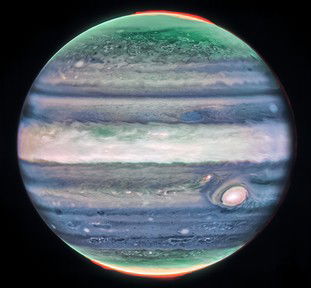
8. The James Webb Space Telescope (JWST) is seen as a 21st century spiritual successor to the famous Hubble Space Telescope. It utilises the infrared spectrum to open yet another window into the cosmos. From which overseas department of France, located in South America, was the telescope launched in 2021?
9. Now we move from the electromagnetic spectrum to gravity, another fundamental force of physics. Almost 100 years after Albert Einstein predicted their existence in his general theory of relativity, the LIGO observatory made the first direct observation of what phenomenon in 2015?
10. We move beyond the fundamental forces to particles. Neutrinos are subatomic particles with no charge, interacting only weakly with other matter. Trillions of neutrinos pass through Earth every second with most sailing straight through undisturbed. To isolate the few neutrinos that do interact from other background radiation, such as cosmic rays, where are most neutrino detectors located?
Source: Author
patrickk
This quiz was reviewed by FunTrivia editor
rossian before going online.
Any errors found in FunTrivia content are routinely corrected through our feedback system.