FREE! Click here to Join FunTrivia. Thousands of games, quizzes, and lots more!
Anatomy of a Knight Trivia Quiz
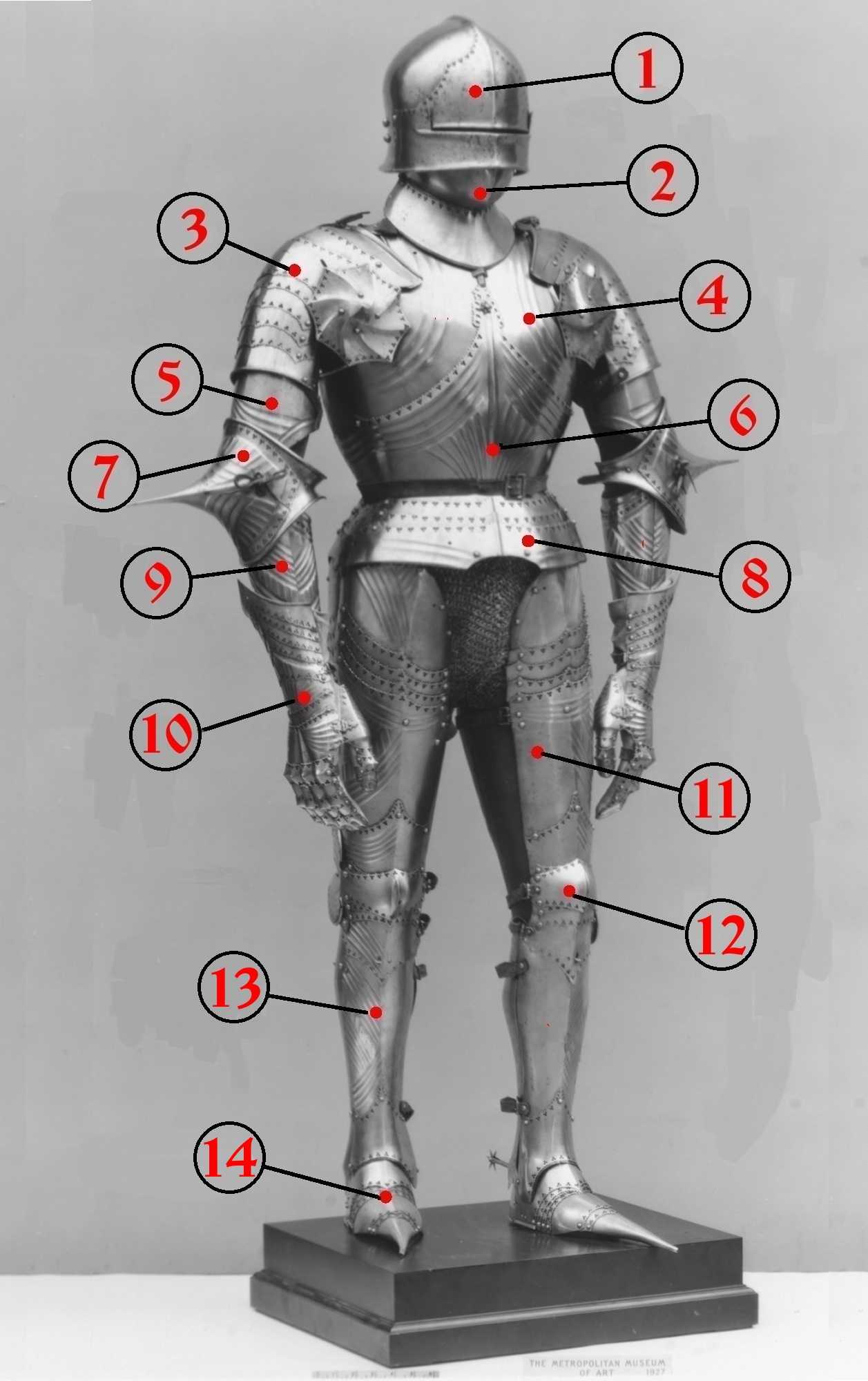
In medieval warfare, a mounted knight was the equivalent of an armoured tank in terms of power on the battlefield. Can you correctly label the different parts of this Gothic steel plate armour from the 15th century?
Last 3 plays: kingmama (1/14), Guest 199 (3/14), mehhhhh58 (4/14).
Click on image to zoom
FauldsCuisseGauntletSalletRerebraceBevorCouterPoleynSabatonPlackartGreaveCuirassVambracePauldron* Drag / drop or click on the choices above to move them to the answer list. View Image Attributions for This Quiz
A sallet is a helmet notable for its smooth, rounded shape and an extended rear section that protects the neck. Widely used in the 15th century, it often relied on a bevor for full facial coverage.
Etymology: from Italian "celata," meaning helmet or concealed, derived from Latin "celare" (to hide).
2. Bevor
The bevor is a defensive plate designed to shield the throat, chin, and lower face. It was commonly worn beneath or alongside helmets such as the sallet, forming a protective barrier where helmets were otherwise open.
Etymology: from Middle High German "bëver" or Old French "bavier," meaning to drool or slobber, referencing the chin area it covers. The word is related to bib in English.
3. Pauldron
Pauldron armour shields the shoulder and upper arm, consisting of overlapping segments that permit arm rotation. Some versions were asymmetrical, offering extra protection on the side most likely to receive blows.
Etymology: from Old French "pouderon" or "espaule," related to Latin "spatula," meaning shoulder.
4. Cuirass
The cuirass forms the core of the armour, made of a breastplate and backplate that shield the torso and vital organs.
Etymology: from Old French "cuirasse," derived from "cuir" (leather), reflecting early hardened leather armour before full plate steel versions.
5. Rerebrace
The rerebrace covers the upper arm, connecting the shoulder armour to the elbow defense and completing the arm's protective assembly.
Etymology: from Old French "arrière-bras," meaning rear arm, distinguishing it from the vambrace ("avant-bras").
6. Plackart
The plackart is a reinforcing plate worn over the lower chest or abdomen, either attached to or worn beneath the main breastplate. It improved resistance to penetrating attacks.
Etymology: from Old French "placke" (plate or patch), related to Middle Dutch "placke" (flat surface).
7. Couter
The couter is an elbow defense, often shaped with projecting flanges to deflect strikes away from the vulnerable joint.
Etymology: from Old French "couter" or "coutel," derived from Latin "cubitum" (elbow).
8. Faulds
Faulds consist of several horizontal metal bands suspended from the lower torso armour. They guard the hips and lower abdomen while maintaining flexibility, especially when sitting or riding.
Etymology: from Old French "faude" or "falde," meaning fold, referring to their layered construction.
9. Vambrace
A vambrace is a forearm guard extending from the elbow to the wrist. It often opens along one side with hinges or straps for ease of wear.
Etymology: from Old French "avant-bras," meaning before the arm (i.e., the forward arm).
10. Gauntlet
A gauntlet protects the hand and wrist, constructed either as a single enclosed piece (mitten style) or with individual articulated fingers.
Etymology: from Old French "gant" (glove) with the diminutive -let, meaning small glove.
11. Cuisse
The cuisse protects the upper leg, typically formed as a curved plate secured to the waist armour. It sometimes incorporated articulation near the knee to avoid restricting movement.
Etymology: from Old French "cuisse," meaning thigh, from Latin "coxa."
12. Poleyn
Poleyns are knee guards designed to cover the joint while allowing bending. They are frequently ridged or winged to protect gaps created by movement.
Etymology: from Old French "poleon" or "genouillière," related to "genou" (knee), from Latin "genu."
13. Greave
Greaves are shin guards that protect the lower leg, often enclosing the calf with two fitted plates joined by hinges or straps.
Etymology: from Old French "greve," possibly from Germanic roots meaning to encase or cover.
14. Sabaton
Sabatons are articulated metal defenses worn over the feet, constructed from overlapping plates to allow walking and mounted movement. Earlier versions were sharply pointed, while later designs favored practicality with rounded toes.
Etymology: from Old French "savate," meaning slipper or shoe, ultimately from Medieval Latin "sabatō."
This quiz was reviewed by FunTrivia editor trident before going online.
Any errors found in FunTrivia content are routinely corrected through our feedback system.