FREE! Click here to Join FunTrivia. Thousands of games, quizzes, and lots more!
Quiz about Chicago Worlds Fair 1893

Chicago World's Fair 1893 Trivia Quiz


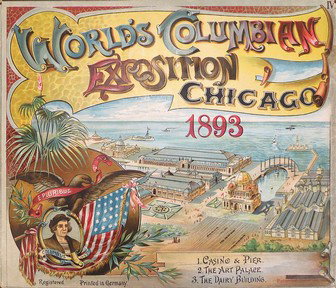
Welcome to the White City, one of the most influential and important exhibitions in world history. Let's see what you know about this remarkable event. Good luck!

A photo quiz by borimor. Estimated time: 4 mins.
  1. Home
  2. »
  3. Quizzes
  4. »
  5. History Trivia
  6. »
  7. U.S. History
  8. »
  9. USA in the 19th.Century

Author
borimor
Time
4 mins
Type
Photo Quiz
Quiz #
424,554
Updated
Jul 29 26
# Qns
10
Difficulty
Average
Avg Score
7 / 10
Plays
43
Last 3 plays: Bowler413 (4/10), waldron (6/10), dana27 (6/10).
-
Question 1 of 10
1. Which area of Chicago was chosen as the main site for the 1893 Chicago World's Fair? Hint


Question 2 of 10
2. The Chicago World's Fair was held to mark which significant historical event? Hint


Question 3 of 10
3. In front of the Court of Honor, inside the Great Basin pool, stood the majestic 30-meter-tall Golden Lady. What was the official name of this statue?
A replica of the statue stands today in Jackson Park in Chicago.
Hint


Question 4 of 10
4. The competition to provide electrical illumination for the Chicago World's Fair became a turning point in the War of Currents. Which side ultimately secured the contract?


Question 5 of 10
5. Which of the following statements is NOT true about the Woman's Building at the 1893 Chicago World's Fair? Hint


Question 6 of 10
6. Which dance gained national attention at the 1893 Chicago World's Fair? Hint


Question 7 of 10
7. An entire Algerian village, a simulated volcanic eruption, the Ice Railway, the first-ever Ferris Wheel, and many more fun, strange, and entertaining attractions. Which 22-year-old businessman and entrepreneur, later known as one of the founders of the United Nations, was the manager of this magical place called the Midway Plaisance? Hint


Question 8 of 10
8. The Wooded Island is considered one of the most beautiful areas of the 1893 Chicago World's Fair. Although the island was almost empty of man-made structures, one nation built a temple-like structure called the Ho-o-den (Phoenix Hall) in the middle of the Wooded Island. Which nation is it? Hint


Question 9 of 10
9. Now I'm feeling a little hungry and thirsty. Thank goodness there was so much delicious food at the Chicago World's Fair! Which of the following statements about the food and beverages at the fair is NOT correct? Hint


Question 10 of 10
10. What tragedy led to the cancellation of the planned closing festivities of the Chicago World's Fair? Hint


(Optional) Create a Free FunTrivia ID to save the points you are about to earn:

arrow Select a User ID:
arrow Choose a Password:
arrow Your Email:


View Image Attributions for This Quiz

Most Recent Scores
Today : Bowler413: 4/10
Today : waldron: 6/10
Today : dana27: 6/10
Today : Guest 136: 3/10
Today : abbymae01: 4/10
Today : pennie1478: 5/10
Today : Guest 104: 3/10
Today : sluggo13: 5/10
Today : legs1313: 6/10

Quiz Answer Key and Fun Facts
1. Which area of Chicago was chosen as the main site for the 1893 Chicago World's Fair?

Answer: Jackson Park near Lake Michigan

The debate over the location of the fair could easily have fallen victim to Chicago's local politics, but after months of bitter arguments over the site, city officials managed to set aside local interests and choose a location that best showcased Chicago's natural beauty and suited the future fair. Chicago had only one natural feature with a distinctive local character: the wide, blue expanse of Lake Michigan along the city's southern edge. Frederick Law Olmsted, the landscape architect of the fair, strongly advocated locating the exposition there rather than in the inner city, which he considered monotonous, flat, and too far from the lake.

However, the site was not without problems. The land was low and often wet and muddy, and it could sometimes be flooded by the lake. At the same time, the lake made it possible to unload goods and cargo, and land access by railways was also an advantage for those hoping to attract a large number of visitors.

Chicago beat three main contenders: Washington, D.C., St. Louis, and New York. The final vote came down to New York and Chicago. St. Louis was the first to drop out of the race. Washington, D.C. was unable to raise enough private capital to host the fair, and New York had difficulty finding a suitable location due to opposition from some residents to holding the fair in Central Park. In contrast, Chicago showed great enthusiasm and presented impressive arguments, emphasizing its spacious site and vast cultural resources. Especially important was its ability to raise large amounts of private capital. Finally, on February 25, 1890, the U.S. House of Representatives decided in favor of Chicago, which defeated New York City by a vote of 157 to 107.
2. The Chicago World's Fair was held to mark which significant historical event?

Answer: The 400th anniversary of Christopher Columbus's discovery of the New World

It is not known who first conceived the idea of holding an international exposition to commemorate the 400th anniversary of Christopher Columbus's first voyage to America. Some historians argue that the idea of organizing such a large international exposition was influenced by the success of the Centennial Exposition, held in Philadelphia in 1876 to celebrate the 100th anniversary of American independence.

Naturally, a large part of the exhibition was dedicated to Christopher Columbus. The fair was filled with poems, lectures, sculptures, paintings, and other elements related to Columbus and his first voyage to the Americas. Here some interesting examples:

1. A monumental statue of Columbus with a sword in his right hand, by Louis St. Gaudens and Mary Lawrence, was installed at the entrance of the Administration Building.

2. On Lake Michigan, replicas of Columbus's three famous ships - the Santa Maria, Pinta, and Nina - were displayed for visitors (see photo). The Convent of La Rabida, which had been visited by Christopher Columbus, was restored.

3. In the collectibles section, commemorative objects included the newly minted Columbian half-dollar.

4. In the arts and culture section, visitors could listen to the "Columbus March and Hymn" by composer John Knowles Paine, which was performed at the opening ceremony. The fair's Women's Council held an exclusive competition called "Seven Ages of Columbus," culminating in a nightly parade of flags depicting those scenes.
3. In front of the Court of Honor, inside the Great Basin pool, stood the majestic 30-meter-tall Golden Lady. What was the official name of this statue? A replica of the statue stands today in Jackson Park in Chicago.

Answer: The Republic

The statue was designed by Daniel Chester French, one of the foremost American sculptors. The original figure stood approximately 20 meters (65 feet) in height and was placed on a pedestal measuring roughly 10 meters (32 feet). The sculpture currently installed in Jackson Park is a reduced replica of the original work, also based on French's design, and was installed in 1918. The total height of the replica is approximately 7.3 meters (24 feet). The pedestal of the replica was designed by Henry Bacon, who collaborated with French on the Lincoln Memorial in Washington, D.C.

The design of "The Republic" was based on the Statue of Liberty in New York and was, in effect, intended to serve as Chicago's answer to the work of Frederic Auguste Bartholdi. The statue was designed in the French Beaux-Arts style, drawing on classical and Renaissance traditions, and reflected an artistic tradition that greatly influenced the development of architecture in the United States.

"The Republic" depicts a woman dressed in a long robe, with her arms extended above her head. In her right hand, she holds a globe upon which rests an eagle with its wings spread. In her left hand, she holds a spear adorned with laurel leaves, together with a plaque bearing the inscription "Liberty" and a Phrygian cap, a symbol associated with the French Revolution. The platform, as well as the figure's head and arms, are all covered in gold leaf.

Minnie Clark and Edith Minturn Stokes, known as part of the original Gibson Girls who embodied the feminine ideal in America during the late 19th and early 20th centuries, as depicted in the illustrations of artist Charles Dana Gibson (1867-1944), served as models for Daniel Chester French's sculpture.

Interpretations of the statue varied; some argued that it represented the Republic of the United States as a single, unified political entity. Others viewed it as an expression of the nation's strength in the aftermath of the Civil War (1861-1865), which had ended only 28 years before the opening of the fair, and as a symbol of the United States role as an exemplar of republican and democratic aspirations around the world.

"The Republic" survived at least three fires during 1894. Although local newspapers and residents at times described it as even more striking as it stood among the ruins, the statue gradually deteriorated over the following years. In plans for the renovation of Jackson Park, debate emerged over its preservation, but as structural elements failed-most notably the loss of the Phrygian cap and the collapse of the right arm-a decision was made to remove it. The responsible committee concluded that further public expenditure was unjustified. On 28 August 1896, workers secretly burned the statue at dawn. The rising smoke drew crowds of residents who gathered to witness the ruins of "The Republic".
4. The competition to provide electrical illumination for the Chicago World's Fair became a turning point in the War of Currents. Which side ultimately secured the contract?

Answer: Nikola Tesla and George Westinghouse's AC power system

The war of currents reached its climax at the Chicago World's Fair. Before the fair, direct current (DC) technology was the dominant system of the two. The fair marked a turning point in the history of electrical technology toward the alternating current (AC) system.

The Westinghouse Electric Company won the contract to supply electricity for the World's Columbian Exposition after submitting a significantly lower bid than that of Edison ($399,000 compared to $554,000). The division of labour was as follows: Tesla developed the fundamental principles of the AC system, while the industrialist and engineer Westinghouse transformed AC into a large-scale industrial system.

On May 1, 1893, President Grover Cleveland pressed a button, and the exhibition was officially opened. The spectacle was breathtaking: one hundred thousand incandescent lamps illuminated, alongside giant searchlights, the neoclassical buildings of what was then called the "White City." According to accounts from fair attendees, nothing could compare to the magical spectacle of the lights during the night exhibitions. Some of them were moved to tears, and stood in silent awe.

Beyond the illuminated fairgrounds, visitors could also explore the technology that made the spectacle possible. Westinghouse's exhibition was presented inside the Electricity Building. Until that point, no world's fair had ever dedicated an entire building to an exhibition focused on electricity - a reflection of the field's growing status as one of the defining technologies of the era.

The significance of the Westinghouse's exhibition lay in its presentation of a complete and operational polyphase electrical system - from generators and motors to transformers and transmission lines - thereby offering millions of visitors a vivid demonstration of how a modern electrical infrastructure functions as an integrated system, from power generation to transmission and final use. The demonstration helped transform AC from a theoretical possibility into a practical, visible, and functioning model.

One of the exhibition's most popular attractions was the Columbus Egg, a demonstration that visually illustrated how a rotating magnetic field could generate mechanical motion without direct physical contact. By means of such a field, a copper egg was made to stand upright and spin - demonstrating the operating principle behind alternating-current motors. The name of the demonstration was derived from the parable attributed to Christopher Columbus, symbolizing an idea that initially appears impossible but becomes clear and intuitive once one sees it working in practice.

The fair effectively established AC as the global standard. It served as a vivid demonstration of how an entire city could be built efficiently, reliably, and economically on the basis of AC technology.

What about Edison? Although losing the contract promoted public campaign regarding the alleged dangers of AC and imposing restrictions on the use of some of his patents at the fair, he visited the fair in August 1893. On one occasion, his friends believed he had become lost within the exhibition grounds and dispatched search parties to locate him. He was eventually found in a side passage of the Agricultural Building, sitting comfortably and eating pancakes and a cracker spread with jam.

Regardless of the outcome of this "war," Tesla, Westinghouse, and Edison remain three of the most defining figures in the history of science.
5. Which of the following statements is NOT true about the Woman's Building at the 1893 Chicago World's Fair?

Answer: The exhibits included nearly equal numbers of works by women and men.

The entire building showcased exclusively women's work. The Board of Lady Managers, which managed the Woman's Building, established strict rules to ensure that the building and all of its exhibits were designed, created, or produced exclusively by women in order to protect its credibility. This was partly motivated by concerns that critics would seize upon any deviation from these rules to discredit the exhibition and undermine women's achievements.

The Woman's Building was situated in a beautiful location near the Western Lagoon. The building was designed in the Italian Renaissance style and was one of the first buildings at the Exposition to be completed. Its purpose was to celebrate the achievements of women in the United States and throughout history. The building featured exhibitions in a variety of fields, including art, science, literature, music, and home economics. The building's most prominent decorative elements were two large murals: one by Mary Fairchild MacMonnies, titled "Primitive Woman," depicting women carrying water jugs and welcoming men returning from the hunt; the other by Mary Cassatt, titled "Modern Woman," celebrating the achievements and progress of women throughout history.

The lead architect was 21-year-old Sophia Hayden, the first woman to receive a degree in architecture from MIT. She earned just $1,000 for designing the building, while male architects of the exposition's major structures received significantly larger commissions. Unfortunately, disagreements with the board caused her great frustration. After the fair, Sophia never worked as an architect again and lived a quiet life in Winthrop, Massachusetts.

The most impressive room was the Venetian-style library. The library contained between 7,000 and 8,000 carefully selected books from 24 different countries, all written by women. Interestingly, the largest number of books came from New York State (about 2,400 volumes), while outside the United States, France led with about 800 volumes. One of the most interesting works was by Genevieve Estelle Jones, who wrote two large volumes of scientific research titled "The Nests and Eggs of Birds of Ohio" in memory of her daughter. The work was valued at $375 (!).

From my research, the building received mostly compliments for its subtle, modest, and calming artistic style, and for the elegant appearance of the building's interior, along with criticism for a lack of originality and boldness. Each and every one of you is, of course, welcome to decide for yourself.
6. Which dance gained national attention at the 1893 Chicago World's Fair?

Answer: Belly Dance

Belly dancing, known then as the "Hoochie Coochie," took place in an area of the fair called the Streets of Cairo (see photo), which recreated the famous city. The show was presented under the name "Algerian Dancers of Morocco." Middle Eastern dancers performed for audiences in an Egyptian-style theater. Unlike modern belly dancers, the dancers at the fair were more fully clothed by the standards of the time. Some of the performers used the stage name "Little Egypt," a name that became closely associated with the dance. One of the dancers later linked with this name was the Syrian-born Fahreda Mazar Spyropoulos. The music associated with her performances known as the "Snake Charmer" song.

The performances were especially popular with male visitors, and many women criticized the show, objecting to their husbands watching what they saw as an exotic and improper dance. One of the jokes that circulated during the fair claimed that the belly dancers were responsible for a rise in divorces.
7. An entire Algerian village, a simulated volcanic eruption, the Ice Railway, the first-ever Ferris Wheel, and many more fun, strange, and entertaining attractions. Which 22-year-old businessman and entrepreneur, later known as one of the founders of the United Nations, was the manager of this magical place called the Midway Plaisance?

Answer: Sol Bloom

Sol was not born with a silver spoon in his mouth; he was born into a poor Jewish immigrant family from Poland that had settled in San Francisco. While still a teenager, he showed extraordinary entrepreneurial talent, finding his way into the entertainment industry as a theater manager and boxing promoter.

In 1889, Sol traveled to the Exposition Universelle in Paris in search of new business opportunities. While visiting the exhibition, he became fascinated by one of its attractions-the Algerian Village, which was part of the fair's displays devoted to the French colonies. Sol recognized the business potential of the extraordinary performances presented there, including scorpion swallowers, acrobats, and glass eaters-acts unfamiliar to audiences in the Western Hemisphere at the time. As a result, he signed a two-year contract to bring the village and its performances to North America.

Reports of Chicago's selection as the host city for the fair led him to travel to the "Windy City" in an attempt to persuade the organizers to adopt the village as a distinctive addition to the exposition. His proposal not only resulted in his appointment as manager of the entire Midway Plaisance (a mile-long area between Jackson Park and Washington Park) amusement complex, but also transformed the nature of the area - shifting it from a space focused primarily on cultural and educational exhibits into an entertainment district that incorporated attractions such as the Ferris Wheel, a hot air balloon, ostrich farms, dance performances, the first commercial movie theater, and variety of other amusements.

Continuing with the previous question, Sol Bloom helped introduce belly dancing to American audiences and composed the famous melody known as "The Snake Charmer Song" or "The Streets of Cairo."

Fun fact: The opening words of the United Nations Charter, "We the peoples of the United Nations...," were written by him.
8. The Wooded Island is considered one of the most beautiful areas of the 1893 Chicago World's Fair. Although the island was almost empty of man-made structures, one nation built a temple-like structure called the Ho-o-den (Phoenix Hall) in the middle of the Wooded Island. Which nation is it?

Answer: Japan

After a long period of self-isolation from 1639 to 1853, Japan was determined to rejoin the international community. Perhaps more than any other nation at the time, it understood the importance of making a positive impression and strengthening its national prestige by showcasing its cultural assets to the world (what we would now call in terms of political science, soft power). Between 1873 (the Vienna World Exhibition) and the Great Exhibition in St. Louis in 1904, Japan participated in 19 international exhibitions.

During those years, the United States was Japan's largest trading partner, and the exhibition provided an opportunity for Americans to learn about Japan and its culture. To support this effort, the Emperor of Japan invested a considerable sum of $650,000 from his personal fortune and remains the building as a gift from him to the city of Chicago.

The Phoenix Pavilion was pre-built in Tokyo and shipped by steamship to the United States, then transported by train to Jackson Park in Chicago. Its construction drew large crowds of curious visitors, who sometimes disrupted the work and even interrupted the building process.

They were looking for a pavilion that would represent Japan's cultural and artistic heritage, and the island was considered the best location at the exhibition. The name of the hall is derived from the legendary phoenix (ho-o), which heralds a period of prosperity and on which the design of the hall was based. The inspiration for the Phoenix Hall (Hoo-do) is the main building of an 11th-century temple known as Byodo-in temple near Kyoto, and the building at the fair was in fact a replica of it, adapted for secular use. The temple belongs to the Pure Land school of Buddhism, a tradition that embraces the belief that a person can be reborn in a holy or pure land that will enable them to attain enlightenment. The building is symbolically designed to evoke a phoenix, with the two side pavilions representing the bird's wings.

The south wing was intended to express the architectural characteristics of the Heian period (794-1185), when the Fujiwara clan was in power. The north wing was designed in the style of the Ashikaga (Muromachi) period (1336-1573), when Japan, after the civil wars of earlier eras, entered a new artistic phase under the influence of Zen Buddhism. The central hall represents the style of the Tokugawa shogunate, a period that extends from the early seventeenth century until the imperial restoration in 1868. The rooms also included a tea room and a library, all inspired by real buildings in Japan.

All the items were imported from Japan, and the staff were Japanese, dressed in traditional clothing, which attracted a great deal of public attention. The structure was designed by the Japanese architect Masamichi Kuru, while students from a Tokyo school of fine arts were responsible for the interior design. The Imperial Museum (Teishitsu Hakubutsukan) oversaw the selection of the art objects and furniture.

The building influenced the renowned architect Frank Lloyd Wright, contributing to the Japanese elements that appeared in his Prairie-style houses and later in his design for the Imperial Hotel in Tokyo.
9. Now I'm feeling a little hungry and thirsty. Thank goodness there was so much delicious food at the Chicago World's Fair! Which of the following statements about the food and beverages at the fair is NOT correct?

Answer: A quote from a forgotten memoir describing the "perfect harmony" at the fair inspired the 1971 Coke song.

It could have been a fascinating story, but there is no connection between the "Coke Song," whose full title is "I'd Like to Teach the World to Sing (In Perfect Harmony)," and the Chicago Fair. Coca-Cola did, however, participate in the fair, but it wasn't a major turning point for the company.

The Brownie was created at the request of Bertha Honoré Palmer, president of the Board of Lady Managers of the fair and a well-known philanthropist, who asked for a delicious dessert smaller than a cake but larger than a cookie, and portable enough to be included in boxed lunches for women visiting the fair. The request was given to the pastry chef of the Palmer House Hotel, Joseph Sehl, who created the first brownie. The name "brownie" came into use shortly after the fair. The original dessert included melted chocolate, walnuts, and a layer of apricot glaze. The Palmer House continues to prepare the original recipe today.

A visit to the fair became a turning point in the life of the famous businessman and confectioner Milton S. Hershey. At the time, Hershey owned the Lancaster Caramel Company. At one of the exhibits, he encountered the chocolate-making machinery of the German manufacturer J. M. Lehmann, which demonstrated the latest advances in chocolate production. Hershey was captivated by the machines and their rich aroma, realized that chocolate could now be manufactured efficiently on a large scale. This experience inspired him to shift his focus from caramel to chocolate. He famously told his cousin, "Caramels are a fad, but chocolate is permanent. I'm going to make chocolate." The following year, he founded the Hershey Chocolate Company.

Last one, the molasses-coated popcorn and peanut snack was introduced at the fair and attracted public attention, but the original version had a problem: the molasses coating caused the ingredients to stick together. In 1896, brothers Frederick and Louis Rueckheim developed an improved process that kept the popcorn and peanuts separate, creating the Cracker Jack product that became famous.

In the photo: A kosher beef sausage stand in an area called "Old Vienna," which was part of the Midway Plaisance, was operated by brothers-in-law Emil Reichel and Samuel Ladany, two Austro-Hungarian Jewish immigrants who later founded the successful Vienna Beef Inc. in Chicago. For those curious about the price, the hot dogs sold for 10 cents each.
10. What tragedy led to the cancellation of the planned closing festivities of the Chicago World's Fair?

Answer: Political assassination

"The end came at sunset. The great Columbian Exposition faded as quietly and sadly as an autumn day, and when the belching cannon had sent a score of shots to heaven and pelted the domes and pinnacles with a million echoes the giant had died." ("The Chicago Herald", October 31, 1893).

It's was sad ending to the white city. Carter Harrison was one of Chicago's most popular mayors, serving five terms in office before his assassination in 1893, just two days before the fair's closing ceremony. The original celebrations were canceled, and instead, the organizers held smaller, more modest and somber ceremonies. A public memorial service was held at the World's Fair in his memory. During the ceremony, the battleship Michigan fired a volley of cannon fire. Afterwards, hundreds of thousands of visitors sang the national anthem, some with tears in their eyes.

How was he murdered? On October 28, a man named Patrick Eugene Prendergast knocked on Harrison's door, angry and frustrated that he had not been appointed the city's legal counsel, a position he believed Harrison owed him after winning his fifth term as mayor. It was an absurd expectation, as the two men had no professional or personal connection at all. Prendergast, apparently mentally unstable, shot Harrison dead at close range.
Source: Author borimor

This quiz was reviewed by FunTrivia editor ponycargirl before going online.
Any errors found in FunTrivia content are routinely corrected through our feedback system.
7/29/2026, Copyright 2026 FunTrivia, Inc. - Report an Error / Contact Us