FREE! Click here to Join FunTrivia. Thousands of games, quizzes, and lots more!
The Oldest Written Language Trivia Quiz
Written language originated sometime c. 3500 BC in Mesopotamia, the land between rivers, in what is modern Iraq. Its creation marks the transition from prehistory to history, and is one of the reasons Mesopotamia is known as a Cradle of Civilization.
A collection quiz
by ponycargirl.
Estimated time: 3 mins.
Last 3 plays: Guest 108 (10/10), cowalsh (9/10), parrotman2006 (10/10).
Your task is to choose the words that relate in some way to the development and use of the world's oldest writing system.
There are 10 correct entries. Get 3 incorrect and the game ends.
StylusMemphisUrukCuneiformHieraticHammurabi CodeBook of the DeadSumeriansHieroglyphicsClayScriptBehistun RockEpic of GilgameshWedge-shapedRosetta Stone
Left click to select the correct answers. Right click if using a keyboard to cross out things you know are incorrect to help you narrow things down.
Historians have credited the ancient Sumerians with the development of the first written language. While it is not known if they migrated to the area or if they were indigenous, it is believed that the Sumerians were living in Mesopotamia by c. 4500-4000 BC. The big advantage to living where they did was that Mesopotamia was also part of the Fertile Crescent, one of the first regions where farming began. The over abundance of food there allowed the people to concentrate on other things and move forward with more complex developments like the wheel, written language, architecture, math, and astronomy. A unified empire was not formed, but rather a confederation of city-states was spread throughout the area. Each city-state had its own government.
One of the Sumerian city-states was Uruk, which was located on the Euphrates River. At its peak the city-state is believed to have contained up to 80,000 people, who lived in the city proper and surrounding farmland; some historians believe that it was the largest city in the world c. 2900 BC. The administration of such a large number of people was difficult. How could all of the transactions regarding labor, grain, food, trade, and other goods be recorded? A better system was required, and historians believe this need led to the origin of writing at Uruk.
But first writing materials had to be designed. Mesopotamia lacked trees and stone for the most part, and the resource that was most abundant there was clay. The area was essentially a large flood plain; as the Tigris and Euphrates Rivers flooded annually, deposits of mud, silt, and clay covered the land. The people found that mixing the deposits with straw and water made good building bricks, which became even more durable after being baked in the sun or in a kiln. Perhaps the soft clay could also be used as a record keeping material and made permanent in the same way?
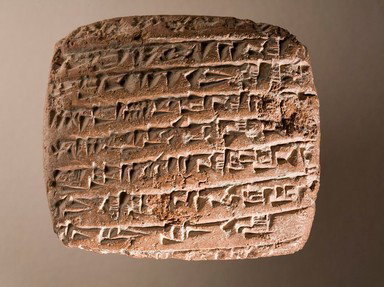
Clay tokens were originally used by accountants to represent different commodities. Keeping track of everything in that manner, however, was a difficult task. Over time the records were kept by making an impression of the token in clay using a stylus. Usually made from reeds, a stylus could really be formed from bone, silver, wood, or even copper. It was formed into a tapered triangle or trapezoid that was cut flat at the end of the tool.
The tool served to give cuneiform, the oldest written language, its name. Cuneiform comes from the Latin "cuneus", which means wedge-shaped. European scholars in the 1600s gave the writings the name because the clay tablets were being discovered at the time. The English word was adopted from the Middle French "cunéiforme".
The development of the stylus was instrumental in making the transition from picture writing to script. Making pictures in the wet clay was difficult, as the clay was easily smudged, and it took too much time. Scribes found that they could quickly make wedge-shaped marks while pressing into the soft clay using the flat end of the stylus. The different script symbols were formed by using different angles, as well as different pressure and depth. Over time there were between 600-1,000 core shapes that formed syllables called phonograms, and the words themselves called logograms. It took a lot of training to learn how to use the cuneiform script, however, many different cultures eventually used it because it was relatively easy to adapt to different languages with the word and syllable symbols. As more people began to adopt the script, the system of core shapes was further condensed.
Sumerian cuneiform was used in the writing of the Gilgamesh Epic in c. 2100 BC. It is the oldest recorded long poem in history. Originally written as a series of poems, the Babylonians (Amorites) were the ones who compiled them together to create the first epic story. The poem told about the hero Gilgamesh, a somewhat mythical king from Uruk, and his quest for immortality after the death of his friend. In addition it also described a great flood that actually is very similar to the story of Noah in the Bible.
The Akkadians conquered the Sumerians sometime around 2334 BC. Thankfully, they respected the great civilization the Sumerians had created, and continued to use their discoveries and learning. Akkadian scribes were required to learn Sumerian cuneiform, and translated many Sumerian texts into Akkadian. Those canny Akkadians adapted the symbols for use with words in their own language. The symbols would mean the same thing in both languages, but were spoken differently. When the Akkadians were subsequently conquered by the Amorites, who were known for their great city of Babylon, the use of Akkadian cuneiform continued. It was the script used to compile and record the Hammurabi Code around 1750 BC. One of the earliest oldest and most comprehensive legal codes ever written, the 282 laws of the Hammurabi Code were carved on a diorite stone, approximately 7 feet (2.13 meters) tall, and covered every imaginable area of life in the ancient world.
Cuneiform script was used for approximately 3,000 years. The last tablets that can be accurately dated are from c. 79-80 AD. They were written by astronomers and priests who were living in Mesopotamia. Then, as with many ancient texts, cuneiform was forgotten. Until, that is, the discovery of the Behistun Rock in Iran in 1835. Much like the famous Rosetta Stone in Egypt, the Behistun Rock was written in three different cuneiform languages, one of which was Akkadian cuneiform. Sir Henry Rawlinson, a British East India Company army officer, and Georg Grotefend, a German scholar, used the different cuneiform scripts to decipher the text.
So, how many cuneiform tablets are left to study today? Archaeologists estimate that as many as a million have been found. While some work to uncover more, others work to translate what the ancient people left behind, which is an astonishing array of business transactions, government decrees, myths, poems, and more.
As you may have already noticed, all of the incorrect terms relate to ancient Egyptian writing.
This quiz was reviewed by FunTrivia editor trident before going online.
Any errors found in FunTrivia content are routinely corrected through our feedback system.