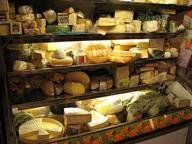
Gruyère comes from western Switzerland and is made from cow's milk under strict AOP protection, which defines both where and how it can be produced. It is aged for several months, slowly developing from a relatively mild, slightly nutty cheese into something deeper, more structured and aromatic.
Unlike what many people expect from "Swiss cheese", Gruyère does not usually form large holes. Instead, it stays dense and smooth, which is precisely why it melts so evenly. That quality makes it a key ingredient in dishes like fondue and French onion soup, where texture matters just as much as flavour.
2. Brie
Answer: Cow
Brie is a soft French cheese made from cow's milk and named after the historic Brie region near Paris. It is best known for its soft interior and thin, edible white rind, which is created through a process of controlled surface mould ripening.
Young brie is mild, buttery and almost delicate, but as it matures it develops a stronger aroma with earthy, slightly mushroom-like notes. The cheese became internationally known centuries ago and was once called the "King of Cheeses" in France. It is commonly served with bread, fruit or wine and is one of the world's most recognisable soft cheeses.
3. Cheddar
Answer: Cow
Cheddar is a popular cheese originally from the English village of Cheddar in Somerset and is made from cow's milk. Its character depends heavily on ageing: younger Cheddar is smooth and creamy, while aged versions become sharper, drier and sometimes crumbly. Some mature cheddars are aged for several years to develop a stronger taste and crumbly texture.
Today, cheddar is produced around the world, but traditional farmhouse cheddar still follows classic English methods developed centuries ago. Its versatility makes it one of the most widely used cheeses for sandwiches, burgers, sauces and snacks.
4. Picodon
Answer: Goat
Picodon is a traditional French cheese from the Rhône-Alpes region, made exclusively from goat's milk. It is a small, round cheese that is typically aged for a few weeks when it develops a firm texture and a strong, tangy flavour with earthy and slightly nutty notes. It is a cheese that tends to become more expressive the longer it matures, rather than simply stronger.
It has AOP protection, meaning its production is tied to specific areas and methods in southern France. Picodon is often enjoyed on its own, in salads, or lightly grilled, when it softens while retaining its distinctive flavour.
5. Crottin de Chavignol
Answer: Goat
Crottin de Chavignol comes from France's Loire Valley and is one of the most well-known AOP goat cheeses. What makes it unusual is that its character changes over time: when fresh, it is soft and bright with a light citrus note, whereas the aged versions become drier, firmer and much more intense.
This progression is part of its appeal, as it can be experienced at various stages of maturity. Crottin de Chavignol is often eaten fresh, aged or even warmed in the oven, where it softens slightly while retaining its distinctive, slightly wild goat flavour.
6. Rodoric
Answer: Goat
Rodoric is a Belgian cheese from the Liège region. It is made with raw goat's milk and aged in humid natural caves. This ageing process gives the cheese a slightly wild character: the rind can appear rustic and uneven, and the texture remains soft and slightly sticky rather than dry or crumbly.
The taste is bold and earthy, with a sharp goat kick up front, but it's rounded out by a deeper, almost mushroom-like richness that comes from the humid maturation environment. It's the kind of cheese that doesn't sit quietly on a plate - it has presence. Usually it's eaten simply, at room temperature, with crusty bread or a glass of dry white wine that can handle its intensity.
7. Pecorino
Answer: Sheep
Pecorino is an Italian cheese made from sheep's milk. There are several regional varieties, with Pecorino Romano being the most famous. It has a firm, often crumbly texture and a bold, salty flavour that becomes more intense with age. Younger versions are smoother with a slightly milky flavour, while aged Pecorino develops sharp, savoury notes and a strong umami character.
Its production dates back to Roman times, when it was a staple food for soldiers thanks to its durability and high salt content. Today, it is widely used as a grating cheese for pasta dishes such as cacio e pepe or carbonara.
8. Idiazabal
Answer: Sheep
Idiazabal is a Spanish cheese from the Basque Country and Navarre, made from raw sheep's milk and protected by PDO status. It can be unsmoked or smoked over beech or hawthorn wood. The smoked version is especially distinctive thanks to its light and rustic aroma. The cheese has a firm, slightly dense texture that becomes more crumbly with age.
Idiazabal has a rich, savoury flavour with a subtle nutty hint. It is often enjoyed in slices, paired with simple accompaniments such as bread, nuts or fruit to allow its complex flavour to shine through.
9. Roquefort
Answer: Sheep
Roquefort is one of France's most famous blue cheeses. It is made from sheep's milk and aged in the natural limestone caves of Roquefort-sur-Soulzon. The caves play an active role in its development, supporting the growth of the blue mould that defines its appearance and flavour. Roquefort has AOP status, meaning both its production area and method are strictly protected.
The result is a bold, salty cheese with a creamy yet crumbly texture and a strong, penetrating character. Its intense flavour means it is usually served in small portions and often paired with sweeter accompaniments, such as fruit, nuts or honey.
10. Pule
Answer: Other
Pule is a Serbian cheese made from donkey milk. It is produced in very small batches at the Zasavica Reserve. Due to the limited amount of milk produced by donkeys, Pule is extremely rare and is more renowned for its rarity than for everyday consumption.
It has a firm, slightly crumbly texture and a surprisingly mild, clean taste. Rather than being strong or pungent, it is light and slightly nutty with a gentle savoury flavour. It is usually eaten in very small portions, mostly due to its rarity rather than for any culinary reason.
11. Chhurpi
Answer: Other
Chhurpi is a traditional cheese from the Himalayan region, particularly Nepal and Bhutan, made from yak milk. It comes in two main forms: a soft version that is eaten fresh, and a hard, dried version that can be chewed for a long time as a protein-rich snack.
The fresh version has a mild, slightly tangy flavour, whereas the dried version has a much more neutral flavour and an almost rock-like texture. In high-altitude regions, its durability, nutritional value and long shelf life in harsh conditions are more highly valued than its flavour.
12. Caravane
Answer: Other
Caravane is a camel milk cheese from Mauritania, produced by the Tiviski Dairy, one of the first commercial dairies in the region. It was developed to make use of local camel milk, which is naturally more challenging to process than cow's milk due to its different composition.
The cheese has a soft, slightly springy texture and a mild flavour with a gentle tang and a light, almost sweet finish, which sets it apart from many stronger cheeses. It is typically enjoyed fresh, and is more notable for its origin and rarity than its intensity.
This quiz was reviewed by FunTrivia editor agony before going online.
Any errors found in FunTrivia content are routinely corrected through our feedback system.