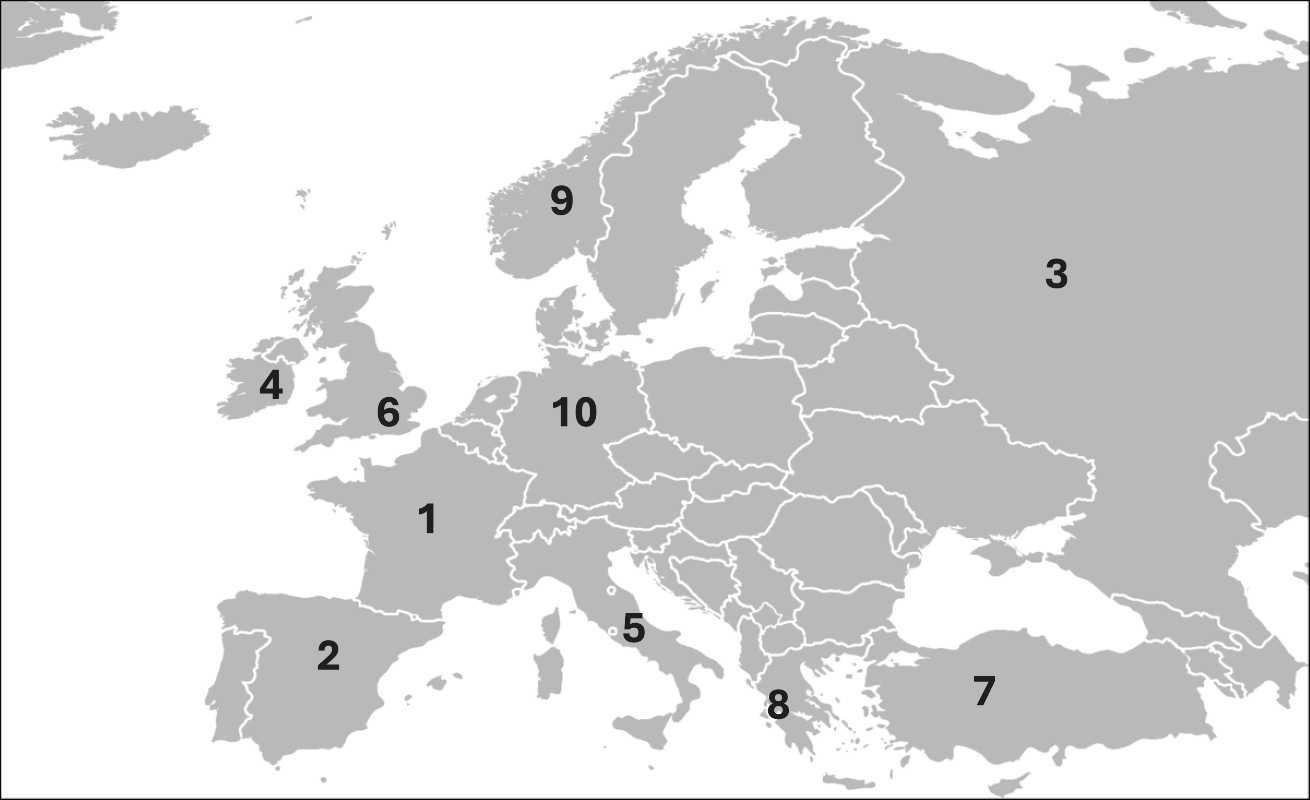
Beyaz PeynirGamalostSage DerbyManchegoKefalotyriMilbenkäseDaralagjazskyRoquefortCashel BlueGorgonzola* Drag / drop or click on the choices above to move them to the answer list. View Image Attributions for This Quiz
1.
2.
3.
4.
5.
6.
7.
8.
9.
10.
Most Recent Scores
Oct 20 2026
:
Guest 86: 1/10
Oct 16 2026
:
Guest 99: 10/10
Oct 15 2026
:
briarwoodrose: 10/10
Oct 14 2026
:
Guest 68: 1/10
Oct 14 2026
:
Guest 208: 4/10
Oct 13 2026
:
sarahcateh: 8/10
Oct 13 2026
:
Guest 84: 10/10
Oct 12 2026
:
chabenao1: 8/10
Oct 12 2026
:
thomas1975: 10/10
Quiz Answer Key and Fun Facts
1. Roquefort
Roquefort is one of France's most famous and historic cheeses, having been manufactured in the Roquefort-sur-Soulzon region of Southern France for over 600 years. It is a medium-hard blue cheese made from the milk of the local Lacaune sheep breed. Under French regulations known as the "appellation d'origine contrôlée", Roquefort cheese must be made in the region and matured in the local Combalou caves.
2. Manchego
Manchego cheese has its origins in the La Mancha region of central southern Spain. As with many historic European cheeses, there are strict national and EU-wide regulations regarding what can be sold as Manchego. It must be made within certain designated areas of La Mancha, and only with the milk of the Manchega sheep breed.
It also has to be matured for at least 60 days (but no more than two years), giving it a characteristic creamy texture and slightly nutty flavour.
3. Daralagjazsky
Daralagjazsky is a traditional Russian cheese originating from the Caucasus region. It is typically made from sheep's milk, although cow's milk versions do exist, and has a rich and distinctive flavour. The texture is firm yet crumbly, and it can be enjoyed both fresh and aged, lending itself well to a range of culinary uses.
4. Cashel Blue
Cashel Blue was one of the first "modern" Irish cheeses to become widely known and has won many awards. The first versions were created in 1984 by the Grubb family on their farm near Fethard in County Tipperary and sold locally. During the 1990s it started to become better known, and in 1999 the family began to manufacture it in larger quantities, and market it more widely.
As the name suggests, it is a blue cheese and is made from cow's milk (although some early versions did use sheep's milk). It has a creamy texture with a mild, tangy flavour, not as strong as some blue cheeses.
5. Gorgonzola
Gorgonzola is a famous Italian blue cheese, traditionally produced in the regions of Lombardy and Piedmont. It is made from cow's milk and is well known for its creamy texture, distinctive blue-green veining, and tangy, slightly spicy flavour. Gorgonzola can be enjoyed young and mild (known as dolce) or more mature and robust (piccante), making it a versatile addition to cheese boards and many classic Italian dishes.
6. Sage Derby
Sage Derby is a traditional English cheese that is easily recognised by its distinctive green marbling, which comes from the addition of sage leaves during the cheese-making process. It is a semi-hard cow's milk cheese with a mild, creamy flavour complemented by the subtle, herby notes of sage.
It traditionally originated in the county of Derbyshire in the English Midlands, but unlike some local cheeses it does not have protected status and can be manufactured elsewhere.
7. Beyaz Peynir
Beyaz Peynir is a classic Turkish white cheese, similar in style to Greek feta, and distinguished by its crumbly texture and slightly tangy, salty flavour. It can be made from either sheep's, cow's, or goat's milk, and is typically matured in a brine solution for six months or so. Many Turkish dishes employ it as an ingredient, and it can also be used raw in salads.
8. Kefalotyri
The traditional Greek hard cheese known as Kefalotyri is usually made from either sheep's or goat's milk. It is similar in style to the Italian Parmesan, and like that variety is especially suitable for grating over pasta and other dishes. It is typically pale yellow in colour with a firm texture and slightly salty flavour. Kefalotyri traces its history back over many centuries, as far as the Byzantine period in Greece.
9. Gamalost
Gamalost is a traditional Norwegian cheese which claims to trace its origins back to the Viking era (800-1000 AD). It is made from skimmed cow's milk and is notable for its unusual brownish colour and strong flavour. The cheese is naturally low in fat and high in protein and keeps well without refrigeration.
As such it was once a staple in the Norwegian diet, especially valued for its nutritional qualities during long winters.
10. Milbenkäse
The name Milbenkäse translates as "mite cheese", which gives a clue as to its manufacture. This German variety is made by fermenting the soft cheese known as quark in a wooden box along with flour and cheese mites. The mites excrete an enzyme in their digestive juices which makes the cheese ripen. Apparently, by the 1970s only a single elderly woman knew the traditional technique for making the cheese, but fortunately she passed the knowledge on to a local schoolmaster who revived the cheese, and it was saved for posterity. Proper Milbenkäse cheese is now only made in the village of Würchwitz, which has erected a statue of a cheese mite to honour its local specialty.
This quiz was reviewed by FunTrivia editor Bruyere before going online.
Any errors found in FunTrivia content are routinely corrected through our feedback system.
This is my Quiz List for the FunTrivia Stars scavenger hunt. As well as meeting the stated requirement, each quiz is of a different format (counting Photo Match and Mystery Sort as separate formats).