
FREE! Click here to Join FunTrivia. Thousands of games, quizzes, and lots more!
Quiz about Whos Been In The Library

Who's Been In The Library? Trivia Quiz


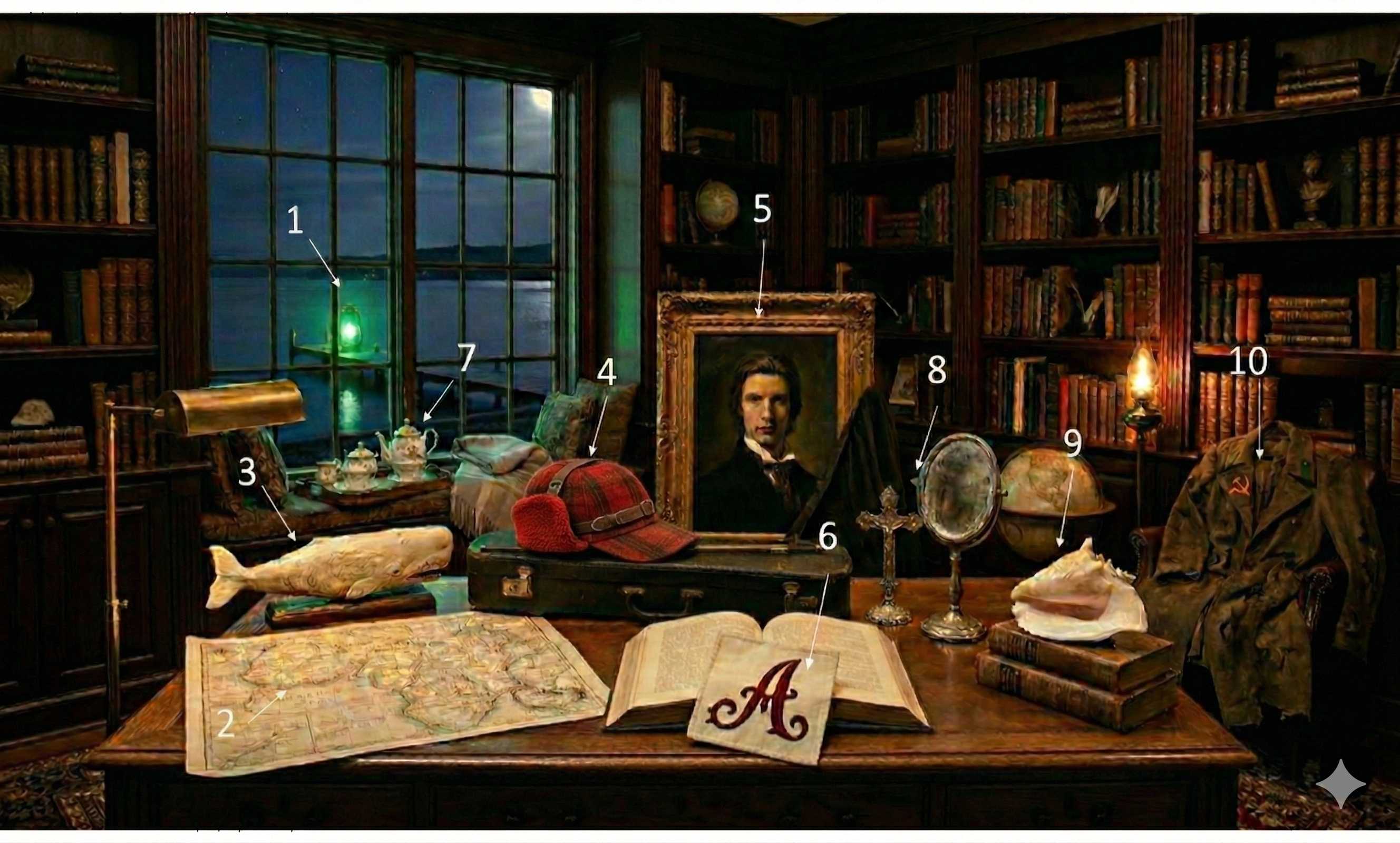
In the photo is a library where various authors across time have visited. Each author left behind something from their novel (usually one of the key symbols in the book). Match the author to the numbered item.

A label quiz by stephgm67. Estimated time: 3 mins.
  1. Home
  2. »
  3. Quizzes
  4. »
  5. Literature Trivia
  6. »
  7. Mixed Literature
  8. »
  9. Literary Classics

Author
stephgm67
Time
3 mins
Type
Label Quiz
Quiz #
423,288
Updated
Mar 04 26
# Qns
10
Difficulty
Average
Avg Score
8 / 10
Plays
94
Last 3 plays: Guest 31 (3/10), james1947 (10/10), Guest 63 (6/10).
Click on image to zoom
Jane Austen J.D. Salinger Joseph Conrad Leo Tolstoy F. Scott Fitzgerald William Golding Bram Stoker Nathaniel Hawthorne Herman Melville Oscar Wilde
* Drag / drop or click on the choices above to move them to the answer list.
View Image Attributions for This Quiz
1.   
2.   
3.   
4.   
5.   
6.   
7.   
8.   
9.   
10.   

Most Recent Scores
Today : Guest 31: 3/10
Today : james1947: 10/10
Today : Guest 63: 6/10
Today : Guest 99: 4/10
Today : Guest 37: 3/10
Today : Guest 72: 10/10
Today : jabb5076: 8/10
Today : Guest 98: 10/10
Today : dslovin: 6/10

Quiz Answer Key and Fun Facts
1. F. Scott Fitzgerald

A novel of the Jazz Age, "The Great Gatsby" was written by F. Scott Fitzgerald in 1925. Much like the people in the book, Fitzgerald lived in the fast-paced, hedonistic world of the 1920s. His volatile relationship with Zelda, his wife, heavily influenced his writing about unattainable love and wealth.

Narrated by Nick Carraway, the novel tells the story of Jay Gatsby, a mysterious millionaire, and his obsessive pursuit of Daisy Buchanan, a woman from his past who represents the elite lifestyle he has spent his whole life trying to attain.

In this classic novel, the green light hangs at the end of Daisy's dock in East Egg and can be seen from Gatsby's house in West Egg. Its distance represents the dream that is almost just out of reach. It can also serve as a beacon shining through fog, representing his love for her. The color green can mean money, as that is a theme throughout the novel. (My book club spent a long time discussing this symbol in the book!)
2. Joseph Conrad

"Heart of Darkness", by Joseph Conrad, was first published as a three-part serial in a magazine in 1899, then was later published as a complete book in 1902. In 1890, Conrad himself actually took command of a steamship on the Congo River, an experience that directly inspired "Heart of Darkness".

In the book, the protagonist, Charles Marlow, is telling a story on a boat while in London, recounting his voyage to Africa to a group of friends. He is hired by a Belgian company to captain a steamer and recover Kurtz, a legendary ivory trader who has gone insane deep in the heart of Africa. The trip is a slow journey into the interior of the continent, where Marlow witnesses the brutal inefficiency and cruelty of the colonial companies.

Maps were both a practical tool and a symbol throughout the novel. Marlow recalls his childhood fascination with maps, specifically the "blank spaces" on the earth. By the time he goes to the Congo, the blank, or "white patch", has become "a place of darkness". In the company's office in Brussels, he sees a map where different colonial powers have marked their territories in various colors. However, when Marlow actually gets to the continent he discovers that the truth does not reflect "map colors".
3. Herman Melville

Herman Melville's "Moby-Dick" was written in 1851. Melville wrote it from experience. He joined the crew of a whaleship in 1841, eventually deserting in the Marquesas Islands and living among the locals there.

The story itself is narrated by Ishmael, a schoolteacher who seeks the sea to cure his depression. He joins the crew of the Pequod, commanded by Captain Ahab. Ahab isn't interested in adventure or money; he is seeking revenge on a white whale, Moby Dick, who previously tore off his leg. The fate of the trip and crew is then an unfolding tragedy.

Moby Dick itself is a symbol. Because it is white, it is used as a "reflection" of the different characters' beliefs and thoughts. To Ishmael, the whale represents indifference of the universe while to Ahab the whale is a symbol of all the evil in the world. Also, Melville points out in the book that nobody can truly "know" a whale and thus it is a symbol of the unknown, like the vastness of the universe or what happens after death.
4. J.D. Salinger

J.D. Salinger's "The Catcher in the Rye" was written in 1951 and, although written for adults, became very popular with a teen audience who identified with the feeling of loneliness and alienation. Salinger was writing this novel when he participated in WWII and the trauma of the war influenced his writing. After the book's success, Salinger became a recluse from society for the rest of his life.

The novel is a first-person narrative told by Holden Caulfield from a mental health facility in California about a trip he had taken to New York. After being expelled from school, he spends several days wandering through the city while unsuccessfully trying to connect with strangers. The only person he truly loves and trusts is his younger sister, Phoebe. He dreams of being the "catcher in the rye" where he is standing at the edge of a cliff in a field of rye, catching children before they fall off. In the end, he realizes that pain and loneliness is the price of emotion.

Holden buys a "very loud" red hunting hat in New York for one dollar which becomes a key symbol in the book. When he feels vulnerable he wears the hat which is a sign of his need to be different from the "phony" people he feels surround him. The red color is also tied to the red hair color of his siblings (and only "friends"). Lastly, the earflaps provide a way to shut out the world. At the end, the cap is transferred back and forth between himself and Phoebe, showing the power of their relationship.
5. Oscar Wilde

Oscar Wilde's "The Picture of Dorian Gray" was published in 1890 and explores the consequences of living a life purely for pleasure and beauty with no moral restraint. Wilde himself believed that life should be a work of art but when the novel was first published in a magazine, it was attacked as "immoral" and "poisonous". During Wilde's later trials for "gross indecency," the book was actually used as evidence against him to suggest he had a "perverted" imagination.

In the novel, a talented artist named Basil Hallward paints a portrait of a beautiful young man, Dorian Gray. Dorian begins a hedonistic lifestyle while sitting for the portrait and makes a wish that the portrait would age and he would not. The wish was granted. As Dorian becomes morally corrupt, the portrait changes to reflect the hideousness of his actions.

The portrait itself is the most famous symbol in the book. It represents Dorian's true self. While Dorian remains eternally young and innocent-looking on the outside, every sin he commits appears as a scar or deformity in the painting. The gilded frame is a symbol that a gorgeous exterior can hide a rotting and putrid interior.
6. Nathaniel Hawthorne

Nathaniel Hawthorne's "The Scarlet Letter" was written in 1850 and is set in 17th-century Puritan Boston. The story was deeply rooted in Hawthorne's family as his great-great-great-grandfather was John Hathorne, the only judge from the Salem witch trials who never repented for his actions. Nathaniel was so haunted by this legacy that he added a "w" to his last name to distance himself from his family's history.

The story follows Hester Prynne who has given birth to a daughter, Pearl, out of wedlock. Because her husband has been missing at sea for years, she is convicted of adultery. As punishment, she is forced to stand on a scaffold for public shaming and must wear a scarlet letter "A" on her chest for the rest of her life. In a twist, the father is actually the town's beloved minister, Arthur Dimmesdale.

The "A" is a powerful symbol through the whole book. Initially, it starts as the symbol of Hester's shame as it stands for "adultery". However, as the years ago by, Hester becomes a seamstress and nurse for the town and her dignity and work change the "A" to now mean "able". When a meteor in the night sky appears as an "A", some people see it as "angel" while the reverend sees it as an evil omen.
7. Jane Austen

Jane Austen wrote "Pride and Prejudice" in 1813. It was a romance, a comedy, and also a critique of the British class system and the role of women at the time. Jane Austen lived a quiet life and focused her works on English families in country villages. She published her books anonymously ("By a Lady"). It wasn't until after her death that her brother revealed her identity to the public.

The novel follows Elizabeth Bennet, one of five sisters who must marry well because they have no brothers and their father's estate can only be inherited by a male. While each sister goes about this in different ways, Elizabeth meets the wealthy Mr. Darcy but finds him arrogant and cold (her prejudice). Darcy initially finds Elizabeth fascinating but her family as socially inferior (his pride). The novel explores their acts through the social customs of the day and their realization they were both wrong.

The tea set symbolized English status and the control of women in that era. Tea was an expensive luxury at the time and the act of presiding over a tea table was a "performance" of a woman's elegance and social standing. This "tea time" in the drawing room was also where women met and discussed both broad social issues and local rumors that flew.
8. Bram Stoker

The gothic novel "Dracula" was written by Bram Stoker in 1897. Stoker was the business manager for the Lyceum Theatre and many people believe that he based the physical presence and dramatic flair of Count Dracula on his boss, the legendary actor Henry Irving. Stoker never went to Transylvania himself and did all the research for the book in libararies in London.

The story of "Dracula" begins with Jonathan Harker, a young English lawyer, traveling to the Carpathian Mountains to help Count Dracula. While there, he is imprisoned in the castle and realizes that Dracula is a vampire. After Harker escapes, Dracula heads to London where he begins to make others into the undead. Chased across Europe, Dracula returns to Transylvania where he is eventually killed and his reign of horror stopped.

In Victorian folklore, a person's reflection was often seen as the "shadow" of the soul. Because Dracula is undead, he lacks this essence, hence he lacks a reflection. The mirror symbolizes his soul's emptiness. The crucifix, which Dracula abhors, symbolizes the power of humanity's faith in battling evil.
9. William Golding

William Golding's "Lord of the Flies", published in 1954, is about the "blackness of man's heart". Golding participated in WWII and was part of the the D-Day invasion. Seeing the capacity for human cruelty firsthand changed his view of humanity. He famously said, "Man produces evil as a bee produces honey". He wanted to write a book about what really happens when rules of society are no longer valid.

The story starts when a plane full of school boys is shot down over a deserted island. Two boys, Jack and Ralph, soon become the leaders and began instituting a form of "law". However, power quickly goes to their heads and soon the boys are all hunting wild pigs in brutal, savage games. After a bit, chaos reigns on the island and many deaths occur before any of the children are rescued.

After the plane crash, the boys find a pink and cream colored conch shell and determine that only the person holding the shell is allowed to talk. At this point the shell symbolizes democracy and the right to be heard. As the "democracy" starts to crumble, the shell bleaches to white and symbolizes the fading out of decency. At the end, the shell and the whole mini-civilization are shattered.
10. Leo Tolstoy

Leo Tolstoy's "War and Peace", written in 1869, is a massive work that blends fiction with the historical reality of the Napoleonic Wars. Tolstoy was a veteran of the Crimean War and had seen combat firsthand and felt that it was people themselves who controlled history.

The novel opens in St. Petersburg, Russia where the three main protagonists are introduced.They include the son of an count, a military prince, and a young girl. The book then focuses on the family life of each of the three and the star-crossed love between some of them. A large section of the tale then focuses, in grisly detail, on France's invasion of Russia, including the burning of Moscow. The latter part of the story then deals with the life lessons learned by each of the characters.

The greatcoat is a symbol in the book which means different things for different types of people. To leaders and generals, the "greatcoat" is simply a soldier who is to be sent to the field. To the actual foot soldier, their coat is their protection and safety in a harsh winter. Since most of the men wear the coats, it also symbolizes the anonymity of people, not only in a battallion, but humankind in the universe.
Source: Author stephgm67

This quiz was reviewed by FunTrivia editor MotherGoose before going online.
Any errors found in FunTrivia content are routinely corrected through our feedback system.
3/4/2026, Copyright 2026 FunTrivia, Inc. - Report an Error / Contact Us