FREE! Click here to Join FunTrivia. Thousands of games, quizzes, and lots more!
Quiz about Paths to Enlightenment

Paths to Enlightenment Trivia Quiz


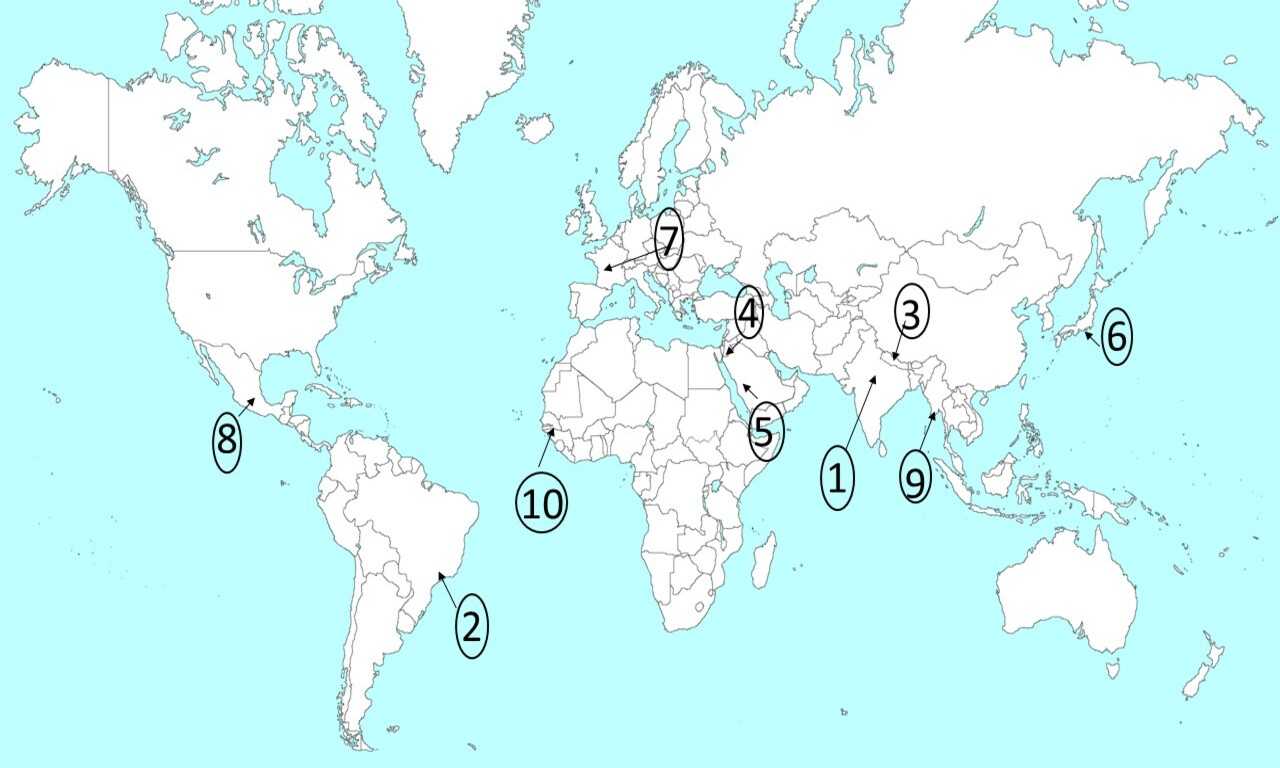
Many people around the world have gone on pilgrimages to holy religious sites to seek enlightenment and answers. Label each pilgrimage site with its appropriate location.

A label quiz by stephgm67. Estimated time: 3 mins.
  1. Home
  2. »
  3. Quizzes
  4. »
  5. Religion Trivia
  6. »
  7. Christianity
  8. »
  9. History of Christianity

Author
stephgm67
Time
3 mins
Type
Label Quiz
Quiz #
423,452
Updated
Mar 28 26
# Qns
10
Difficulty
New Game
Avg Score
9 / 10
Plays
16
Last 3 plays: xchasbox (4/10), JanIQ (10/10), Wendy55H (7/10).
Click on image to zoom
The Basilica of Our Lady of Aparecida Golden Pagoda/Shwedagon The Western Wall The Grand Magal of Touba The Kaaba Lourdes Basilica of Our Lady of Guadalupe Mount Kailash The Ganges River Ise Grand Shrine
* Drag / drop or click on the choices above to move them to the answer list.
View Image Attributions for This Quiz
1. Hindu  
2. Catholic  
3. Hindu, Buddhist, Jain, Bon  
4. Jewish  
5. Muslim  
6. Shinto  
7. Catholic  
8. Catholic  
9. Buddhist  
10. Mouride   

Most Recent Scores
Today : xchasbox: 4/10
Today : JanIQ: 10/10
Today : Wendy55H: 7/10
Today : Guest 86: 0/10
Mar 28 2026 : turaguy: 10/10
Mar 28 2026 : Victortennis: 10/10
Mar 28 2026 : ozzz2002: 6/10
Mar 28 2026 : mulligas: 8/10
Mar 28 2026 : Guest 124: 4/10

Quiz Answer Key and Fun Facts
1. The Ganges River

The Ganges River as a pilgrimage site is central to the Hindu spiritual practice and has been for over 2,500 years. The flowing water in northern India is believed to be a celestial river that descended from heaven to earth. Hindus will travel there because to bathe in the water is to wash away sins from both the present and past lives. Having one's ashes scattered in its waters is believed to help the soul break free from the cycle of rebirth. The river is seen as a bridge between the physical world and the divine realm.

The most significant event associated with a Ganges pilgrimage is the Kumbh Mela. It is often cited as the largest peaceful gathering of humans in the world, visible even from space. It is held on a rotational basis every 12 years at four locations, two of which are on the Ganges or at its confluence with the Yamuna River. These spots were chosen because, according to mythology, drops of the Amrita (the nectar of immortality) fell at these spots during a battle between gods and demons.
2. The Basilica of Our Lady of Aparecida

The Basilica of Our Lady of Aparecida, in Sao Paulo, Brazil, draws millions of pilgrims each year. For over three centuries, it has been a key part of the Catholic faith there. At its heart is a small clay statue of the Virgin Mary, found in 1717 by three fishermen in the Paraiba do Sul River. The fishermen pulled up the body first then the head. As soon as the statue was reassembled on the boat, the river was filled with fish. Pilgrims travel from across the continent to touch the glass protecting the image, believing that her intercession provides physical healing and spiritual protection.

The most significant event associated with this pilgrimage is the Feast of Our Lady of Aparecida, held annually on October 12th. The number of devoted visitors peaks during this national holiday, attracting upwards of 160,000 faithful in a single day. The Basilica itself is a massive structure built in the form of a Greek cross and is designed to hold a huge volume of people. These pilgrims often walk for hundreds of miles or climb the "Passarela da Fe" (Pathway of Faith) on their knees to fulfill vows made in exchange for miracles.
3. Mount Kailash

Mount Kailash, in a remote area of the Tibet region of China, holds a unique position as a sacred peak for four major religions: Hinduism, Buddhism, Jainism, and Bon. Rising to an elevation of 21,778 feet (6,638 m), its distinctive four-sided pyramidal shape is believed to be the physical manifestation of Mount Meru, the spiritual center of the universe. For Hindus, the mountain is the eternal abode of Lord Shiva, where he sits in perpetual meditation with his consort Parvati. This pilgrimage site is seen as the "Stairway to Heaven", a bridge where the earthly and divine planes intersect. Unlike other Himalayan peaks, Kailash has never been climbed; out of respect for its sanctity, it remains a forbidden summit, preserved as a pure space for the gods.

The primary ritual associated with Mount Kailash is the Kora, a grueling 32 mile (52 km) walk around the mountain's base. Pilgrims believe that completing a single circuit wipes away the sins of a lifetime, while completing 101 circuits ensures immediate enlightenment. The journey is a profound test of faith, as travelers must navigate high altitudes and several passes. Many Tibetan Buddhists perform the Kora through full-body prostrations.
4. The Western Wall

The Western Wall, in the Old City of Jerusalem in Israel, serves as a very sacred site where Jews can freely pray, acting as a profound physical link to their biblical past. While it is often called the "Wailing Wall" due to centuries of pilgrims weeping over the destruction of the Holy Temple, it is actually a retaining wall from the expansion of the Second Temple by Herod the Great in 20 BC. Many believe the "Divine Presence" never departed from this specific wall, making it a portal where prayers are directly received by the Almighty.

The most deeply personal ritual associated with a pilgrimage to the Western Wall is the placing of handwritten notes into the crevices between its massive limestone blocks. These slips of paper, containing prayers, pleas, or thanksgivings, transform the ancient stones into a living archive of prayer. People, Jewish and non-Jewish alike, make the journey to touch the stone and leave a missive. Twice a year, these notes are collected and buried on the Mount of Olives to ensure their sanctity is preserved.
5. The Kaaba

The Kaaba, located in Mecca, Saudi Arabia, serves as a sacred site in Islam, acting as a profound physical link to Abraham. While it is a distinct cuboid structure draped in the black Kiswah, it is recognized by Muslims not as an object of worship, but as the singular direction toward which all prayers on Earth are oriented. It symbolizes the oneness of the Almighty and the earthly anchor for the Divine presence.

The most deeply communal ritual associated with a pilgrimage to the Kaaba is Tawaf, the act of circling the structure seven times in a counter-clockwise direction. The Tawaf brings people from every corner of the globe, wearing the simple white Ihram garments, witnessing the House and, if possible, touching or kissing the Black Stone (al-Hajar al-Aswad) set into its eastern corner. This ancient stone is held in deep reverence and, according to tradition, was originally a white stone brought from Paradise, which turned black over time due to the sins of humanity. The prayers here are often voiced out loud with a collective statement of "Labbayk" (Here I am, O Lord) from the large crowd.
6. Ise Grand Shrine

The Ise Grand Shrine, located on the Kii Peninsula in central Honshu, Japan , serves as a sacred site in Shinto, acting as a spiritual link to the sun goddess Amaterasu Omikami. While the site itself is a complex of simple wooden structures, it is recognized by practitioners not merely as a historical monument, but as the living soul of Japan and the earthly dwelling of the Divine. It symbolizes the interconnectedness of nature, the imperial lineage, and the perpetual renewal of life.

The most significant pilgrimage act associated with Ise is Shikinen Sengu, the act of rebuilding the shrine's structures and renewing its treasures every twenty years. This tradition, starting over 1,300 years ago, brings together master carpenters and the faithful to recreate the sanctuary exactly as it was, using fresh cypress wood and ancient techniques. The ritual culminates in the solemn transfer of the shintai (the sacred mirror representing the deity) from the old shrine to the new.
7. Lourdes

The Sanctuary of Our Lady of Lourdes, located at the foot of the Pyrenees Mountains in France, serves as a premier site of pilgrimage in Catholicism, acting as a profound physical link to the Virgin Mary. It is centered around the Grotto of Massabielle, which is a jagged, natural rock formation. The sanctuary is recognized by the faithful as a site where the veil between heaven and earth was pulled back in 1858 AD. That is when a young girl saw a vision of the Virgin Mary and a miraculous spring came forth.

The most deeply communal ritual associated with a pilgrimage to Lourdes is the Lourdes water ritual, where pilgrims drink from and immerse themselves in the spring. This act of "taking the water" brings millions from every nation solemnly seeking spiritual or physical healing. At certain times of the year, the Marian Torchlight procession also occurs. Thousands of pilgrims carrying flickering candles shielded by paper shades travel through the sanctuary grounds. The tune of "Ave Maria" is historically heard at the site sung in dozens of languages simultaneously.
8. Basilica of Our Lady of Guadalupe

The Basilica of Our Lady of Guadalupe, located in Mexico City, is historically one of the most visited Catholic shrines in the world, acting as a physical link to the Virgin Mary. The structue is the home of the Tilma, which is a cactus-fiber cloak of a humble peasant miraculously imprinted with Mary's image. In 1531 AD, a peasant named Juan Diego experienced visions of the Virgin Mary and her image became part of his cloak. Under normal circumstances, the cloak should have disintegrated after 30 years or so, but it has survived over 500 years without fraying.

The most deeply communal ritual associated with a pilgrimage here is the Peregrinacion, the journey of millions who travel from the farthest reaches of Mexico and beyond. This act of "marching to the Mother" brings people of all backgrounds, many wearing traditional dress or carrying personal banners of their hometowns. The crowd silently walks beneath the Tilma. In the outside plaza, prayers are offered and songs sung to the Virgin Mary.
9. Golden Pagoda/Shwedagon

The Shwedagon Pagoda, located in Yangon, Myanmar, is one of the most sacred Buddhist sites in the area, serving as a link to four previous Buddhas. Structurally, it is a towering, bell-shaped monument plated in hundreds of gold bars and topped with a diamond-encrusted vane. It is recognized by the faithful not as a tomb, but as a treasury of the Divine, as it houses eight hairs of Gautama Buddha.

The most deeply communal ritual associated with a pilgrimage to Shwedagon is the water libation at the planetary posts. This practice brings together thousands who go to the site to find the specific "corner" of the octagon corresponding to the day of the week they were born. Then the pilgrims bathe a statue of the Buddha and a guardian animal with cups of cool water which is an act of symbolic purification. The ritual atmosphere reaches its height at dusk during the lighting of the oil lamps. Thousands of small terracotta lamps are lit by hand, creating a ring of light around the base of the golden building.
10. The Grand Magal of Touba

The Great Mosque of Touba, located in the plains of central Senegal, serves as the spiritual capital of Mouridism, honoring the Sufi saint Cheikh Amadou Bamba. It is a monumental structure featuring five towering minarets with the central one reaching toward the heavens. It is considered a place of prayer, and also as a place of refuge built on the site where Bamba had a vision of the Divine. It symbolizes the power of peaceful resistance and the "victory of the soul" over colonial oppression.

The most deeply communal ritual associated with this pilgrimage is the Grand Magal, an annual gathering of millions that commemorates Bamba's departure into exile by the French in 1895 AD. Unlike many pilgrimages that focus on mourning, the Magal is a ritual of gratitude. Pilgrims perform the Ziarat, a solemn visit to the tomb of Cheikh Amadou Bamba, moving through the mosque or sitting in religious circles chanting poems written by Bamba himself.
Source: Author stephgm67

This quiz was reviewed by FunTrivia editor looney_tunes before going online.
Any errors found in FunTrivia content are routinely corrected through our feedback system.
3/29/2026, Copyright 2026 FunTrivia, Inc. - Report an Error / Contact Us