FREE! Click here to Join FunTrivia. Thousands of games, quizzes, and lots more!
Anatomy of a Flower Trivia Quiz
During the warmer days of the year, flowers are all around us to brighten our lives, unless you suffer from hay fever. This quiz asks you to take a closer look and identify the individual parts which make up the flower.
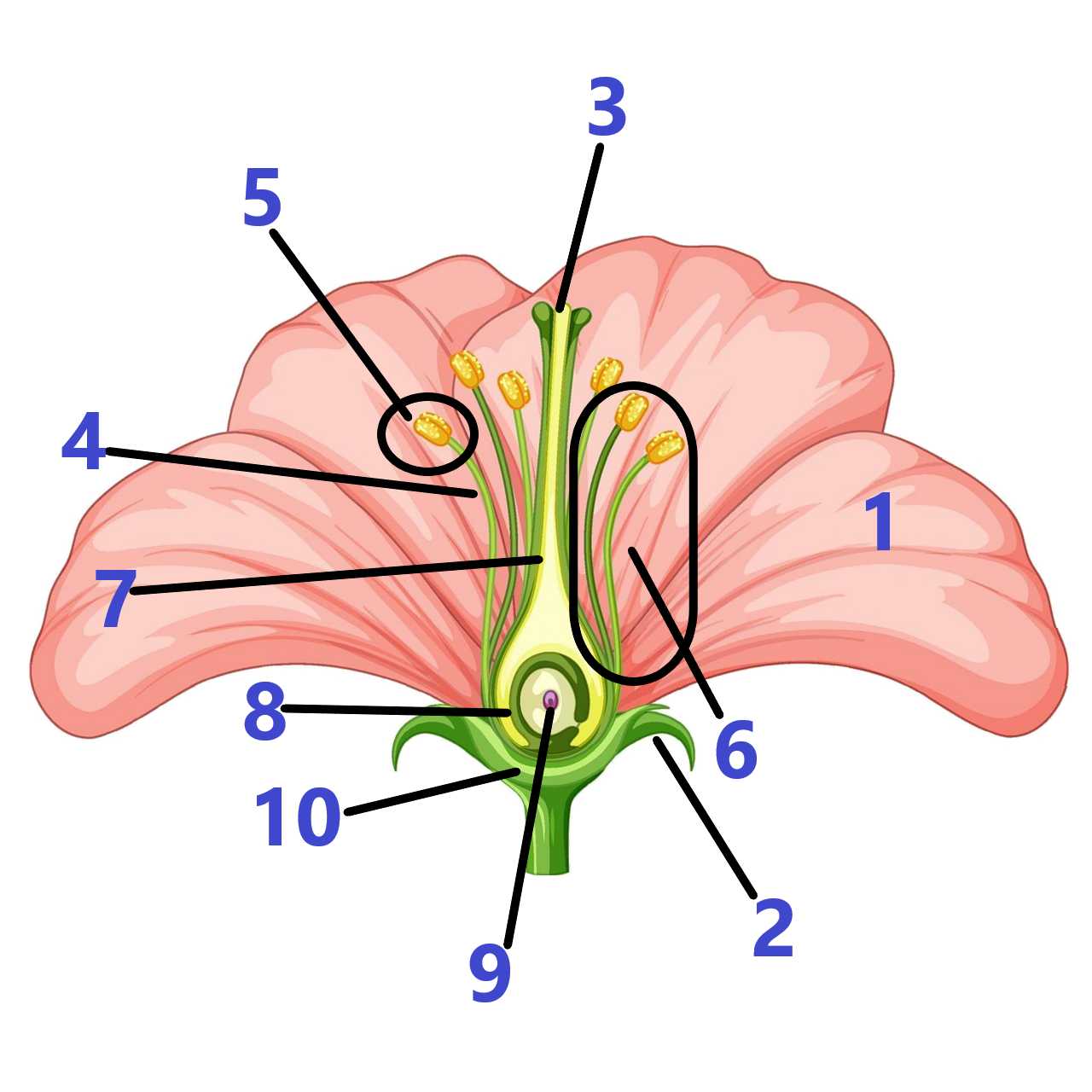
Identify the parts of a flower from the numbers listed
Click on image to zoom
SeedStyleOvaryStamenSepalStigmaReceptacleFilamentPetalAnther* Drag / drop or click on the choices above to move them to the answer list. View Image Attributions for This Quiz
Petals are the pretty and colourful parts of a flower which attract pollinators, such as bees, to them so they can propagate. They are sterile and are actually modified leaves, botanically. Petals are frequently arranged in groups of three or five, called monocots and eudicots respectively.
The whole group of petals is known as the corolla.
2. Sepal
The sepals are the part of the flower which protect the bud before it opens Once the flower is in bloom, the sepals remain visible below the petals. The sepal is often a modified leaf, but can sometimes be similar to petals.
The sepals as a whole are referred to as the calyx, while the petals and sepals together are called the perianth.
3. Stigma
The stigma is one part of the female reproduction area in flowers. If you look into a flower, the top of the stigma can be seen in the middle. It is often sticky, to catch and hold pollen grains before they are collected by insects who visit the flower.
The name derives from Latin, via Greek, and means 'mark' or 'spot'. Botanists used the term due to the shape of the area which can be seen.
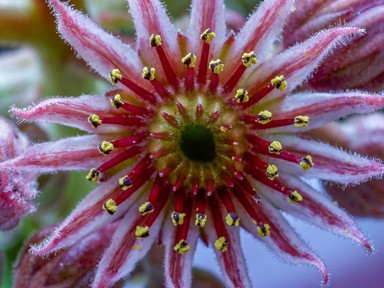
The cover photo shows the stigma in the middle of the flower.
4. Filament
With a name deriving from the Latin word for 'thread', the filament is a long, thin stalk which provides support for the anther, which sits at the top. Flowers have several filaments, which surround the style and form part of the male reproductive system of the plant.
Looking at the cover photo, you will see the filaments forming a circle in front of the petals.
5. Anther
The anther is the pollen producer of the plant. Flowers have several anthers, which sit of the top of the filaments. Most pollen is yellow and it is this which insects visiting the plant transport on their bodies and transfer to other plants, thus fertilising them.
The anthers are clearly visible in the cover photo.
6. Stamen
Together, the filament and anther are known as the stamen, forming the male reproduction system in flowers. To make the plant even more attractive to visitors, some stamens have nectaries, producing nectar, at their base so that bees, butterflies and birds, such as hummingbirds, dive even further into the flower collecting more pollen as they do so.
The stamens, as a group, are called the androecium.
7. Style
The style is the hollow tube which runs down the centre of the flower - the stigma is the top part of this. It is sometimes called the pollen tube as it is formed by pollen travelling down it to the ovary, to fertilise the seeds contained there.
The stigma, style and ovary combined are called the carpel. The pistil, which is similar in function, is made up of several carpels. These parts of the flower are the female reproductive organs.
8. Ovary
The ovary is where seeds are produced and kept until they are fertilised by pollen via the style. Ovaries in flowering plants contain ovules, which develop into seeds once fertilised by a grain of pollen. Depending on the type of flower, the ovary can develop into a fruit. If roses, to give one example, are left alone they will develop into a hip, a fruit which can be used in pies or jam. I can recall having rosehip syrup regularly when I was a child and it can still be found in health food stores and from online retailers.
Unfertilised ovules form the seeds in the fruit and can be used to propagate new plants.
9. Seed
As has been mentioned earlier, the seed develops from an ovule within the ovary. Ovules remain attached to the ovary wall by a stalk known as the funiculus. Once the ovule is mature, it can be fertilised by pollen and develop into a seed. Seeds generally have a coating which is often a hard case.
Dispersal can take place in various ways. Animals can eat the fruit, which is actually the mature ovary of the flower, and disperse the seeds by excretion. Others are carried by wind - think of dandelions as an example - while some depend on water to transport them.
10. Receptacle
The receptacle is the small, supporting part at the base of the flower where it joins the stem. It is also known as the torus or, historically, the thalamus. It is a thicker part of the stem and all the other parts of the flower are attached to, and supported by, it.
The receptacle also acts as the platform on which the eventual fruit will form.
This quiz was reviewed by FunTrivia editor WesleyCrusher before going online.
Any errors found in FunTrivia content are routinely corrected through our feedback system.