FREE! Click here to Join FunTrivia. Thousands of games, quizzes, and lots more!
Quiz about Climate Change

Climate Change Trivia Quiz


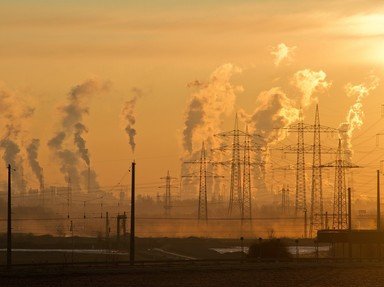
Greenhouse gases (GHG) emissions have had a severe impact on climate change since world begin to industrialize in the 18th century. This quiz covers some of the issues.

A multiple-choice quiz by sw11. Estimated time: 3 mins.
  1. Home
  2. »
  3. Quizzes
  4. »
  5. Science Trivia
  6. »
  7. Environment
  8. »
  9. Environmental Problems

Author
sw11
Time
3 mins
Type
Multiple Choice
Quiz #
423,898
Updated
Apr 26 26
# Qns
10
Difficulty
Average
Avg Score
6 / 10
Plays
34
Last 3 plays: Guest 86 (4/10), Guest 209 (3/10), Guest 68 (3/10).
- -
Question 1 of 10
1. IPCC is the leading international body for the assessment of climate change. What do the letters I and P stand for? Hint


Question 2 of 10
2. Over the past 100 years, carbon dioxide (CO2) emission has constituted about which percentage of the total emission of greenhouse gases? Hint


Question 3 of 10
3. CO2 emissions had risen 280 parts per million (ppm) from the pre-industrial period to what average level by March 2026? Hint


Question 4 of 10
4. The target agreed at the 2015 Paris Agreement is to limit global warming below what amount? Hint


Question 5 of 10
5. When compared over a 100-year period against CO2, which of these gases has the greater impact on warming the climate over a shorter period of time?


Question 6 of 10
6. Which gas remains in the environment for the shortest period of time? Hint


Question 7 of 10
7. IPCC has identified which gas as the most potent greenhouse gas over a 100-year period?


Question 8 of 10
8. What happen to the oceans when increasing amounts of CO2 are released into the atmosphere?


Question 9 of 10
9. Between 1880 and 2026, sea levels have risen by how much? Hint


Question 10 of 10
10. What is the title of the documentary produced by former American vice president Al Gore to raise awareness of the effects of global warming? Hint


(Optional) Create a Free FunTrivia ID to save the points you are about to earn:

arrow Select a User ID:
arrow Choose a Password:
arrow Your Email:


Most Recent Scores
Today : Guest 86: 4/10
Today : Guest 209: 3/10
Today : Guest 68: 3/10
Today : zartog: 4/10
Today : Guest 71: 2/10
Today : Guest 71: 5/10
Today : kyleisalive: 4/10
Today : Guest 24: 3/10
Today : Lindaellen: 4/10

Quiz Answer Key and Fun Facts
1. IPCC is the leading international body for the assessment of climate change. What do the letters I and P stand for?

Answer: Intergovernmental Panel

The Intergovernmental Panel on Climate Change (IPCC) was established in 1988 by the United Nations Environment Program (UNEP) and World Meteorological Organization (WMO). Its role is to provide the world with a clear scientific view on the current state of knowledge about climate change and its potential environmental and socio-economic impacts. Nearly 200 countries are members of IPCC.
2. Over the past 100 years, carbon dioxide (CO2) emission has constituted about which percentage of the total emission of greenhouse gases?

Answer: Nearly 75%

About 74.4% of CO2 was emitted into the environment. Other gases emitted were methane (17.3%), nitrous oxide (6.2%) and F-gases (2.1%).

The primary driver of CO2 emissions over the last century came from the burning of fossil fuels in power plants from coal, oil and natural gas. Until the 1960s, coal was the main source of fuel for power plants. About 45% to 50% of CO2 emissions came from coal, 30% to 35% from oil, and 15% to 20% from natural gas.
3. CO2 emissions had risen 280 parts per million (ppm) from the pre-industrial period to what average level by March 2026?

Answer: 490 ppm

The CO2 ppm level from the pre-industrial period rose from 280 ppm to 392 ppm in 2012. In 2016, the CO2 ppm level hit above 400 ppm.

In March 2, 2026, the daily average reached 492.41 ppm. This represents a total increase of about 149 ppm (over 50%) since the pre-industrial baseline of approximately 280 ppm. The concentration of CO2 in the atmosphere is the highest in the last 800,000 years.
4. The target agreed at the 2015 Paris Agreement is to limit global warming below what amount?

Answer: 1.5°C

The target set is to keep global warming below a rise of 1.5°C this century. To achieve this goal, the world needs to halve the annual greenhouse gas emissions in the next eight years, according to the Emissions Gap report 2021. Temperatures recorded from the nineteenth century show increase of 0.8°C. Approximately 0.6°C. was over the last three decades.
5. When compared over a 100-year period against CO2, which of these gases has the greater impact on warming the climate over a shorter period of time?

Answer: Nitrous oxide

One ton of nitrous oxide would generate 265 times the warming effect of one ton of CO2. Nitrous oxide remains in the atmosphere for about 121 years. Nitrous oxide emissions come mainly from agriculture when nitrogen fertilizers are applied to the soil
6. Which gas remains in the environment for the shortest period of time?

Answer: Methane

Methane remains in the environment for about 12 years. The warming effect is 28 times more than CO2 over a 100-yeer period. Methane emissions come from livestock, agriculture, biomass burning, waste and fossil fuel production.

It would take hundreds of years to return to pre-Industrial levels, as CO2 will remain in the atmosphere for hundreds of years even if CO2 emissions were to be dramatically reduced today.
7. IPCC has identified which gas as the most potent greenhouse gas over a 100-year period?

Answer: Sulfur hexafluoride (SF6)

SF6 emission is about 3 parts per trillion by volume. Although minute in comparison to other gases, the global warming potential of SF6 is 23,900 times greater than CO2 over a 100-year period. SF6 is an inert gas in the atmosphere with a lifetime of 800 to 3,200 years. The gas is used mostly in the electricity industry for its insulating properties.
8. What happen to the oceans when increasing amounts of CO2 are released into the atmosphere?

Answer: Increase in acidity

More CO2 intake results in the oceans becoming more acidic, as CO2 dissolves in seawater to form carbonic acid. This increase has an impact on coral reefs, as it prevents the coral from forming calcified skeleton. Corals, oysters, and tiny plankton need to build their shells and skeletons. Shells can dissolve in acidic water. The decline in small shelled organisms, which are their main food supply, threatens larger species, such as fish and whales.

The higher temperatures stress corals, causing them to expel the algae living in their tissues, resulting in coral bleaching. Without the algae, corals turn white and often die.
9. Between 1880 and 2026, sea levels have risen by how much?

Answer: 21 - 25 cm (8 - 10 in)

Sea levels rose at an average of 1.4 mm (0.06 in) per year in the 20th century. In the 21st century, the average rose by almost double to 3.6 mm (1.4 in).

Rises in temperature cause sea water to expand thermally. Thermal expansion makes the sea water increase in density, which leads to rising sea level. The other causes are melting of ice-caps and glaciers in the Arctic, Antarctic and Greenland.
10. What is the title of the documentary produced by former American vice president Al Gore to raise awareness of the effects of global warming?

Answer: An Inconvenient Truth

Al Gore, who is a strong activist in climate change, produced a documentary to raise public awareness of the dangers of global warming. It called for immediate measures to curb the destructive effects on the environment.

This documentary was released in 2006 and won two Academy awards for Best Documentary Feature and Best Original Song.
Source: Author sw11

This quiz was reviewed by FunTrivia editor rossian before going online.
Any errors found in FunTrivia content are routinely corrected through our feedback system.
4/26/2026, Copyright 2026 FunTrivia, Inc. - Report an Error / Contact Us