FREE! Click here to Join FunTrivia. Thousands of games, quizzes, and lots more!
Parts of the Human Eye Trivia Quiz
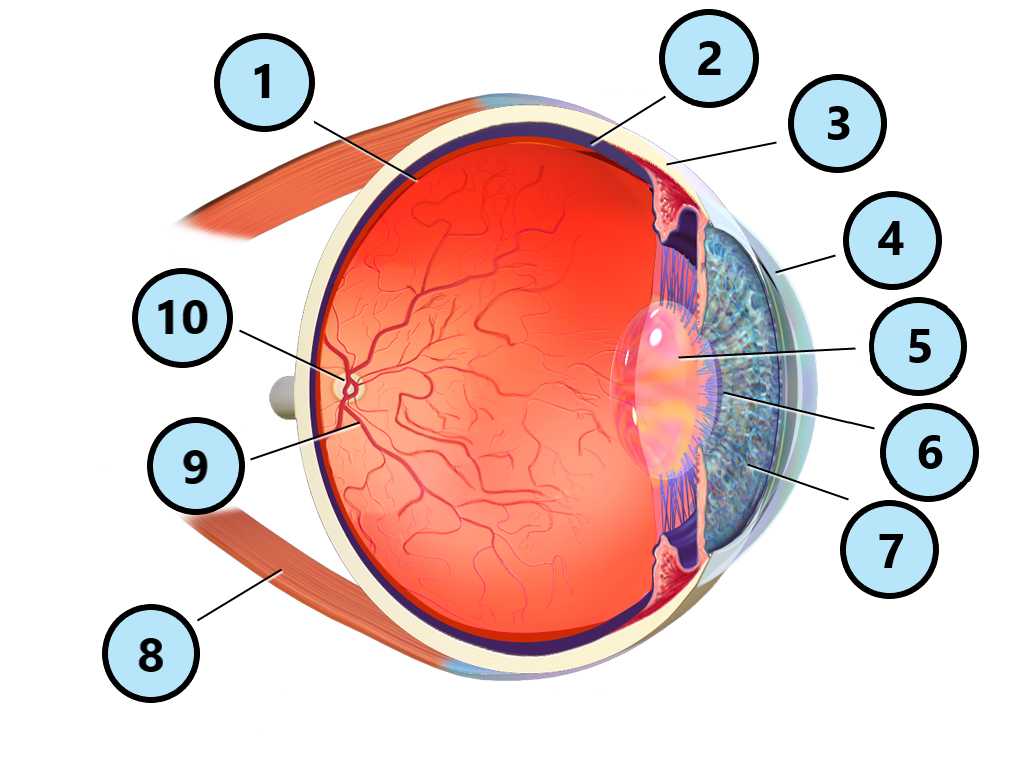
A most complex organ, the human eye requires several different parts in order for it to work properly. Can you label them using this Blausen Medical diagram?
retinalenschoroidscleramuscleoptic disciriscorneablood vesselspupil* Drag / drop or click on the choices above to move them to the answer list. View Image Attributions for This Quiz
The retina is a thin layer of tissue at the back of the human eye. It contains specialized cells called photoreceptors (which include rods and cones) that detect light and convert it into electrical signals. These signals travel through the optic nerve to the brain, where they are interpreted as images.
It also includes a small central area called the macula, which allows for the detailed vision needed for reading and recognizing faces.
2. choroid
The choroid is the layer of the human eye located between the retina and the sclera. It is filled with blood vessels that supply oxygen and nutrients to the retina. It also contains dark pigment that absorbs excess light, which prevents light from scattering inside the eye. This feature helps improve the clarity of the images we see.
3. sclera
The sclera is the tough, white outer layer of the human eye. Its main function is to help maintain the eye's shape and protect its inner structures. It is composed of strong connective tissue and acts like a protective shell around the more delicate parts of the eye. It also serves as a surface for muscle attachment, which enables the eye to move in different directions.
4. cornea
The cornea helps protect the eye, while also focusing light. As light enters the eye, the cornea bends it so that it can be properly directed toward the retina. This makes it essential for forming clear images. Unlike most other parts of the eye, the cornea does not contain blood vessels; instead, it receives oxygen directly from the air and nutrients from surrounding fluids.
5. lens
The lens is a flexible structure located behind the iris in the human eye. By changing its shape, the lens adjusts focus so that objects at different distances can be seen clearly, a process called accommodation. This ability allows the eye to switch between viewing things up close and far away.
6. pupil
The pupil is the small, dark opening in the center of the human eye that controls how much light enters. It appears black because the light that enters the eye is absorbed rather than reflected back out. The pupil changes size based on the level of light in the environment, expanding in dim light to allow more light in and contracting in bright light to limit it.
7. iris
The iris is the colored part of the human eye. It surrounds the pupil and controls how much light enters. The iris allows the pupil to change size, as it contains special muscles that make the pupil larger or smaller. Melanin is largely responsible for the coloring of the iris; people with more of this pigment typically have brown eyes, while those with less may have blue or green eyes.
8. muscle
Six muscles, called the extraocular muscles, are attached to the outside of each human eye and work together to move the eye up, down, side to side, and at angles. These muscles allow both eyes to stay aligned and track moving objects smoothly. Smaller muscles inside the eye also help control the size of the pupil and adjust the shape of the lens for focusing.
9. blood vessels
Blood vessels supply oxygen and nutrients to the eye and remove waste products. They are especially important in areas like the retina and the choroid, where cells need a constant supply of energy to function properly.
10. optic disc
The optic disc is a small area at the back of the human eye where the optic nerve connects to the retina. It is the point where nerve fibers leave the eye to carry visual information to the brain. This area does not contain photoreceptors, which means it cannot detect light and creates what is known as a blind spot in vision. Normally, this blind spot is not noticeable because the brain fills in the missing information using input from the other eye.
This quiz was reviewed by FunTrivia editor rossian before going online.
Any errors found in FunTrivia content are routinely corrected through our feedback system.