Last 3 plays: Datsmeharse (2/10), Ampelos (6/10), Aph1976 (6/10).
Click on image to zoom
Vena cavaHeartHepatic portal veinLiverPulmonary veinHepatic veinKidneysPulmonary arteryStomach, intestinesAorta* Drag / drop or click on the choices above to move them to the answer list. View Image Attributions for This Quiz
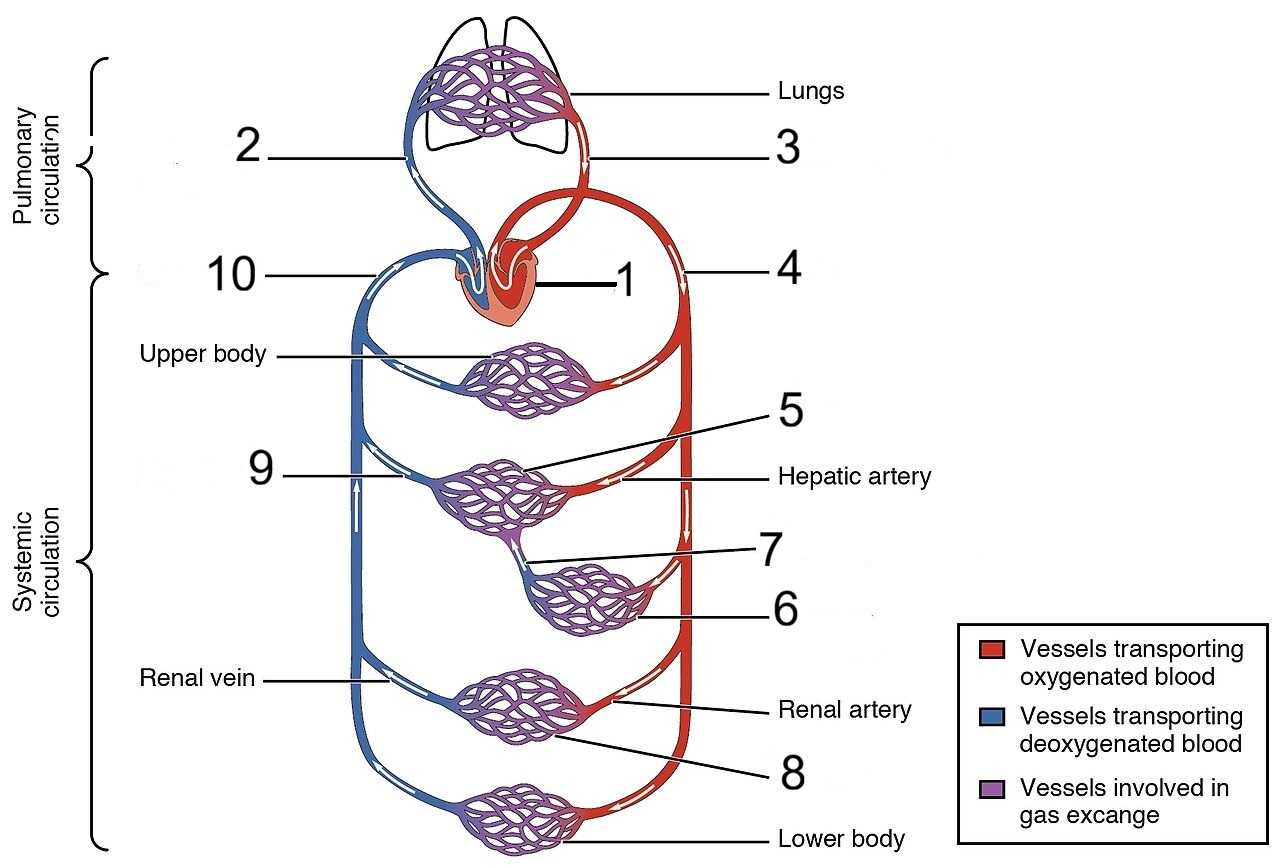
Here we are at circulation central! The heart's regular contractions push blood out into the two main divisions of the body's circulatory system, alternating between the pulmonary and main body circuits. The mammalian heart has four chambers, with the upper chamber on each side (called the atrium) receiving blood as it enters the heart, and the lower one (called the ventricle) responsible for sending it out again.
The heart could form the basis for an entire quiz, but for now we will leave it with this basic description, which will see some expansion as we consider the other parts of the diagram.
2. Pulmonary artery
The pulmonary subsystem takes deoxygenated blood from the heart to the lungs. The pulmonary artery is the largest artery in this subsystem, taking blood from the right ventricle. (Note that the side of the chamber is described from the perspective of the individual looking down at their own chest, so the view in the diagram shows it on the left side.)
While one usually thinks of arteries as carrying bright red oxygenated blood, that is only true for the systemic circulatory subsystem. For the pulmonary subsystem, the arteries carry blood that are low in oxygen and high in carbon dioxide - as indicated in the diagram by their blue colour. The blood isn't actually blue, it is a dark purplish colour, but blue is conventionally used to indicate deoxygenated blood.
3. Pulmonary vein
After leaving the heart, the blood travels through arteries of steadily decreasing size, until they reach the lungs where the blood vessels contact the alveoli, small cavities in the lung which fill with air when you inhale. At this point the blood vessels are called capillaries, the bridge between arteries and veins where the blood can gain and lose dissolved substances through the very thin walls of the blood vessels. Since this air has less carbon dioxide and more oxygen than the blood, the process of diffusion allows the gases to transfer from the area of higher concentration to that of lower concentration (CO2 blood to air, O2 air to blood).
This process continues for the entire time the capillaries are in contact with the lungs. They gradually recombine to create larger blood vessels, which are now called veins, as they are on their way back to the heart. The largest of these is the pulmonary vein, which delivers oxygenated blood to the left atrium.
4. Aorta
Once the oxygenated blood is in the heart, it passes from the left atrium to the left ventricle, the lower chamber on the same side, through the mitral valve. From there it enters the aorta, the largest artery. Because this blood is under the highest pressure from the heart's contractions (it has to have enough impulse to carry through quite a large system of blood vessels), it has quite thick walls.
The aorta leaves the heart pointing in an upward direction, before curving around to head towards the abdomen. The first part, called the ascending aorta, sees smaller arteries branching off to the head and arms. The descending aorta carries blood down into the thorax and the abdomen, and again sees arterioles branching off towards various organs. The aorta finally ends when it branches into the iliac arteries (supplying blood to the pelvis and legs) and the median sacral artery (a vestigial artery in humans, which interacts with several other blood vessels in the pelvic area).
5. Liver
As the aorta travels through the abdomen, it has a number of branches, including the celiac artery whose three main branches lead to various internal organs. Each of these has a specific name related to the organs it serves. The left gastric artery goes to the stomach, the splenic artery to the pancreas, and the hepatic artery to the liver.
This is a bit of an over-simplification, as, for example, the common hepatic artery itself has branches that include the proper hepatic artery (to the liver), the right gastric artery (to the stomach) and the gastroduodenal artery (to the pylorus and proximal area of the duodenum). But for your semester exam, let's leave it with one main organ for each branch.
6. Stomach, intestines
While it may not be obvious until you have worked out some of the other parts of the diagram, this tangle of capillaries is serving the stomach and intestines, following the branching of the aorta into the celiac artery. It can be deduced either because the other main body parts are located elsewhere, or because you know that the hepatic portal vein goes into the liver on its way back to the heart.
While we often talk about the circulatory system in terms of oxygen and carbon dioxide, that is only one of its significant functions. Here in the digestive system, it also performs the essential task of accumulating molecules of digested nutrients, and carrying them to the parts of the body where they can be synthesized into the new molecules the body needs to function. Once again, this happens in capillaries whose thin walls allow molecules to pass through from areas where they are concentrated onto the blood, where the concentration is lower.
7. Hepatic portal vein
Also just called the portal vein, this is not actually a vein, as the blood it carries is taken to liver capillaries, not directly to the heart. However, the blood does have less oxygen that is found in the blood vessels that entered the gastrointestinal tract.
It has also accumulated a significant amount of nutrients, along with a lot of undesired elements from the process of digestion, which are carried to the liver for cleansing. About three quarters of the blood flowing through the liver is delivered by the portal vein, rather than directly by the hepatic artery.
8. Kidneys
The final specific delivery point of the circulatory system shown in this diagram is the kidneys, which are served by the renal arteries - one for each kidney. They carry nutrients for the kidneys but, more importantly, they carry a truckload of waste products from the gastrointestinal system, sent to the kidneys to be filtered out and removed from the body. The kidneys are composed of a lot of small structures called nephrons which facilitate transfer of toxins from the blood, to be processed into urine by the kidney.
Now that the general process of delivering nutrients and collecting waste has been completed by the arterial system, it is time for the capillaries to recombine into venules (small veins), then into veins, and return to the heart.
9. Hepatic vein
There are a number of veins that recombine to get the blood back to the heart, many of which are named for their location. The hepatic vein drains the deoxygenated (and detoxified) blood from the liver, and takes it along to the inferior vena cava.
While this diagram suggests that there is a single hepatic vein, this is often considered as being the result of the joining of three distinct hepatic veins (left, middle and right), each originating from a different segment of the liver.
10. Vena cava
This might more accurately be labelled venae cavae, as there are two large veins that meet as they return the blood from the systemic circulatory system to the heart. The upper vena cava brings blood that has travelled through the upper body, while the inferior vena cava gathers all the veins carrying blood that has passed through the abdomen and lower body. Both veins deliver their blood to the right atrium, the upper chamber on the right side of the heart.
Once the blood has returned to the heart from the body, it passes through the tricuspid valve to the right ventricle, and we are back where we started, with a journey to the lungs next on the agenda.
This quiz was reviewed by FunTrivia editor rossian before going online.
Any errors found in FunTrivia content are routinely corrected through our feedback system.