FREE! Click here to Join FunTrivia. Thousands of games, quizzes, and lots more!
Vietnam Ease Trivia Quiz
Vietnamese Cultural Symbols
"Ease" into this classification quiz by simply identifying these ten Vietnamese cultural symbols by whether or not they are foods. I hope it's easy enough for you!
A classification quiz
by trident.
Estimated time: 3 mins.
Pho is by far the most famous Vietnamese soup on the planet, with its rich broth, rice noodles, and pieces of tender meat (typically beef or chicken). Within Vietnam, there are numerous variations, but historians generally agree that the dish first became popularized in the early twentieth century, likely in the 1910s. One of the soup's strengths is that it can be garnished in innumerable ways, with pho restaurants outside the country itself offering local sauces and spices.
2. Banh mi
Answer: A Vietnamese Food
Borrowing a number of ingredients from French cuisine, a legacy of that country's colonial rule in Vietnam, the banh mi transforms the baguette into a flavorful sandwich. Vegetables typically include carrots, cucumbers, and radishes that have been pickled, along with proteins such as barbecued pork, pork sausage, or even tofu. French condiments, such as pate or mayonnaise, finish off the sandwich. Along with pho, this food has come to represent Vietnamese cuisine worldwide.
3. Bun cha
Answer: A Vietnamese Food
Served with a savory, tart dipping sauce, bun cha consists of a small spread of food items that are dipped and eaten as desired. Rice noodles and grilled pork are mostly mandatory, but other food items might include fresh lettuce or herbs, bean sprouts, spring rolls, and grilled pork patties. If you were thinking of trying one new Vietnamese food, this would be the one I recommend the most.
4. Goi cuon
Answer: A Vietnamese Food
When imagining Asian cuisine, it wouldn't be wrong if your mind settled on an image of spring rolls. However, with Vietnamese goi cuon, you have what some would call a "summer roll," a non-crispy version made with thin rice paper instead of being wrapped and fried.
The wrapping is so thin that you can see the ingredients inside, usually shrimp and pork along with vegetables. Various dipping sauces are usually included on the side, such as hoisin sauce, peanut sauce, or nuoc cham (made with fish sauce).
5. Com tam
Answer: A Vietnamese Food
Originally prepared and eaten by poor rice farmers, com tam is a rice dish made primarily with "broken rice," small fragments of rice that break off during processing and do not make it into packages of whole-grain rice. Broken rice is generally considered less desirable, but it can still make a delicious meal. Along with the special rice, com tam includes grilled pork, vegetables, sauce, and often a type of Vietnamese egg omelet.
In Vietnamese culture, chopsticks are often used, but com tam is generally eaten with a spoon and fork.
6. Ao dai
Answer: Not a Food
Ao dai is traditional Vietnamese clothing for both men and women consisting of a long tunic worn over silk trousers. It is worn on formal occasions and has a history that goes back as far as the eighteenth century. French fashion designs influenced the modern ao dai style in the 1950s, particularly those worn by women. During communist rule, the clothing style became a complicated issue, as it was a traditional garment but one that many considered had become too intertwined with foreign influences and seen as too decadent. Nowadays, the ao dai is embraced by most Vietnamese people as a patriotic symbol of the country.
7. Non la
Answer: Not a Food
Non la, translated as "leaf hat," is mainly used to refer to the pointed, conical hat worn by Vietnamese laborers to protect them from the sun's harsh rays and from rain. It has become an iconic symbol associated with Vietnamese rice fields. It can be made from many different types of leaves, including palm leaves, and is usually crafted with a bamboo frame.
A special dance typically performed by young girls called the "non la dance" uses the hat as a prop to hide the dancers' faces and to swing around in patterns.
8. Tet
Answer: Not a Food
Tet refers to the Vietnamese New Year, considered the most important celebration in Vietnamese culture. It generally falls near the end of January or the beginning of February. The holiday, like many lunar new year celebrations across East and Southeast Asia, shares historical roots with the Chinese New Year.
However, Tet has developed its own specific traditions and customs that set it apart. Returning to family, cleaning one's house, visiting relatives' graves, giving money, and preparing special Vietnamese foods are all common.
9. Cai Rang
Answer: Not a Food
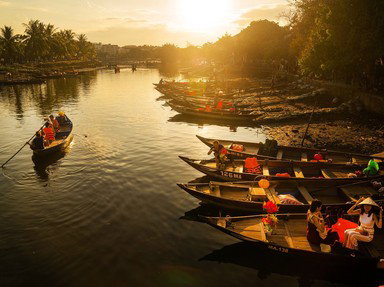
The Cai Rang floating market, in the district of Cai Rang, is a famous symbol of Vietnam. There you can rent a small boat and make your way across the waterways, stopping at various vendors, who are also in small boats. Fruits, vegetables, and other cooking ingredients are the most common items for sale, though as the floating market becomes more and more famous, small trinkets and souvenirs are becoming more popular. If you are curious what might be for sale on a particular boat, some vendors raise tall "beo" poles, with their various products tied to them.
10. Da Nang
Answer: Not a Food
Da Nang is a city in central Vietnam, popular as a tourist hotspot, international port, and cultural hub. It is flanked by both mountains and the ocean, making it an ideal location for photographers. Bisected by a river, the city has also constructed a number of uniquely designed bridges, such as the Dragon Bridge, which resembles a dragon, and the Golden Bridge, which looks like a pair of giant stone hands lifting the bridge up from the mountainside.
This quiz was reviewed by FunTrivia editor stedman before going online.
Any errors found in FunTrivia content are routinely corrected through our feedback system.