FREE! Click here to Join FunTrivia. Thousands of games, quizzes, and lots more!
Quiz about The Echidna Beaks Spikes and Puggles

The Echidna: Beaks, Spikes, and Puggles Quiz

The Short-Beaked Echidna

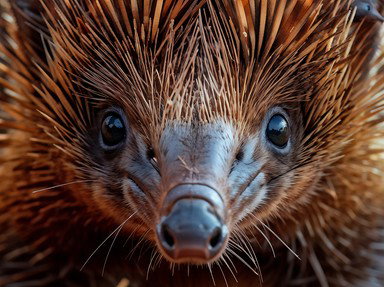
If you've ever seen a potato with spikes and a funny nose waddling across the landscape, you may have just spotted a short-beaked echidna, by far the most common species of these strange monotremes. Here are ten questions about the little critter. Enjoy!

A photo quiz by JJHorner. Estimated time: 2 mins.
  1. Home
  2. »
  3. Quizzes
  4. »
  5. Animal Trivia
  6. »
  7. Wild Mammals
  8. »
  9. Marsupials and Monotremes

Author
JJHorner
Time
2 mins
Type
Photo Quiz
Quiz #
423,730
Updated
Apr 08 26
# Qns
10
Difficulty
New Game
Avg Score
7 / 10
Plays
14
Last 3 plays: Guest 108 (6/10), klotzplate (10/10), bluepeter46 (6/10).
-
Question 1 of 10
1. Where are you most likely to find a short-beaked echidna? Hint


Question 2 of 10
2. What is the primary diet of the short-beaked echidna in the wild? Hint


Question 3 of 10
3. Like platypuses, echidnas lay eggs.


Question 4 of 10
4. What is the main purpose of the backward-pointing hind claws in the short-beaked echidna? Hint


Question 5 of 10
5. Which sensory ability helps the short-beaked echidna locate prey underground? Hint


Question 6 of 10
6. What term describes the behavior in which multiple males follow a single female in a line during the breeding season of the short-beaked echidna? Hint


Question 7 of 10
7. Which of the following behaviors is commonly used by short-beaked echidnas when threatened? Hint


Question 8 of 10
8. Which behavior helps the short-beaked echidna regulate its body temperature in hot conditions? Hint


Question 9 of 10
9. What is the name given to a baby echidna? Hint


Question 10 of 10
10. Echidnas have the lowest average body temperature of any mammal.


(Optional) Create a Free FunTrivia ID to save the points you are about to earn:

arrow Select a User ID:
arrow Choose a Password:
arrow Your Email:


View Image Attributions for This Quiz

Most Recent Scores
Today : Guest 108: 6/10
Today : klotzplate: 10/10
Today : bluepeter46: 6/10
Today : linkan: 9/10
Today : thomas1975: 6/10
Today : camulos: 8/10
Today : Aph1976: 6/10
Today : Peachie13: 10/10
Today : Guest 71: 9/10

Quiz Answer Key and Fun Facts
1. Where are you most likely to find a short-beaked echidna?

Answer: Australia

Did you have the kind of mother who could take a week's worth of leftovers, throw it into a casserole, and call it dinner? That's kind of what echidnas look like, and the short-beaked echidna is no exception.

They're spiny like hedgehogs, lay eggs like reptiles, and nurse their young like mammals, except... well, there were no nipples left in the fridge. They secrete milk through special pores instead.

Welcome to the extremely weird club affectionately called monotremes. You'll mostly run into them in Australia, where they shuffle around forests, deserts, and just about anywhere that has tasty arthropod tartare on the menu. They're not picky eaters, but they are very picky about being left alone. I can totally relate.

Now, technically they didn't stop at Australia. Echidnas also hang out up in New Guinea, where a few different species live, including some that are a lot hairier than their Aussie cousins.
2. What is the primary diet of the short-beaked echidna in the wild?

Answer: Ants and termites

Sure. Echidnas are just walking insect vacuums. Out in the wild, their main diet consists of ants and termites, and they take their jobs very seriously. Short-beaked echidnas, in particular, are famous for bulldozing anthills and termite nests. They use their strong claws to tear things open, then deploy their long, sticky tongues that flick in and out faster than you'd expect from something that wobbles like me getting out of bed in the morning.

Echidnas have a surprisingly refined system for this whole operation. Their snout is packed with electroreceptors that help them detect the tiny electrical signals of their prey. So while we're out here squinting at the ground, trying to find where we dropped our car keys, they're scanning for lunch like a superhero. Once they lock in, it's game-over for whatever colony they've invited to dinner that day.

Echidnas have no teeth, so all those squirmy bugs get mashed up using the keratinous pads in their mouths. Sounds kind of gross, but it works well... and guaranteed to turn any ant colony into a smoothie in no time.
3. Like platypuses, echidnas lay eggs.

Answer: True

Yeah, echidnas and platypuses like being difficult. Again, they're from that casserole we call the Monotremata order. They don't play by anybody's rules, and they don't care what you think.

I should point out that the egg in the image is not to scale.

Instead of giving birth to live young, they lay eggs. Actual eggs. The echidna lays a single soft, leathery egg and tucks it into a temporary brood pouch, which sounds cozy, especially considering the rest of Mom's body is covered in spines. The egg hatches after about ten days. Way to go, Mom!

But things get stranger. Echidnas don't have nipples. None. So when it's time to feed the baby, the mother secretes milk through specialized skin patches, and the baby, called a puggle, just sort of laps it up from the surface. The pouch sticks around for a while after hatching, giving the tiny, underdeveloped puggle a safe place to grow before it gets relocated to a burrow. Eventually, those spines come in, and sharing a pouch stops being a fun idea for everyone.

Monotremes split off from other mammals a very long time ago, so they kept some reptile-like traits while still being fully mammalian. Hair, warm blood, milk production. Check, check, and check. Egg-laying. Well, also check. I'm not one to tell them they're doing it wrong.
4. What is the main purpose of the backward-pointing hind claws in the short-beaked echidna?

Answer: Grooming

The short-beaked echidna has this oddly specific feature that belongs on a medieval tool but is actually for personal hygiene. On each hind foot, one of the claws is elongated and curves backward. It seems like someone put something in the casserole that definitely shouldn't be there, until you see the echidna's grooming habit. Turns out, when you're covered in dense fur and a forest of stiff spines, you need something a little more heavy-duty than a comb.

These backward-pointing claws are perfect for reaching in between the spines, where dirt, parasites, and the general horrors of Australia tend to accumulate. The echidna will use them to scratch and rake through its coat, keeping things relatively clean and under control. It's not a spa day situation, but it works as some quick maintenance before getting back to digging for bugs.
5. Which sensory ability helps the short-beaked echidna locate prey underground?

Answer: Electroreception

The short-beaked echidna has a superhero trick up its sleeve, or it would if echidnas had sleeves. It's called electroreception. Its snout can detect tiny electrical signals produced by the muscle movements of other animals. Ants and termites aren't exactly broadcasting loud signals, but when you've got thousands of them twitching around underground, it adds up. The echidna sweeps its snout over the ground like it's running a scan in a sci-fi movie, picking up on where the action is happening without needing to actually see anything.

This ability comes from specialized receptors in the skin of the snout, similar in concept to what you find in the platypus, although not quite as advanced. The platypus is the king electroreceptive monotreme here, detecting electrical signals in water with impressive precision, while the echidna uses a simpler version suited for land.
6. What term describes the behavior in which multiple males follow a single female in a line during the breeding season of the short-beaked echidna?

Answer: Echidna train

I swear I didn't make that up! The short-beaked echidna has one of the strangest dating scenes in the animal world. And yes, it's called an 'echidna train.'

It's exactly what it sounds like. During the breeding season, a single female will wander around with a line of males trailing behind her, sometimes for days or even weeks. It's a wobbly, waddling, slow-moving conga line of spiky introverts, all pretending this is perfectly normal social behavior. (In human civilizations, we generally call it 'stalking'.)

The males don't fight it out immediately. Instead, they just follow. Patiently. Awkwardly. The line can be anywhere from a couple of males to as many as ten, all shuffling along behind the female as she goes about her business. And you know what the other female echidnas have to say about the lass being followed by ten males.

Over time, weaker or less determined males drop off, until only the most persistent ones are left. So yeah, basically, the first competition is endurance. How long can you wobble? Echidnas have their own kinks, too.
7. Which of the following behaviors is commonly used by short-beaked echidnas when threatened?

Answer: Digging down and exposing its spines

Echidnas are too cool to panic. They opt for stubborn defiance and wish any potential threat good luck dealing with a big ball of spikes.

And the short-beaked echidna is a perfect example. When something sketchy shows up, it doesn't sprint off like a normal animal. Instead, it starts digging if it can. Immediately. Straight down. Those powerful claws go to work, and within minutes it can anchor itself into the ground so only a dome of sharp spines is exposed. A predator's would-be meal just turned itself into a half-buried cactus.

If the ground's too hard or time's up, they switch tactics, and curl into a tight ball. It's a classic move, and they commit to it. All the soft parts get tucked away, and what's left is a compact bundle of spikes pointing in every direction. Predators like dingoes or birds of prey will generally decide pretty quickly that it's not worth the effort. It's a defense strategy built on a dare. "Go ahead. Try. See how you feel in a few minutes." It makes up for their low-speed wobbling. If you can't outrun the danger, outlast it.
8. Which behavior helps the short-beaked echidna regulate its body temperature in hot conditions?

Answer: Seeking shelter in burrows

The short-beaked echidna doesn't do well with extreme heat. When it gets too hot, it prefers to just... disappear. It digs burrows or slips into existing ones, creating a little underground refuge where things are cooler. Soil is good at buffering temperature swings, so even a shallow burrow can feel like stepping into the shade. Whatever works, mate.

They're not perfectionists about it, though. Sometimes it's a proper burrow they've dug themselves, other times it's a hollow log, a rock crevice, or a conveniently abandoned hole.

Echidnas can also reduce their activity during hotter parts of the day, shifting more toward early morning, evening, or even nighttime habits when needed. It's less about fighting the environment and more about avoiding it.
9. What is the name given to a baby echidna?

Answer: Puggle

Okay, they're not baby-hedgehog cute, but baby echidnas are still pretty darn delightful. They also happen to have one of the most dangerously cute names in the animal kingdom. They're called puggles. Yes, puggles!

When a short-beaked echidna hatches its single egg, the newborn is tiny, pink, and medium-rare at best. No spines yet, no real defenses, just a squishy little creature that looks nothing like the spiky wobbler it's going to become. It immediately crawls into the mother's pouch, which is temporary and gets the job done.

Inside the pouch, the puggle latches onto those milk-secreting patches since, once again, echidnas skipped the whole nipple thing, which is just a crime. It shouldn't work, but it does. The puggle stays there for a while, growing and developing until those spines we all love start coming in. And that's when things get a bit less cozy. Living in a pouch full of sharp points is not a good plan for anyone involved.

So Mom moves the puggle into a burrow, where it continues to grow while she comes back periodically to feed it. Drop the kids off. Bring snacks. Fair enough. Eventually, the puggle develops fully into a miniature version of an echidna, spikes and all, ready to begin a life of quiet digging and sucking insects. It's a living.
10. Echidnas have the lowest average body temperature of any mammal.

Answer: True

Echidnas run a little... cool by mammal standards. The short-beaked echidna usually clocks in with a body temperature around 30° to 32° C (86° - 89.6° F), which is noticeably lower than other mammals that like to hang out closer to 37° C (98.6° F). So yeah, while they're technically warm-blooded animals, they're COOL warm-blooded animals.

And they know it.

(The body temperature of Arctic ground squirrels can go below freezing, but only while hibernating. They spend most of their time at a comfy 37° C.)

What's even more interesting is that their temperature isn't super rigid. Echidnas can let it drift a bit depending on the environment, which helps them conserve energy. If it gets cold, they don't immediately panic and burn calories trying to stay perfectly warm. They can also enter torpor, basically a short-term, low-energy state where their body temperature drops even further.

All of this ties back to them being monotremes, one of the oldest extant branches of mammals. Their physiology is a bit more... flexible about stuff like that, and they don't care about your rules.
Source: Author JJHorner

This quiz was reviewed by FunTrivia editor rossian before going online.
Any errors found in FunTrivia content are routinely corrected through our feedback system.
4/8/2026, Copyright 2026 FunTrivia, Inc. - Report an Error / Contact Us