FREE! Click here to Join FunTrivia. Thousands of games, quizzes, and lots more!
Quiz about Which Ones Are Primates Part 4

Which Ones Are Primates? (Part 4) Quiz


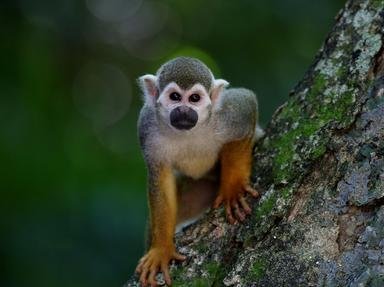
Primates are characterized by having five-fingered grasping hands with fingernails, forward-facing eyes, relatively large brains compared to most animals, social behavior and longer than average lifespans amongst animals.

A collection quiz by Billkozy. Estimated time: 3 mins.
  1. Home
  2. »
  3. Quizzes
  4. »
  5. Animal Trivia
  6. »
  7. Wild Mammals
  8. »
  9. Primates

Author
Billkozy
Time
3 mins
Type
Quiz #
422,697
Updated
Jan 12 26
# Qns
12
Difficulty
Average
Avg Score
9 / 12
Plays
132
Last 3 plays: Guest 12 (10/12), rockstar51 (7/12), Guest 90 (8/12).
In this collection of 18 choices, there are 12 primates. Pick out those 12.
There are 12 correct entries. Get 3 incorrect and the game ends.
Chimpanzee Macaque Gray-shanked douc Drill Saki Siamang Marmoset Zorilla Gabon talapoin Avahi Margay Long-tailed pangolin Monkey slug Blue-footed booby Gorilla Bondegezou Ape Barbara Brown's titi

Left click to select the correct answers.
Right click if using a keyboard to cross out things you know are incorrect to help you narrow things down.

Most Recent Scores
Today : Guest 12: 10/12
Jan 12 2026 : rockstar51: 7/12
Jan 12 2026 : Guest 90: 8/12
Jan 12 2026 : Guest 170: 8/12
Jan 12 2026 : dmaxst: 12/12
Jan 12 2026 : Morrigan716: 9/12
Jan 12 2026 : Dreessen: 12/12
Jan 12 2026 : Scottie2306: 9/12
Jan 12 2026 : Guest 172: 8/12

Quiz Answer Key and Fun Facts
Answer:

Here are the primates:

Chimpanzees are the closest living biological relatives to humans, sharing 98.7% of their DNA with humans. These primates are the essence of advanced primate intelligence: they use sticks to extract termites from tree holes, and use stones to crack open nuts, and use leaves as sponges for water.

Gorillas share about 98% of their DNA with humans, making them one of our closest living relatives of humans after chimpanzees and bonobos. Gorillas live in complex social groups called troops, usually led by a dominant silverback male. They use tools, such as sticks to test water depth, they display emotions, and have been taught sign language in captivity.

Macaques are of the Old World monkeys group, and a clear example of primate biology, behavior, and adaptation. Their large brains help with problem-solving skills, the use of tools, and complex social learning.

Another Old World monkey is the drill, a tree-dwelling monkey found in rainforests in Nigeria, Cameroon, and Bioko Island (located off the coast of Cameroon). Drills have dark fur, and a black face with white chin fringe. Males have brightly colored backsides. Due to habitat loss from deforestation and hunting for bushmeat, conservationists consider them among Africa's most endangered primates.

The gray-shanked douc is an Old World monkey of the subfamily Colobinae (leaf-eating monkeys), making it a close relative of langur monkeys. It lives in trees in complex social groups, and is active in the daytime. Named for its gray lower legs, it has an orange-yellowish face with white whiskers, and a white throat with orange-collared collars. "Douc" is an old Vietnamese word for "monkey" which is where they are found, and alas, considered endangered.

The Gabon talapoin is a small species (3 to 5 pounds) of Old World monkey, native to central Africa living in troops near swamps along rivers in Gabon, Cameroon, and nearby regions. They are good swimmers, and they have greenish-gray fur, and eat fruit and insects. The International Union for Conservation of Nature, classified them as Near Threatened.

The marmoset belongs to the New World monkey group, one of the three major divisions of primates. They are excellent climbers with their opposable thumbs and big toes. The claws they have on most digits instead of nails assist them in climbing as they grip onto tree bark. But they still have flat nails on their big toes.
They have also a high brain-to-body size ratio.

Barbara Brown's titi is a small New World monkey native to the Atlantic coastal forests and dry scrublands (Caatinga) of northeastern Brazil. This primate also goes by the name Blond titi monkey, and Northern Bahian blond titi. There are smaller sized titis and larger titis, with the Lucifer titi being the largest titi. Barbara Brown's titi is considered to be on the critically endangered list, and is named in honor after the zoologist Barbara Elaine Russell Brown.

The saki is a type of New World monkey sharing a family with other monkeys like titis and uakaris. They are small with long, bushy, non-prehensile tails for balance, not gripping. Ther reside in the rainforests of northern and central South America. They are diurnal (active by day) and they live almost exclusively in trees, able to jump 30 feet between them.

The avahi is a primate, a type of lemur, also called the woolly lemur. Like all lemurs, it is found only in Madagascar. They are the smallest members of their Indriidae family. Avahis are nocturnal and eat mainly leaves. They spend a lot of time resting to conserve energy due to the relatively low nutritional value of their diet.

The siamang is the largest of the gibbon family of primates. It has a large throat sac, called a gular sac, which inflates when they make amazingly loud, resonant calls. It has webbed toes which is relatively unusual and hangs out in the rainforests of Malaysia, Thailand, and Sumatra, where they swing from tree limb to tree limb.

These are not primates:

The blue-footed booby is a seabird, famous for its vivid blue feet used in courtship dances.
The bondegezou is a tree-dwelling marsupial found in New Guinea.
The long-tailed pangolin is a scaly anteater covered in keratin scales.
The margay is a tiny wild cat from Central/South America.
The monkey slug is the larval stage caterpillar of the hag moth, a type of insect.
The zorilla is a small carnivorous mammal in the weasel family.
Source: Author Billkozy

This quiz was reviewed by FunTrivia editor rossian before going online.
Any errors found in FunTrivia content are routinely corrected through our feedback system.
1/13/2026, Copyright 2026 FunTrivia, Inc. - Report an Error / Contact Us