FREE! Click here to Join FunTrivia. Thousands of games, quizzes, and lots more!
Quiz about Tales of Brave Ulysses

Tales of Brave Ulysses Trivia Quiz

"The Odyssey" in Entertainment

The release of Christopher Nolan's "The Odyssey" in the summer of 2026 has sparked renewed interest in Homer's epic poem and its many adaptations in various media. This quiz will take a look at some works inspired by the poem. Watch out for spoilers!

A multiple-choice quiz by LadyNym. Estimated time: 3 mins.
  1. Home
  2. »
  3. Quizzes
  4. »
  5. Entertainment Trivia
  6. »
  7. Entertainment by Themes
  8. »
  9. Myths and Legends in Entertainment

Author
LadyNym
Time
3 mins
Type
Multiple Choice
Quiz #
425,116
Updated
Aug 06 26
# Qns
10
Difficulty
New Game
Avg Score
8 / 10
Plays
22
Last 3 plays: Guest 72 (3/10), Guest 94 (8/10), JoannieG (8/10).
- -
Question 1 of 10
1. "The Odyssey" influenced many literary works produced in antiquity, notably Virgil's "Aeneid". Which key episode of Christopher Nolan's 2026 film is based primarily on Virgil's account? Hint


Question 2 of 10
2. Based on the events of the second half of "The Odyssey", "Il ritorno di Ulisse in patria" is one of the three surviving complete operas by what great late Renaissance/early Baroque Italian composer, widely regarded as the father of opera? Hint


Question 3 of 10
3. Set in his native Dublin, James Joyce's epic modernist novel "Ulysses" details one day in the life of a man named Leopold Bloom. The novel's final chapter, "Penelope", is dedicated to his wife's late-night musings. What is her name - reminiscent of a famous Dublin icon? Hint


Question 4 of 10
4. Filmmakers have been inspired by "The Odyssey" since the beginnings of cinema. Which iconic Hollywood actor, known for portraying a rebellious slave, starred in the title role in 1954's "Ulysses"? Hint


Question 5 of 10
5. A notable example of psychedelic/hard rock, the song that gives this quiz its title was recorded in 1967 by what influential though short-lived band? Hint


Question 6 of 10
6. The TV mini-series "L'Odissea", aired in 1968 on RAI, the Italian public broadcasting company, boasted an international cast that included which future Bond girl (and wife of a very famous drummer) in her acting debut? Hint


Question 7 of 10
7. Not all adaptations of "The Odyssey" have proved successful. In fact, the 1976 Broadway musical "Home Sweet Homer" is remembered for all the wrong reasons. What unflattering distinction does it hold?


Question 8 of 10
8. The 2000 film "O Brother, Where Art Thou?", directed by Ethan and Joel Coen, is a modern adaptation of "The Odyssey" set during what historical period? Hint


Question 9 of 10
9. A retelling of "The Odyssey" from a strictly female point of view, the 2005 novella "The Penelopiad" was written by what award-winning Canadian author, known for a dystopian novel set in the Republic of Gilead? Hint


Question 10 of 10
10. One of the biggest film releases of 2026, Christopher Nolan's "The Odyssey" has attracted both positive and negative attention. One of the criticisms levelled at the movie is the very reduced role of the gods. Which Olympian deity, Odysseus' nemesis in Homer's epic, is conspicuously absent from Nolan's film? Hint


(Optional) Create a Free FunTrivia ID to save the points you are about to earn:

arrow Select a User ID:
arrow Choose a Password:
arrow Your Email:


Most Recent Scores
Today : Guest 72: 3/10
Today : Guest 94: 8/10
Today : JoannieG: 8/10
Today : mjgrimsey: 3/10
Today : i-a-n: 9/10
Today : cardsfan_027: 10/10
Today : Dizart: 10/10
Today : Guest 195: 5/10
Today : Terrirose: 9/10

Quiz Answer Key and Fun Facts
1. "The Odyssey" influenced many literary works produced in antiquity, notably Virgil's "Aeneid". Which key episode of Christopher Nolan's 2026 film is based primarily on Virgil's account?

Answer: the Trojan Horse and the fall of Troy

Written between 29 and 19 BC, Virgil's epic poem "Aeneid" is based on both "The Iliad" and "The Odyssey". While the second half of the poem, which focuses on the war between the Trojans and the Latins, was inspired by "The Iliad", the first six books mirror much of the structure of "The Odyssey", revolving around the wanderings of Trojan prince Aeneas and his followers after their escape from Troy.

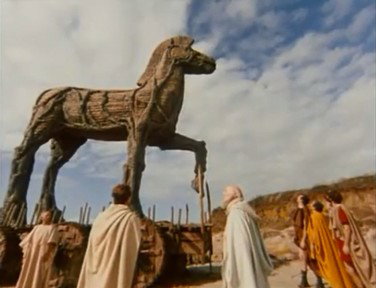
In Book 1 of the poem, Aeneas' fleet is forced to seek refuge at Carthage, ruled by Queen Dido. There, in Book 2, the hero relates to the queen the events that brought him and his companions to Carthage - beginning with the episode of the Trojan Horse and the subsequent fall of the city, which are narrated in detail. The character of Sinon, who also appears in Nolan's film, originates from the "Aeneid" - in which, however, he is a traitor rather than a victim. In Homer's poem, the Trojan Horse and the fall of Troy are only briefly mentioned in Book 8.

While the encounters with the Sirens and the gigantic, man-eating Laestrygonians do not appear in the "Aeneid", Aeneas' fleet escapes both Polyphemus and the whirlpool of Charybdis. Like Odysseus, Aeneas also visits the Underworld, though the two episodes unfold quite differently.
2. Based on the events of the second half of "The Odyssey", "Il ritorno di Ulisse in patria" is one of the three surviving complete operas by what great late Renaissance/early Baroque Italian composer, widely regarded as the father of opera?

Answer: Claudio Monteverdi

Composer and choir master Claudio Monteverdi (1567-1643) is a major figure of Late Renaissance and Early Baroque music, both religious and secular. Unfortunately, much of his output has been lost, especially the operas he composed between 1604 and the year of his death. Of these works, based on classical mythology and ancient history, only three complete operas survive: "L'Orfeo" (1607), "Il ritorno di Ulisse in patria" (1640) and "L'incoronazione di Poppea" (1643). Though Monteverdi was not the first to compose operas in the modern sense of the word, he developed and refined the budding genre by giving it a more accomplished musical and theatrical structure.

Premiered in Venice during the 1639-1640 Carnival season, "Il ritorno di Ulisse in patria" is an opera in three acts introduced by a prologue. The libretto, based on Books 13-23 of Homer's "Odyssey", was written by Venetian poet Giacomo Badoaro. The opera is known for its large cast of characters, which includes several small choruses and some of the key characters in the epic poem's concluding episodes, as well as various deities (who are designated with their Roman names rather than Greek ones). The action is generally faithful to the content of the poem - from Ulysses' arrival to Ithaca to his revenge against the suitors and his joyful reunion with Penelope.

Antonio Vivaldi was mainly active in the 18th century, Gioacchino Rossini in the 19th century, and Giacomo Puccini at the turn of the 20th century.
3. Set in his native Dublin, James Joyce's epic modernist novel "Ulysses" details one day in the life of a man named Leopold Bloom. The novel's final chapter, "Penelope", is dedicated to his wife's late-night musings. What is her name - reminiscent of a famous Dublin icon?

Answer: Molly

Although not known for being an easy read, James Joyce's "Ulysses" is one of the foundational texts of modern literature in any language. The monumental work, published in Paris in February 1922, chronicles one day (16 June 1904) in the life of Leopold Bloom, an advertising canvasser with Jewish roots. One of Joyce's primary sources of inspiration for his work was Charles Lamb's "Adventures of Ulysses" (1808), an adaptation of "The Odyssey" for children that introduced him to the titular character. The novel is divided into three books - "Telemachiad", "Odyssey" and "Nostos" - which parallel the structure of Homer's epic for a total of 18 episodes titled after characters or events in the poem.

The final episode in the novel, titled "Penelope", consists of a long soliloquy by Molly, Leopold's wife - who, unlike her literary parallel, is unfaithful to her husband. An extreme instance of the stream-of-consciousness technique, Molly's thoughts are arranged into eight paragraphs - each of which is an enormous sentence - almost entirely lacking punctuation. In her soliloquy, Molly revisits the events of the day - notably the beginning of her affair with her manager, Blazes Boylan - in rather explicit terms. Then her thoughts turn to reminiscing about her courtship with Bloom in her native Gibraltar and their first intimate encounter. The lengthy passage begins and ends with "yes", emphasizing Molly's acceptance of life and her yielding but resilient nature.

The three wrong options are female characters that appear in the novel. The Dublin icon referenced in the question is Molly Malone
4. Filmmakers have been inspired by "The Odyssey" since the beginnings of cinema. Which iconic Hollywood actor, known for portraying a rebellious slave, starred in the title role in 1954's "Ulysses"?

Answer: Kirk Douglas

43 years after the first film based on "The Odyssey" - a silent film by Italian director Giuseppe de Liguoro released in 1911 - another Italian, Mario Camerini, directed an adaptation of "The Odyssey" for the silver screen. One of the first Europe/US co-productions, "Ulysses" was produced by Dino de Laurentiis and Carlo Ponti (who would later marry Sophia Loren) and featured an international cast spearheaded by Kirk Douglas, one of Hollywood's most bankable actors. Silvana Mangano (then de Laurentiis' wife) starred in the dual role of Penelope and Circe, while Anthony Quinn portrayed Antinous, the ill-starred leader of the suitors. Quinn and Douglas would star together in two more films, notably "Lust for Life" (1956).

"Ulysses" follows the plot of "The Odyssey", though taking some liberties with it - such as Ulysses losing his memory and regaining it just before his wedding to Nausicaa (Rossana Podestà), the daughter of his host, King Alcinous of the Phaeacians. In addition, the protagonist's seven-year captivity on Calypso's island is not featured in the plot: it is Circe who tries to detain Ulysses by promising him eternal life but is eventually forced to let him go. The film was shot on location in the Mediterranean and North Africa, while the interior scenes were filmed in Rome. "Ulysses" was a great success in Italy, though critical reception was not equally enthusiastic.

One of Kirk Douglas' most celebrated roles was that of Spartacus, the leader of a slave rebellion against Rome, in the 1960 film of the same title directed by Stanley Kubrick.
5. A notable example of psychedelic/hard rock, the song that gives this quiz its title was recorded in 1967 by what influential though short-lived band?

Answer: Cream

Written by guitarist Eric Clapton with lyrics by Martin Sharp, "Tales of Brave Ulysses" was first released as the B-side of Cream's single "Strange Brew" in May 1969. It was subsequently included on the band's second studio album, "Disraeli Gears", released on 2 November of the same year. Musically, the song is remarkable for featuring one of the earliest uses of a wah-wah pedal, a guitar effect that became a hallmark of psychedelic rock.

The song was the first collaboration between Clapton and Sharp, an Australian artist, songwriter and filmmaker who also created the album's colourful cover artwork. Sharp had written a poem inspired by Greek mythology that reflected his love of the Mediterranean islands and his longing for sunshine in the grey and chilly London winter. As is often the case with songs written in those heady years, the lyrics are as visionary and colourful as the album's famed cover. The connection to the story of Ulysses is mainly provided by the reference to the encounter with the Sirens, while the image of Aphrodite riding a crimson shell evokes Botticelli's iconic painting "The Birth of Venus": in fact, the goddess of love does not appear as a character in "The Odyssey". "Tales of Brave Ulysses" is also one of the first rock songs that openly reference mythology, Greek or otherwise.

Cream were active for a mere three years (1966-1968), while the other bands listed as wrong options stuck around for much longer.
6. The TV mini-series "L'Odissea", aired in 1968 on RAI, the Italian public broadcasting company, boasted an international cast that included which future Bond girl (and wife of a very famous drummer) in her acting debut?

Answer: Barbara Bach

Hailed as one of the most faithful adaptations of "The Odyssey", truly capturing the spirit of Homer's epic, "L'Odissea" was directed by Franco Rossi and co-produced by Italy, France, Germany and Yugoslavia. The eight episodes were broadcast between 24 March and 5 May 1968, for a total running time of 446 minutes. The cast included Kosovo Albanian actor Bekim Fehmiu as Odysseus, famed Greek actress Irene Papas as Penelope and young French actor Renaud Verley as Telemachus. The exteriors were filmed in former Yugoslavia, whose scenery resembled that of Ancient Greece. The special effects were designed by well-known horror director Mario Bava (who directed the fourth episode, narrating the encounter with the Cyclops Polyphemus) and Academy Award-winning visual effects artist Carlo Rambaldi (of "Alien" and "ET" fame). Rossi would also go on to direct a TV adaptation of Virgil's "Aeneid" (1971).

Barbara Bach (at the time known as Barbara Gregorini) already had a successful career as a model when she was chosen by Franco Rossi for the role of Nausicaa, the young Phaeacian princess who rescues the shipwrecked Odysseus. After her divorce from Gregorini, Barbara Bach returned to the US and, in 1977, starred as Anya Amasova in the James Bond film "The Spy Who Loved Me". She married former Beatles drummer Ringo Starr in 1981 and is now known as Barbara Bach, Lady Starkey.

In Christopher Nolan's 2026 movie, Odysseus' meeting with Nausicaa and his stay at the Phaeacian court - which in the poem acts as a frame story for the hero' narration of his wanderings after the end of the Trojan War - are not present. Odysseus recounts his fragmented memories to Calypso.
7. Not all adaptations of "The Odyssey" have proved successful. In fact, the 1976 Broadway musical "Home Sweet Homer" is remembered for all the wrong reasons. What unflattering distinction does it hold?

Answer: it closed after only one performance

With its unforgettable characters and suspenseful adventures, "The Odyssey" sounds like a perfect fit for a musical adaptation on the same epic scale as "Les Misérables". The sorry plight of "Home Sweet Homer", however, tells a different story - one shared by many other Broadway productions whose stage debut was so underwhelming that it led to their immediate closing. The musical, initially simply titled "Odyssey", was conceived as a vehicle for Yul Brynner after the success of "The King and I" more than two decades earlier. The book, originally written by Erich Segal, the author of best-seller "Love Story", focused on Odysseus' return to Ithaca where Penelope and Telemachus awaited him.

With the involvement of Albert Marre and Mitch Leigh - both known for their work on "Man of La Mancha" (1965), a musical adaptation of another famous literary classic - at the end of 1974 the production embarked on a national tour that was plagued with problems. The two stars, Brynner (Odysseus) and Joan Diener (Penelope), who was also Marre's wife, were frequently ill and missed performances, which inevitably led to bad reviews. Despite these setbacks, the musical made it to the opening date at Broadway's Palace Theater on 4 January 1976 - only to have a closing notice posted as soon as the curtain fell.

Now the musical is mostly remembered for its inglorious end, while other attempts to adapt the Homeric epic for musical theatre have also flown largely under the radar.
8. The 2000 film "O Brother, Where Art Thou?", directed by Ethan and Joel Coen, is a modern adaptation of "The Odyssey" set during what historical period?

Answer: Great Depression

Many modern works inspired by "The Odyssey" have borrowed elements of Homer's epic and adapted them to different settings. This is the case of Joel and Ethan Coen's "O Brother, Where Art Thou?", a satirical musical comedy nominated for two Academy Awards (Best Adapted Screenplay and Best Cinematography). Though neither of the Coen brothers was familiar with Homer's epic, they had come to love the story through some of its adaptations and its overall influence on popular culture. The film's title comes from "Sullivan's Travels", a 1941 film by Preston Sturges in which "O Brother, Where Art Thou?" is a fictitious book about the Great Depression.

Set in rural Mississippi in 1937, the film stars George Clooney as Ulysses Everett McGill, a convict who escapes from a chain gang with fellow convicts Pete (John Turturro) and Delmar (Tim Blake Nelson) to retrieve a buried treasure. Some of the trio's adventures parallel episodes in "The Odyssey" - notably their encounters with Polyphemus (here a one-eyed member of the Ku Klux Klan portrayed by John Goodman), Tiresias (the Blind Seer, portrayed by Lee Weaver) and the Sirens. Holly Hunter stars as Penny, Everett's ex-wife, who corresponds to Penelope. The film is known for its soundtrack, mainly consisting of folk music from that specific historical period, performed by eminent contemporary artists such as Alison Krauss, Gillian Welch and Emmylou Harris. In 2002, the film's soundtrack won the Grammy Award for Album of the Year.

The 2003 film "Cold Mountain", based on the novel of the same title by Charles Frazier, is also a modern adaptation of "The Odyssey", set near the end of the US Civil War.
9. A retelling of "The Odyssey" from a strictly female point of view, the 2005 novella "The Penelopiad" was written by what award-winning Canadian author, known for a dystopian novel set in the Republic of Gilead?

Answer: Margaret Atwood

Margaret Atwood's "The Penelopiad" is part of the Canongate Myth Series, an international project based on modern rewritings of ancient myths published by independent Scottish publisher Canongate Books. Atwood's novella was one of the first three works published in the series on 21 October 2005. When Atwood was first approached by the publisher, she struggled for some time to find a suitable topic to write about, finally settling on "The Odyssey", which she had read as a teenager. In particular, she wanted to address the issue of the hanging of the twelve maids accused of having aided the suitors.

As the title implies, some key events in "The Odyssey" are narrated by Penelope, with the twelve maids as a Greek-style chorus offering their own perspective on those events. From 21st-century Hades Penelope reminisces about her past life, revealing some disturbing details about her dysfunctional family and her conflicted relationship with Odysseus' mother and nurse. After Odysseus' return and his revenge against the suitors, the issue of the maids' execution lies unaddressed between the pair. Penelope's chapters are interspersed by the maids' commentary - delivered in different narrative styles - in which they lament their enslaved condition and speak of their dreams of freedom. Their presence in Hades haunts both Penelope and Odysseus, reminding them sharply of the injustice committed against these young women.

Margaret Atwood's best-known work is the novel "The Handmaid's Tale" (1985), adapted into a successful TV series. Another feminist retelling of "The Odyssey" is the 2018 novel "Circe" by American author Madeline Miller, which is set to be adapted by HBO.
10. One of the biggest film releases of 2026, Christopher Nolan's "The Odyssey" has attracted both positive and negative attention. One of the criticisms levelled at the movie is the very reduced role of the gods. Which Olympian deity, Odysseus' nemesis in Homer's epic, is conspicuously absent from Nolan's film?

Answer: Poseidon

Gods and goddesses play a major role in both Homeric poems. They openly side for or against human characters, actively influencing events and often determining the outcome of the story. In "The Odyssey", Odysseus is helped and protected through his trials by Athena, a fitting patroness for a man of great cunning and intelligence. However, in his hubris he antagonizes the sea god Poseidon by blinding his son, the Cyclops Polyphemus, and then boasting about it. It is Poseidon's enmity that almost causes the hero's death in a storm when leaving Calypso's island.

Christopher Nolan's adaptation, with an eye to modern sensibilities, keeps only one of the major deities that appear in the poem - Athena, portrayed by Zendaya - while Poseidon's curse against the hero is not mentioned explicitly. In his encounter with Polyphemus, Odysseus does not deceive the Cyclops by telling him that "Nobody" blinded him, nor does he reveal his name to the monster before leaving the island. Though Circe and Calypso are both immortal, their divine nature is downplayed, while other deities that appear in the poem (namely Hermes and Helios, the Sun god) have been edited out.

The diminished role of Ancient Greece's all-powerful deities has prompted criticism from classicists such as Emily Wilson, who published an English translation of "The Odyssey" in 2017. Other critiques point to the absence of sex, which is a key element of the poem, or the removal of some female characters - in particular Nausicaa and her mother, Queen Arete. In spite of that, the film's critical reception has been very positive overall.
Source: Author LadyNym

This quiz was reviewed by FunTrivia editor kyleisalive before going online.
Any errors found in FunTrivia content are routinely corrected through our feedback system.
8/6/2026, Copyright 2026 FunTrivia, Inc. - Report an Error / Contact Us